About Me

My photo
Author of queer, wry sci fi/fantasy books.

Tuesday, 17 February 2015

50 Shades Of Commentors: Abuse and Romance, Part 1

Hello hello!

So, longtime readers will know that I owe the Fifty Shades of Grey series a bit of a...debt of honour, I guess. The marathon read-along I published on Twitter, complete with a prologue and epilogue blog post for each, is what established my name. The authors I've met, my editing career...none of it would have been possible without a goofy and darkly disturbing trilogy of poorly written and imagined porn.

However, I've seen cries from across the internet over fifty shades of fatigue. So instead, I'm going to bring you a short series on dark romance and BDSM, and we're even going to talk about why the hell this series (and other dark romances) have been so popular. Clearly, the movie has touched a nerve, and it's too easy to hate on it. So we're going to do the hard thing, and examine why it works--as well as providing much better alternatives. I've even got an exclusive interview with the up-and-coming dark romance darling Katie de Long, a new author who's bringing a shadowy, diverse, intelligent angle to a much maligned genre. 


First, however, we're going to start this the easy way--I present to you, the comments section of every Fifty Shades of Grey article I've read so far.

  • A Middle-Aged Man ·  Top Commenter
    Oh, man, I can't believe my wife is dragging me to this. *barf*
    • A Middle-Aged Woman
      Read the books. Why hasn't anyone read the books? They're so much better!
      • Some Twentysomething Feminist
        Holy crap, these books are basically a manual on abuse! Why the hell aren't we talking about this? 
      • Another Feminist
        No kidding. I love BDSM, but this is driving me crazy. Let's have an intelligent and reasonable conversation about alternatives to this book!

        A Well-Meaning Devil's Advocate
        We don't really talk about crappy role models for men, though. What about the bad lessons young boys are learning?
      • A Middle-Aged Woman
        How did anyone survive these books? I laughed my ass off at the prose and her "inner goddess", way too hard to get my panties in a bunch.

    Friday, 30 January 2015

    Holla, Holla: A Meditation on Selling Out

    Hello hello!

    So I was talking to my content editor a while ago, and we had a minor scuffle over genre classifications for exactly WHAT Urban Fantasy is. I thought one of my books fit into the category, and she heartily disagreed.

    UF, according to Wiki, is this:

    "Urban fantasy is a sub-genre of fantasy defined by place; the fantastic narrative has an urban setting. Urban fantasy exists on one side of a spectrum, opposite high fantasy, which is set in an entirely fictitious world. Many urban fantasies are set in contemporary times and contain supernatural elements. However, the stories can take place in historical, modern, or futuristic periods, and the settings may include fictional elements. The prerequisite is that they must be primarily set in a city.[1][2]"

    It certainly matches my reading experience. But readers themselves have different ideas about UF. Some complain when the setting isn't contemporary. A lot, actually. Noire is also an expected element. And, as noted, the city setting is quite important. That seemed a bit off to me, because while the city bit only makes sense, what about steampunk that runs on magic? But no, most readers would not call that an urban fantasy. Where does the line between urban fantasy and cyberpunk stand? That's another tricky question.

    The thing is, after I whined and moped a bit, I realised that what I thought wasn't as important as what readers thought. Definitions change and evolve, and while it's impossible to read minds or make everyone happy, not ignoring the blatantly obvious can be quite helpful. I quarrelled and protested, but ultimately, the modern setting rule--especially with paranormal elements--won out over my personal definition and Wiki's. After perusing Reddit and Facebook and surveying people, I found that they tended to fall in line. I took the "urban fantasy" tag out of the book's tag list.


    And then I got to thinking... 


    The thing is, it still bothered me that I was changing the classification of my book away from what *I* thought it was. Between that and contemplating the necessity of trigger and content warnings, I was quite torn about something.

    When does the marketing of a book become selling out? Is "selling out" even an applicable argument when it comes to marketing and classification by genre?

    Actually, no. 


    It's hard to explain this to authors who are starting out, but it's important not to get too married to your categories--because you'll have to change them anyway. Categories for books are there to serve you, not worship. Does a book have most features of a romance but end tragically? Don't stick it under romance unless you can find a 'dark romance' or 'bittersweet' category; the readers will eat you alive. (Romance readers, in particular, are a special group.) Does your book about a half-angel, half-demon going to high school have a lot of queer themes and involve a diversion into horror territory in a big way? Cool. Give it a try in the horror listings as well as YA and New Adult or Paranormal. The key is to rotate.

    But...but...genre rules!


    No. Put down that "How to Write a Whatever" book. Pick up a new book instead. Read that. Take notes on what you liked, what you didn't like, and what worked, as well was what didn't. When did you find your attention drifting? That's a pacing issue. Kindles have a note-taking function. Use that sucker. It's not about selling out. It's about reaching readers.

    Before I'd released The Underlighters as a stand-alone, outside of its place in The Loved, The Lost, The Dreaming, I almost ended up launching it as a tidied-up, de-sexed and lower violence YA version. Yes, this really happened. Miss I-Hate-Censorship herself almost caved and censored a book to make it fit people's needs. I even considered the advice one author gave me, to "put a girl with a flaming sword, fighting a Sandman" on the cover.

    That might have worked, but readers who came to it would have been annoyed by the unreliable narrator, literary styling and pacing, and all the queer and equality issues that "interfered' with the action story. Ultimately, I'm not an author who writes that kind of fantasy, and misdirecting readers to think that it would conform to those expectations would only have pissed off everyone--the readers, and me. I left The Underlighters as it is, in all its convoluted glory. If I was doing it again, I'd put a more post-apocalyptic cover on it and chop that sucker in half, because I'm better at novellas than writing novels--but that's a discussion for another day.

    So, wait, when does "selling out" happen? What does that even mean?


    People seem to mistake "success" or change for selling out. I know I've done it. I've seen friends do it. But as long as you're not rewriting your book entirely to serve the market, even doing things you hate in order to sell books, you're okay. Ultimately, only you will know whether you've trespassed on your own integrity.

    However, actually trying to sell books, talk to readers, pay for advertising, and read books on categories and niches isn't "selling out". Even now, there are still a lot of indie authors who seem to think that recognition will just happen magically and that art will somehow be self-sustaining, solely on the power of being an awesome, well-written (or well-crafted) piece of work.

    I can confirm, first-hand, that it doesn't work like that. However, marketing and genre-classifications don't have to make you feel like you need a shower. The important thing is to focus on serving your vision and your work, and getting it into readers' hands.

    Have you ever felt unreasonably upset about doing something for your art? Have you changed something that you later regretted? Did you get upset when a favorite author or artist changed something? I want to know, so tell me in the comments.

    ***
    Thanks for dropping by the nest once again. Leave your comments, rebuttals, and vehement agreements below. Don't miss any of the phuquerie. Find Michelle on Twitter, Facebook, and on Tumblr, and find her work on Amazon. Check back on the blog to see when one of the irregular posts has careened onto your feed. This is the one and only SciFiMagpie, over and out! 

    Saturday, 3 January 2015

    Canadian Facts: An Unrelated Diversion

    Hello hello!

    Today I have an unrelated diversion, inspired by our upstairs neighbours. While the Canadian goose, beaver, and moose are all famous and well-recognized symbols of Canada, one of our most common species--which comes in all genders and ethnicities--has not often been catalogued. I present to you--the Common Hoser.

    Common Hoser (Acer vulgaris)

    The Common Hoser, once believed to be a faltering breed, is still alive and well in most of Canada. Its range is extremely broad, encompassing the entire country, even northern and coastal extremities. Most specimens observed in the wild are male, but females have been recorded. Age ranges run between approximately 10 years old (juvenile hoser larva) and 90 years old (ancient hoser; often called a "coot").  Working at gas stations, on gas rigs, fishing boats, on construction sites, and on farms, the Common Hoser presents a wide array of skin tones and apparent origins. However, the breed can be distinguished from others by its leathery skin, which is uniformly so regardless of occupation or apparent origin.

    There is nothing it cannot fix with duct tape.

    Its food groups include the following: Molson or Beer beer, maple syrup, smokes, bacon, and Timmy's. It has been observed to partake in marijuana as well from time to time. Young hosers are often more adventurous and omnivorous in their diet, but all examples of the species demonstrate a clear predilection for fried foods.

    It has seven plaid shirts in his closet, and an eighth, which is the formal plaid. While other invasive species, such as the Common Hipster, and the more elusive Lumberjack, also favour this attire, the Common Hoser wears its preferred coat with a certain grease-stained and frayed, paint-splattered aplomb which indicates its species from a distance.

    The minute October arrives, its parka is surgically attached to his skin and is not shed until May. Even if it's actually too warm for the coat, they'll wear that parka.

    The normal volume range of the Common Hoser is approximately 60-100 Decibels, and the cries of the Common Hoser ("Fuckin' Eh! Yeah, Man!") can be heard for over 2 km in fair weather.

    The breeding period of the Common Hoser coincides with hockey season, a sacred mating ritual for many Canadians. Hosers, however, swarm in ever-increasing numbers during this period, and only recede somewhat in spring.

    At present, in deep winter, the Common Hoser is invaluable for its ability to keep basic services running for other species and subspecies of Canadians. Hosers--you are loud and sometimes irritating, but we salute you.


    ***
    Thanks for dropping by the nest once again. Leave your comments, rebuttals, and vehement agreements below. Don't miss any of the phuquerie. Find Michelle on Twitter, Facebook, and on Tumblr, and find her work on Amazon. Check back on the blog to see when one of the irregular posts has careened onto your feed. This is the one and only SciFiMagpie, over and out! 

    Wednesday, 31 December 2014

    Feminist Fist-Fighting: How Teardown Culture Hurts Activism

    Hello hello!

    So this has to be one of the hardest entries I've ever had to write. First of all--how does one criticize teardown culture without it sounding like tone-policing or idea-policing? That's tricky. So, a disclaimer.

    You are entitled to think whatever you'd like and say whatever you'd like, whether you are a feminist or not. However, no-one is immune from criticism. That said, all criticism should be taken in context of power structures--if you are criticizing someone who is less powerful or privileged than you are, you may want to rethink your stance. Having more privilege means your words will carry more weight. Be kind, and do not silence others. 

    That paragraph is extremely important, and I'd like anything else said here to be taken with that context. After all, punching up is a lot harder than punching down, and it's oh-so-tempting and easy to take potshots at someone because what they say has made you uncomfortable. Or because they criticized someone you like--even if that person is in the wrong. (For the record, I can't help still loving Amanda Palmer...but I won't defend some of the dumb shit that's fallen out when she's opened her mouth.)

    With that said, we kind of need to do something about this intra-feminist teardown culture thing.


    What is teardown culture?


    I've noticed that there have been a lot of articles lately about various feminists insulting other feminists. Now, obviously, people aren't perfect and their actions merit criticism. I love Amanda Palmer, but she's done some decidedly stupid and bad things. Apologized for them as well, but they did still happen. Criticism and critique are part of a healthy culture, so it's fine to leave room for them to happen.

    What makes me uneasy is when I see people on my friendlist saying that "feminists are stupid because ___" (lately, Feminists Are Stupid Because they didn't like a man's shirt.) The most common one is that feminists focus too much on the small things, "microaggressions", rather than "big things". The problem with that is simple--small things add up to the big things, and microaggressions in conversations prevent dialogue about said big things. If you have a conversation and someone is undermining you constantly, framing things so that you look unreasonable and hysterical (hysteria itself is basically the most sexist diagnosis ever), the conversation about 'big issues' can't even happen. It's particularly bad when feminists do this to other feminists.

     I'm really, profoundly uncomfortable with Annie Lennox saying these kinds of bad things about Beyonce. As a white woman, people are going to listen to her more. Sinead O'Connor also tore a strip off Miley Cyrus a good long time ago, and as an older and more respected artist, people wrote Miley off as a dumb young teenager. (Admittedly, her response was incredibly tasteless and referred to O'Connor's bipolar disorder.) There are important discussions, and then there are things like what Lennox said, and those comments don't help. There are all kinds of arguments, and the people who get listened to are usually the white, able, rich, cis ones. You don't have to like it, but it's a fact--and it's demonstrated by things like arrest rates.



    This wolf is displeased about racism too.

    Calling people out is not a bad thing, but disowning them is bad


    Believe it or not, people have different approaches to feminism, and that doesn't make their feminism bad. Someone might be more upset or more negative in tone; someone might have a focus on misogynoir, and another person might have a focus on trans rights for the disabled. None of these are wrong or inferior just because they involve a personal focus. Ideally, feminism should be intersectional and acknowledge many areas of inequality.

    That said...not everyone is "there" yet. I personally ignored disability issues for a long time because I had some pretty unpleasant misperceptions about disabilities, both mental and physical. Then I met some people with various disabilities and ability challenges, and learned that they were not only gifted in certain ways, but really normal. However, if you'd asked me about this issue years ago, I probably would have said something ignorant and tasteless without meaning to.

    Yes, people can be frustrating and disgusting and cruel--but they can also learn to do better. Sometimes a lesson won't register the first time, but will sink in later.


    But...but...they might have less privilege, but they said something stupid! On the internet!


    I've been there. Lots of times. Take a deep breath. Take another one, until you stop seeing red. Walk away from the computer. Now decide whether you really want to bump the person's comment so others can see it, regardless of your brilliant response. Type your brilliant response in another window or a chat program so you can get the poison out without looking like an impulsive idiot.

    It's also worth remembering that people use the internet to vent, and can say things that are problematic on one level but emotionally justified on another. However, telling them to shut up and not vent can lead to more problems...especially because some people are often silenced in social situations. Women (and people who present as female) get it a lot, for example.

    This is why tone policing is not actually just a fake problem. People do try to vent and explain their feelings, and sometimes end up being angry--even saying pretty unpleasant things. But when those are said in a safe space, particularly, calling them out on those comments may be the worst thing that you could possibly do. White feminists (yo) tend to get particularly upset when people say things that sound awful about, say, white people, cis people, men, etc, etc--but it's really important to put one's own feelings to the side and try to listen to the person's feelings. The reason someone says something that can be problematic is often rooted in bad experiences, particularly when the people they're talking about the majority culture.

    So, to borrow an example from the links above, you might see a trans* or queer person ranting about cis scum. Not only is it not your job to tell them that "not all non-trans and non-queer people are like that", it's worth asking them if anything happened to them recently, and asking if they're okay. These rants never come out of the blue--and said person might well have had a friend beaten up in an alleyway recently for being a "tr---y".

    The other thing is to remember that if someone's ranting about how men can be awful, how white people don't care, etc, etc--remember--it's not about you.  If you feel it's about you, ask the person in private. Failing that, take steps to make sure you aren't one of the people being targeted--i.e., try to listen instead of overreacting, for a start.


    Okay, but this person--or public figure--is genuinely doing something wrong. Wat do?


    Focus on actions rather than personal traits. Research things before you post them. Try not to pick a side obviously, if you can avoid it. Keep someone's feelings and perspective in context--what could have happened to them in life that made them think a certain way? Your positive experiences might have been someone else's trauma, or just unpleasant life events.

    Sometimes, it's also just not worth commenting. I saw a discussion about how #BlackLivesMatter had been hijacked to #AllLivesMatter on Twitter; the person supporting #AllLivesMatter (which is what you'd call a derailing) identified themselves as black, gay, and HIV+. The person calling them out appeared to be male and was also black. Clearly, this complicates the issue, but the fact remains that #AllLivesMatter has derailed some of the conversation specifically about violence against African Americans. I could have chimed in...but my own perspective wouldn't have contributed enough to the conversation, and might have silenced its participants.
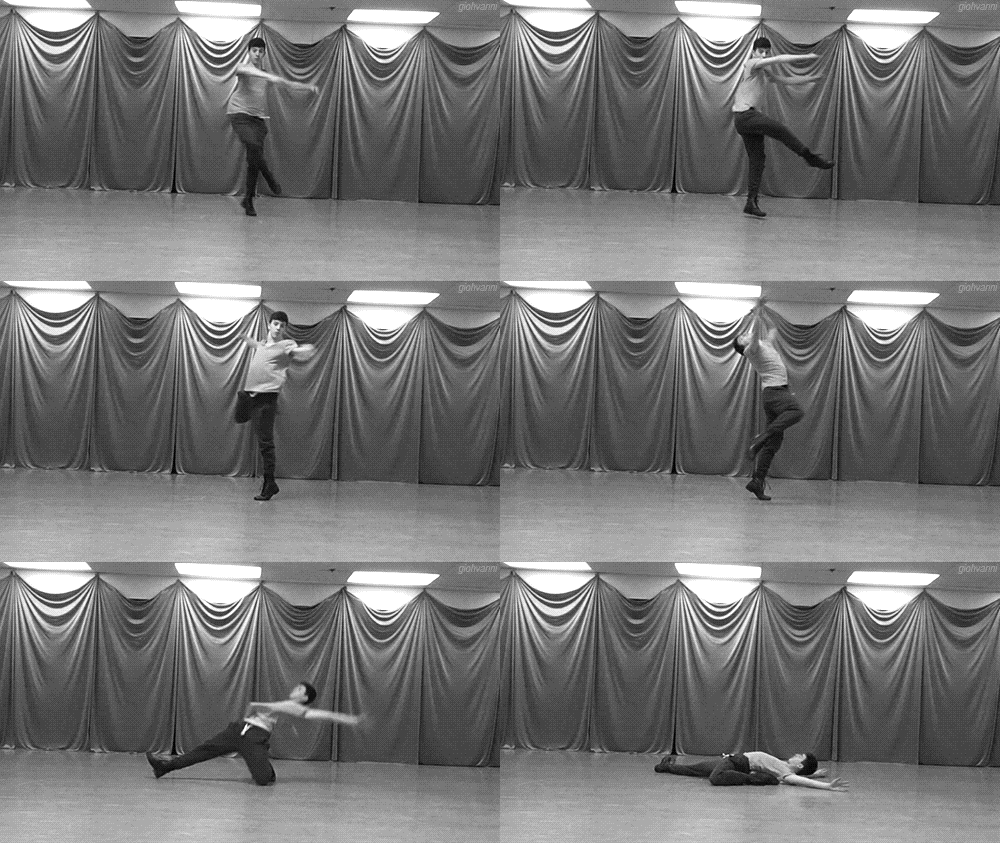


    This is basically how feminism feels a lot of the time.


    I'm incredibly triggered right now and I really, really need to address this! I'm upset!


    Been there. Get out of that conversation and seek a friend or do some self-care activities. You won't be able to express your hurt feelings well in this state, and it may result in more trauma. Ultimately, you are more important than the person on the internet, but exploding on them could hurt you as well. You don't deserve that. Find a cat/dog/stuffed animal/scrap of fabric/wall/comfort item to stroke or lean against, get a drink of water, and close the window. Then delete your search history so you don't obsessively go back to the conversation and hurt yourself.


    Seriously, dude, that was not cool. I need to call this person out. 


    Okay, but be moderate and try to be as kind as you can. See above re: the learning process and the fact that people can be hurt. Sometimes, ignoring people is safest for your sanity, but if it's just not an option, try to focus on facts and avoid talking about personal faults. You'll look good and you might inform the people who are reading the comments but not saying anything. And avoiding a knee-jerk reaction is a good way to dodge a possibly day-ruining flamewar.

    Above all, don't give into the temptation to say, "You're not a real feminist/activist/etc!" Even if you're thinking it, there is no possible way that will end well. We need to work together instead of competing in the Oppression Olympics ("I know you've had it bad, but (x) has had it worse! And I've had it worse than (x)!") or trying to play Who's a Better Feminist. Women (and feminine or queer-presenting people) are criticized more harshly than men. Men who stick up for these issues will generally be less harshly criticized because of the way power is structured here. That's good in terms of helping to signal boost things, but it's not as good on a micro level. Sometimes a person will get treated as an expert because of their social position rather than their skills.   That means that people who do have these advantages--such as, again, being white--should be careful and try not to abuse them.



    Even Kyle needs to punch people sometimes.

    Okay, fine. Any last words?


    Remember that people's words are informed by their lives. I'm pro-choice, but if someone is personally against abortion--as in, they are meh about the right to choose but couldn't bear to have an abortion themselves--it's not my job to try to convince them that having an abortion would be okay for them. Again, I can't stress enough that any online debates and discussions need to be informed by sensitivity to social privileges. Not being able to see someone's face or real name can soften the lines of privilege, but they don't disappear completely.

    Basically, what it boils down to is this: Don't be a dick. Especially when the person you want to criticize has less societal power than you do. Also, don't pull a Benjanun Sriduangkaew.

    *A quick note about language used in this post before we wrap up--I know the words "stupid" and "dumb" are sometimes seen as problematic because of the implications about low intelligence, etc, etc. Because they're in common use and the context is in debate, I've left them in the post. Let me know if you object to this or have questions/comments on the issue.*


    ***
    Thanks for dropping by the nest once again. Leave your comments, rebuttals, and vehement agreements below. Don't miss any of the phuquerie. Find Michelle on Twitter, Facebook, and on Tumblr, and find her work on Amazon. Check back on the blog to see when one of the irregular posts has careened onto your feed. This is the one and only SciFiMagpie, over and out! 


    Google+