About Me

My photo
Author of queer, wry sci fi/fantasy books.

Tuesday, 5 January 2021

New Year, Same Me - But Different

 Well, the good news is that I'm not dead, as you can tell from this post existing. The other good news is that I've been writing a lot. Book 3 of the Meaning Wars is done, Book 4 is also now done and out to beta readers (but if you're interested, I can always use more!), and book 5 is 2/3rds done. In addition to that, I also am 60K of 100K into a coauthored book with a friend of mine, Anna Lewis, set in her series about a nigh-immortal pirate who's about to get his first taste of therapy in five hundred years. 

That probably sounds like a lot more writing than I've done in the last few years, and that's completely correct. However, I haven't been running my online text-based D&D game, and as you all know, my blog's been on hiatus. 

2020 Bad

But the last few years has been A Lot - Trump's presidency and the related empowerment of authoritarian leaders across the world, issues around trans rights and especially Black and Brown lives and existence - it's been hard, especially over 2020, to feel as though my words have any merit, weight, or meaning. Stepping aside and letting PoC talk is rarely a bad thing, but self-doubt latching on to that was maybe not great.

I mean, in 2016, two artists I value deeply passed away - Leonard Cohen and David Delamare. People die, that's just how that works; I personally don't want to die ever, if I can help it. (Blog post upcoming; yes I've thought this through extensively, shush.) Other artists died, too. Britain and India and Brazil empowered disgusting right-wing leaders. There were more incidents of racist, transphobic, misogynistic, and homophobic gun violence than I care to list here. But as much as Trump's inauguration and the resulting ripples up here in Canada have felt like living in a state of war, the pandemic has been closer to living under war than I've ever expected to feel. None of us were prepared. And yet, somehow, 2020 had a lot of personal development bright spots for me. 

So why now? Why not just write a farewell post and give up blogging, for example? Well...

I never stopped having things to say

2016 to 2020 has been a disruptive period for the world, and from late 2014 to 2020, it was pretty rough on me as well. The fact that a hard period in my own life synced up with global events just made everything going on sort of more relatable in a way. 

For example, I often fall asleep to politics podcasts because a) sometimes mildly boring things and comforting voices are great, and b) knowing that bigger problems than my own exist is oddly soothing. And c), knowing what's going on in the world gives me a sense of agency, whether illusory or valid. 

However...

A lot of the posts I started to write were rather short. Because I've primarily written my blog posts and articles in a full-length format, I sometimes wait far too long to actually express them. This might also be the cause of something else I dislike - the tendency for people to read my work, but not reply to it, perhaps because it's *too* complete and exhaustive. 

So this year, I want to try something different. I will be putting out more posts again (certainly more than once a month; I'd like to go back to the weekly post schedule I had/aimed for previously). But my posts might be scattered-sounding, less comprehensive, and messier. Above all: probably shorter and less complete. We'll see how it goes; if I hate it, I'll probably try something else, but I've been thinking about it for a few days, and I feel surprisingly good about it. I might also go into more personal topics than I have in the past - but the probability of this turning from an analysis/commentary/writing blog into, I don't know, a skincare and lifestyle blog, is extremely low. I might even stick some more poetry up here, since for some reason, people don't seem to hate it.

Sometimes, Productivity is Self-Care

This is a tricky topic at the best of times, because capitalist propaganda/training says that we should only feel good about ourselves if we're doing things and making money. But as many writers about "self-care" have observed, there's also more to self-care and building good mental health habits than buying heavy blankets and colouring books, making overnight oats, or taking baths with artisanal bombs and essential oils. Those things are all fine, great, and can be part of recovery too - but for myself and many others. 

Towards the end of 2020 - especially after the election in the US brought in a change of power, and a light seemed to break through the clouds - I finally started to kick some bad habits and feel like perhaps, maybe, the world is not doomed after all. I started the process of kicking some deep-seated bad habits as well, and that's already shaken my world at its foundations.

I have so much more to write about this, but I'm going to let this content breathe and start on my next post instead. 

Hope 2021 is off to a survivable start for people! Let me know in the comments how you got through 2020, and what you're hoping for in 2021. 

***

Michelle Browne is a sci fi/fantasy writer and editor. She lives in Lethbridge, AB with her partner-in-crime and their two cats. Her days revolve around freelance editing, knitting, jewelry, and learning too much. She is currently working on other people’s manuscripts, the next books in her series, and drinking as much tea as humanly possible. Find her all over the internet: * OG Blog * Mailing list * Magpie Editing * Amazon * Medium * Twitter * Instagram * Facebook * Tumblr * Paypal.me * Ko-fi


Thursday, 18 June 2020

What Is Even Happening Right Now?

So, astute readers will have noticed that I've been completely silent since February. Where'd I go for three months? This is going to be rambling and less focused than my usual posts, but perhaps my readers will forgive it.

Content warning: pet death, current events

Well...frankly, I haven't been able to figure out how to write about what's been going on. Despite years of editing and writing science fiction, including stories about or related to pandemics, actually enduring one myself was not something I seriously considered. I mean, I grew up in the era of both SARS and H1N1, the latter of which I actually contracted. It was a bit scary, and it sucked, but the deaths were relatively few in number, and fewer still, those who developed serious complications.

Now, I realise the case was different for those living in Hong Kong and China and South-East Asia in general, but that was my experience as a Canadian. I trusted the medical system to handle a disease of significant scale. 

How fact and fiction differ


For starters, the contagiousness of a disease is inversely proportional to its ability to spread. This is something that sci fi usually gets completely wrong - diseases are portrayed as both easy to catch and very deadly. But an extremely deadly disease usually burns itself out. Bubonic plague was an exception to this in part because the way diseases spread in the ancient world is different from the way they spread now - there were a lot more vectors back then because of the lack of knowledge about hygiene. There may be more opportunities to spread diseases now due to the increased population size and contact methods, but human beings have far less contact with blood, other animal species, and each others' bodily fluids than we used to. We know that washing our hands is even a thing we should do, rather than just a cosmetic or convenience factor, and we have functioning sewage and water lines (in many parts of the world, though not all, of course). The world is a lot less gross than it was in earlier eras, and frankly, that's protecting us more than we realise. 

Not enough, of course, to keep us from contacting new bacteria and viruses, and global warming is also increasing our risk of contracting ancient illnesses for which we no longer have immunity. 

The practical upshot


Of course, all of this is intellectually interesting, but living through a pandemic is still flat-out terrifying and hard to deal with. I was already following the news avidly, fearful and concerned about the world, and then...this all happened. 

But that wasn't all. On April 4th, our cat Maxwell Maximilian Maximus passed away, having a heart attack at the age of about 12. We rushed him to the vet's office, but were told it was too late, and he was in heart failure. I'll skip the painful details, but his sudden death shook both my partner and I quite badly. We later realised he'd had his first heart attack in late November, and had actually been in heart failure for some time, but the benefit of hindsight is a sad one. 

Still, having a cat for almost his entire life was a privilege and a joy. Because I hysterically demanded that we fill the "cat-shaped hole" in our home as soon as possible, with tears still on our faces, we went to the non-profit Humane Society to have a look at their cats. I can't recommend that enough for anyone grieving a lost pet - the joy animals have and their appreciation for human company is immense. After a few more visits and some discussion, about three weeks later, we brought home Alfred (Alfred Sylvester Codworth) and Chester (Chesterfield Archer Chestermere), a dignified 4yo tuxedo Ragamuffin-mix and a bouncy 10mo shorthaired tuxedo respectively, both with light green eyes. They get along wonderfully, and although new pets absolutely never replace the old, they made grieving a lot easier. 


Cat pictures, because of course. Top: Chester; bottom: Alfred.


Alfred, named for his calm and butler-like solicitiousness, even seemed to figure out what happened to Maxwell. Of course the house still smelled of Max (to the cats), and coming fresh from the shelter, they started investigating to see where the other cat might be. On Alfred's first day at our home, he sniffed the area by the bookshelf in the bedroom where Max had spent most of his time crouching, and seemed to follow the scent trail to the closet where Max hid in fear (an unusual place, one he never spent time in) when the heart attack was happening. Animals instinctively know the smell of death, and Alfred must have recognised it at some point. He somberly padded from the closet to myself on the carpet by the bed. I burst into tears and hugged him, and the calm creature patiently let me sob into his luxuriant black fur. 

Since then, of course, things have been markedly less glum, and less painfully quiet than during the two weeks and a bit before we brought them home. It seemed like things were looking up. With a 290K fantasy novel to work on, I had professional occupation aplenty to boot. I even re-started my online D&D campaign, feeling that it might help me stay motivated and connected to the world. 

But the world had other plans. 

Current situation, protests


Although I've been planning a blog post on Things I've Been Wrong About, such as police reform, I am in many ways not especially well-equipped to speak on the epidemic of police violence and decades of racial injustice that has provoked Black Lives Matter's triumphant resurgence. Suffice to say for now that I fully support these efforts, and I now understand why merely reforming police is inadequate. I will be writing more about some of thoughts about this and other leftist issues in the future, so I'll keep it short for the time being. 

You'd think that writing about revolutions would equip me to handle living through one to some degree, but I don't feel especially well-prepared. If I am better prepared than I would have been otherwise, it's hard to say. The truth is, the world's been in a rough spot for as long as I can remember, and by the world, I mostly mean "America," the loudest part. I also am considering a post about what it's been like to grow up as a Millennial, for the purposes of contrasting it with the Gen Z experience, so look for that in the coming weeks. 

Do I think this is the apocalypse? 


Well, the apocalypse is never the end of the entire world, because that's meaningless - if by "the world" we mean "our experience and lifestyle up to this point," then yes, this is an apocalypse - but we've had those before. The start of the Cold War, the First and Second World Wars, the invasion of North America by Europeans - all of those were apocalypses. 

But I also believe that these painful contractions are spasms of death for some of our worst beliefs. The fact that people can even demand justice and be listened to is a significant step forward. However, not resting on our laurels or being content with crumbs is of vital importance, and any momentum gained from demanding either the abolition or restructuring of the police has to be used to demand the restructuring and abolition of prisons and other measures for creating equity. 

There's a lot of work to come. We have to stick together, forgive each other sometimes, keep learning, and take time to rest, because the world just won't stop. 

***
Michelle Browne is a sci fi/fantasy writer and editor. She lives in Lethbridge, AB with her partner-in-crime and their two cats. Her days revolve around freelance editing, knitting, jewelry, and learning too much. She is currently working on other people’s manuscripts, the next books in her series, and drinking as much tea as humanly possible.
Find her all over the internet: * OG Blog * Mailing list * Magpie Editing * Amazon * Medium * Twitter * Instagram * Facebook * Tumblr * Paypal.me * Ko-fi

Monday, 10 February 2020

The Art of Destruction: Distressed Aesthetics

A belated happy new year, my dear followers!

So, I have a neat idea for a new series coming up. But after the holidays (which were pleasantly busy) and some interpersonal scuffling in January (which was not nearly as lovely, but came to an all-right enough resolution), my idea bank was absolutely flat broke.

A nice chat with friends has filled the bowl up, but while I work on those posts, here is something I stashed off to the side after a Facebook conversation last year.

I often reference fashion and clothing to help get in the right mindset for my writing projects. Whilst working on Poe's Outlaws (Book 4 of The Meaning Wars series; book 3, The Meaning Wars, is ready for beta-reading and edits now!) I indulged in my usual technique of sifting through Dolls Kill and Pinterest to look at various bits of outre, fun, futuristic fashion.

Of course, when working on Monsters and Fools and planning for After the Garden's sequels, I also like to look at post-apocalyptic and distressed clothing. I like distressed clothing anyway, but it tends to get a lot of flack.

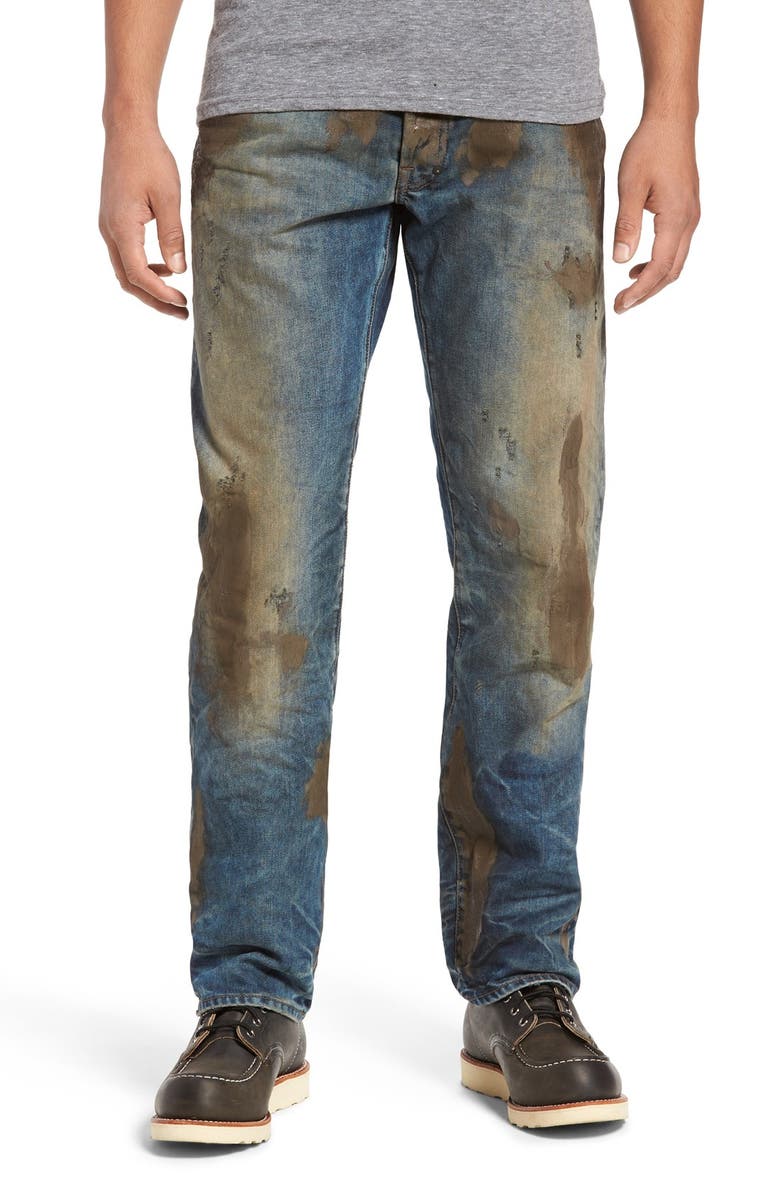
On an episode of a podcast called Minion Death Cult, the hosts discussed some common reactions of tradespeople and Boomers to distressed and some faux-muddy jeans. (Not unsurprisingly, there were a lot of tired jokes about just selling people old, worn-out jeans from "real" tradesmen.) But not a lot of people understand how distressed clothing works, or why it's somehow different from their dad's old, grimy jeans and tattered denim jacket, so I'm going to break it down.

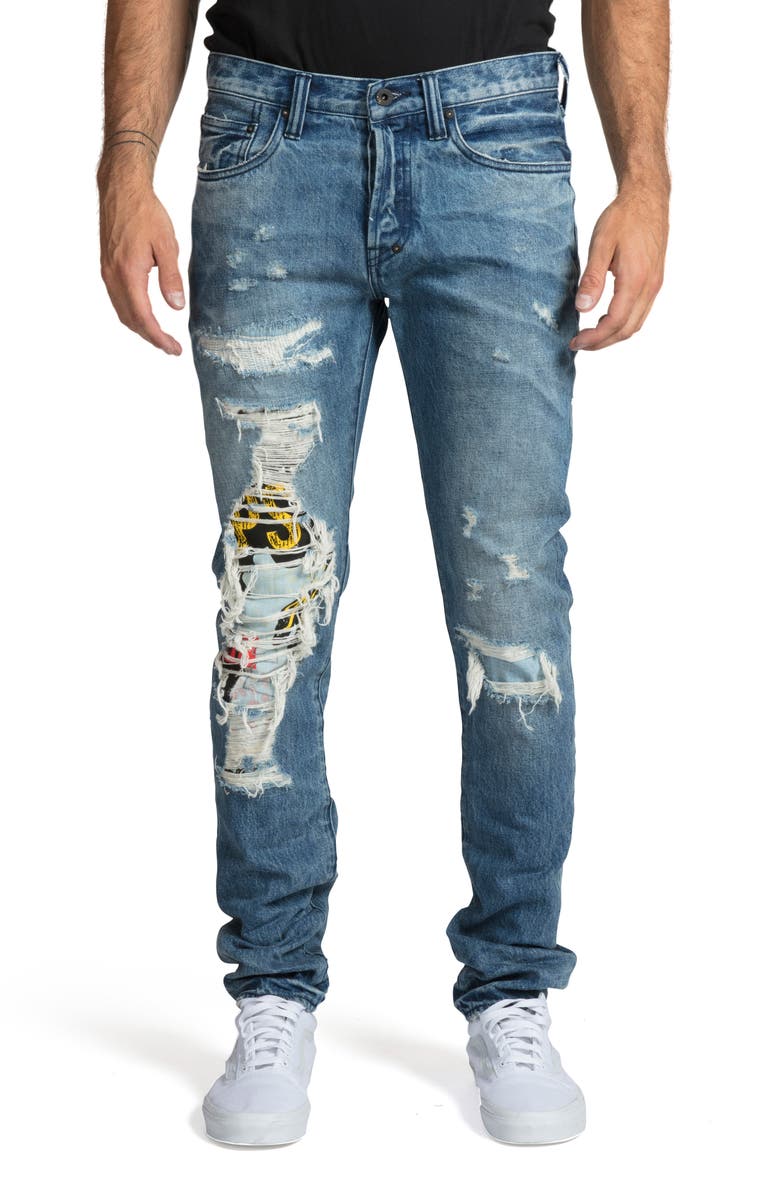
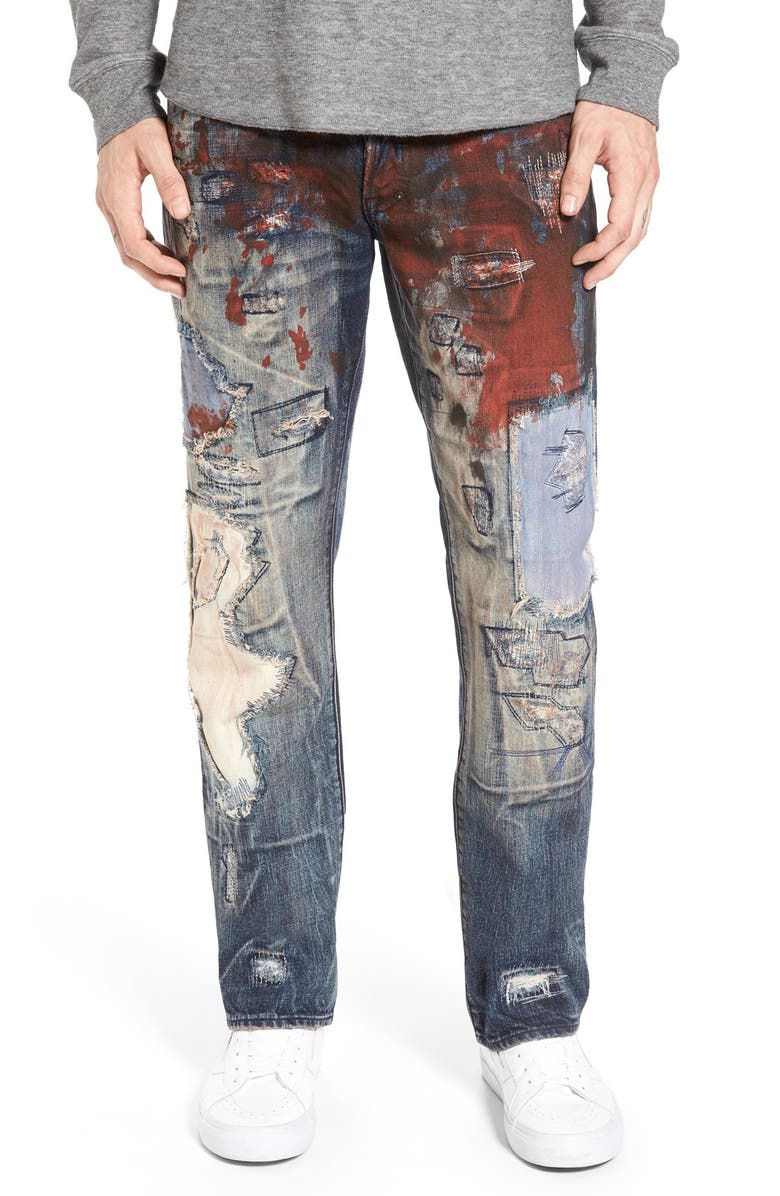
Note: all images in this article came from the Nordstrom website. Most or all are designed by PRPS.


PRPS Barracuda Straight Leg Jeans, Main, color, 490 PRPS Conductor Stripe Denim Jacket, Main, color, AUTO
PRPS Windsor Slim Fit Jeans, Main, color, AMBULANCE
PRPS Le Sabre Slim Fit Jeans, Main, color, FROST


I'm gonna take the unusual stance here of defending distressed jeans, because I've been studying and making distressed knit clothing and other types of distressed clothing for a bit. Why? Because I like post-apocalyptic fashion, and I think wrecked things are often beautiful.

You may be familiar with the term "wabi-sabi," which sometimes passes in and out of vogue for decorating trends. The term is comprised of two Japanese words - wabi, in a nutshell, refers to the beauty of simplicity; sabi, to the beauty of age and use. There's a bit more to it, but that's the quick explanation of these beautiful and imperfectly translatable terms. Wabi-sabi is usually used in reference to home decor, but it totally applies to clothing, too.

Anyway, getting on with the point - the thing about dirty jeans is that they're gonna leave dirt on wherever you sit. Fake dirt still captures the same look, the rather beautiful way the brown stains and fades into the tightly woven blue threads, but it won't leave big ol' scuffmarks on your leather car seats.

As for the distressing, the interesting and beautiful way that denim falls apart tends to happen in less sexy areas - the knees, the thighs, the crotch. Distressing clothes on purpose lets you get the look without impairing the wearability and structural integrity of the clothes. Sometimes that doesn't work at all, like with the cheaper distressed jeans that are all holes and have a high spandex content, but that's still the idea.

As far as how this relates to designing and making clothing, with knitwear (such as the awesome punk sweaters we all may love, or at least have seen before), it's important to know how the particular fibres and yarns work structurally. There's a reason why clothing made to be or look distressed looks so awesome and a lot of actually busted up clothing or "home-made" distressed stuff looks crappy. Knowing where and how to cut fabric in pre-made knits, how to style the runs, or how to make patterns with the runs and holes, is all very calculated. As I've learned myself, if you try to distress a finely-knit sweater, it'll look like crap; distressing needs a chunkier, thicker yarn to be really noticeable. And wet-blocking a ravelled sweater (stretching while wet) is very important - otherwise, the threads maintain their curled appearance, and don't become those straight lines that create contrast with the curving knitted stitches. It's also really important to actually tie off runs in a distressed sweater, or the whole thing will, in fact, unravel.

The advantage of knitting a sweater with a distressed look is that you can control this process. In effect, dropped stitches and yarn-overs create a sort of freeform lace look, and don't destroy the structural integrity of the sweater (which unravelling a pre-made sweater CAN do).

So basically there IS a method to the madness in pre-distressed clothing, and knowing how to distress your clothing well and safely - whether it's for a stage production, Halloween, or fashion - takes more than sharp scissors and boredom!

PRPS Le Sabre Slim Fit Jeans, Main, color, WIND CHILL

PRPS 'Barracuda' Destroyed Straight Leg Jeans, Main, color, 490
Predictably, clothes like this inspire retorts like, "I could give you my old jeans covered in cow manure and farm dirt and motor oil for that price!" But that's the point - the "fake dirt" that so baffled the Washington Post and CNN, where reporters appeared unfamiliar with the concept of "p a i n t", will not rub off or dirty other surfaces. The pants don't contain the scent and sweat of another person's work, nor are they worn out and about to fall apart, as those pants probably are. (For example, the wear patterns and distressing and whiskering all appear on the thighs and calves of the jeans, rather than in the crotch, around the bottom cuffs, and etcetera.) 

It's not about pretending you work - it's about exploring the beauty of entropy and things that are lived-in. The way fabric dye fades, the soft whiskering of denim fabric, the delicate feathers of raw-edged cotton - all of these have their own beauty. Repairs can create a contrast from the original fabric or material as well, and it needn't be ugly. People familiar with "that weird gold thing," kintsuogi, may also know have seen it in cases where useful objects are repaired and the cracks are patched with gold leaf to highlight their beauty. 

Here's another example of finding beauty in marks and unexpected places. When I saw an advertisement for Canada Post that featured a very intriguing necklace, I tracked down the artist's work and had a look at her site.


However, to my surprise, most of her jewelry was either minimalist and geometric, or covered in dented and scratched textures, like this!


There is real value in appreciating things as we wear them out. If we are to shift to a less consumption-driven culture, which is necessary in the fight against climate change, we're gonna have to get used to not having things that look new all the time. Supplies and availability of items may be restricted. Repairing clothing and items instead of just throwing them out has also become pretty popular amongst Generation Z, many of whom are embracing thrifting and minimal-waste lifestyles.

But in addition to that, there's also a beauty in the broken or fraying, the imperfect, the less-than-new. Most of the time we spend with an item will be active. Jewelry gets scratches. Clothes rip. Colours fade. Paper tears. And all of those things expose new beauties and different aspects of the item, revealing its structure and design and suggesting or reminding us of experiences we've had.

After all, our possessions act as anchors for memories. There's a reason why in pre-industrial times, treasured items were passed down through generations or repaired over and over. Our things aren't just pretty diversions or useful parts of daily life - they're parts of our lives, woven or tangled with our memories.

***
Michelle Browne is a sci fi/fantasy writer and editor. She lives in Lethbridge, AB with her partner-in-crime and Max the cat. Her days revolve around freelance editing, knitting, jewelry, and learning too much. She is currently working on other people’s manuscripts, the next books in her series, and drinking as much tea as humanly possible.
Find her all over the internet: * OG Blog * Mailing list * Magpie Editing * Amazon * Medium * Twitter * Instagram * Facebook * Tumblr * Paypal.me * Ko-fi

Saturday, 30 November 2019

What Might Have Been

I've been super busy with work this month, neglecting my blog as a consequence, but I had so much to say about this that I couldn't help but pull up my chair and get writing about the book Lion’s Blood by Steven Barnes.

You can also find it on non-Amazon links via Goodreads, here.

Having just finished The Testaments by Margaret Atwood, another work of speculative fiction focusing on bigotry, rights issues, and ultimately, redemption and overcoming, I was thirsty for more. I wanted something delicious, magnificent, challenging — and well, just as enjoyable. (The Testaments was spectacular; I read it in a few days, something that’s exceptionally rare for me now. It’s no slender volume; even my cheap paperback had to resort to small print and thin margins to make the hundreds 

Having just finished The Testaments by Margaret Atwood, another work of speculative fiction focusing on bigotry, rights issues, and ultimately, redemption and overcoming, I was thirsty for more. I wanted something delicious, magnificent, challenging - and well, just as enjoyable. (The Testaments was spectacular; I read it in a few days, something that's exceptionally rare for me now. It's no slender volume; even my cheap paperback had to resort to small print and thin margins to make the hundreds of pages fit.

And every page was worth it. I've come away with many new insights, but it was also just a rich and pleasurable read. In terms of prose, it is window-like and not overly florid or purple, but there are many lush and detailed, evocative descriptions. Characters are rendered well, even those from many different factions and backgrounds - I can't even imagine how much research went into this, but I assume the answer is "all of it."

I think of important books, podcasts, documentaries, and articles as "vegetables," things which are important and vital for health, if sometimes less than pleasurable to ingest, but this book requires a new category: "fruit," things which are as delightful to partake in as they are enriching for the mind. The fact that I enjoy it might sound surprising, because, well...

"But it's about white slavery!" 


Yes. Yes it is. And not in the (rather disgusting and misleading) way that term is used currently to depict human trafficking, but in a correctly alternate-historical concept of chattel slavery. And it goes into detail about Irish culture, even using bits of Gaelic - which my own insufficient studies could only comprehend piecemeal, but I was still pleased and impressed by the attention and meticulousness of depicting a culture not ravaged by Christian conquests.

Now, I've read Octavia Butler's Kindred, and I'm glad I had that in my system first, because there was some horrifying brutality demonstrated towards the slaves that, as I unaware of such practices in detail, would have been very upsetting. It wasn't easy anyway, but with my admittedly less than perfect knowledge, it seems both accurate and maybe a tiny bit gentler than actual slavery and transportation was on Black people.

One of the biggest things about this book is that seeing white characters in a position of true subjugation - without the cultural dominance we enjoy and benefit from in this world and setting - made the struggles of Black folks so much clearer. As I read the narrative, and watched Aidan O'Dare's family and friends suffer in the holds of cargo ships and in the teff fields of New Bilalistan, my mind constantly superimposed the realities of our own world over it.

If you've ever wondered what it's like for Black people, this book answers some parts of that endless and nuanced question in so many painful ways.

"Was it hard to read?" 


Oddly enough, no. I'm far from a newcomer to Black fiction and Afrofuturism in general, and I've trained myself to focus on Black characters as protagonists, so that definitely helped - but it's also just a damned good book and an emotionally compelling read.

However, I think the biggest relief for me was that the story isn't gleeful in depicting white subjugation, because that would have been an easy (and disturbing) tactic. Rather, the perspectives espoused really made some things about our own history clearer to me, and gave me new insights and things to think about.

The White Savior Hiding in Black Stories 


Recently, the movie Harriet was released, and met with controversy because it followed a path that many books, movies, and narratives about slavery do: providing a significant role for a Good White Person (usually a man) and a Bad Black Man. In a movie about Harriet Tubman, that's particularly egriegous, but it speaks to that shadow-demon, white guilt, who begs and cajoles us white folks to think, "Well, I would have been 'One of the Good Ones..."

This thought is often a comfort to people watching or enjoying any sort of traditional narrative set in the antebellum South; the idea of being a "good master," and thereby enjoying both moral comfort and the expected privilege and wealth. White people don't usually fantasize about being a poor landholder or even a Union soldier; no, it's being a privileged person who stoops to help the downtrodden that we fetishize.

But Lion's Blood portrays Black characters in this role - as moral people of faith, who have ethical discussions and who are well-educated, just as white slave-owners perceived themselves to be - and it really busted a hole in that entire concept.

Here's the thing about the idea of "the good master" - one cannot truly live up to ideals of equality and ethics if one owns or enslaves people, or treats other humans as objects. (I'm not going to get into animal rights discussions here because that's another issue, but suffice to say the topic was also on my mind.) As much as Wakil Abu Ali and his sons Ali and Kai are admirable men, there is a missing stair in their ethics. Yes, they treated their slaves and servants mercifully a lot of the time, letting them keep their culture, keeping families together, and not enforcing their religion on them - but they still kept them as slaves.

Unfortunately, dominant culture trains us to handwave this. (By us, I mean everyone, but it's definitely easier to handwave for those of us born into whiteness.) We forgive the Good Master, because after all, it was just like that in those days, wasn't it? But if Aristotle and Marcus Aurelius could look at real, live enslaved people on their streets, then turn away and consider "enslavement of the mind" more important, because "some people are born to slavery," and if Neitzsche could hold the same idea, then perhaps we should not be chary of asking what the devil our ancestors were thinking. Slavery is bad, was bad, and was never justified, even when it was a cultural norm, and we need to stop excusing justifications of it based on contemporary normalization.

Our ancestors - mine very much included - may have "tamed" the land, and built impressive things, but they also subjugated, tormented, and slaughtered people. Admiration and humility in the face of that legacy have to go hand-in-hand. Some white folks retreat into the comforting fiction of white supremacy or the beguiling vagueness of denial, but cowardice begets no change. It damages the spirit and leaves others in amendable, preventable suffering. There are a lot of problems to fix that have resulted from the historical legacies of colonialism, but by God, let us at least admit they exist!

There is no “Good Master” as long as someone proclaims themselves an owner of other human beings. Perhaps they are less evil, but being less evil is not goodness.

However, this book was about a flipped history, a lavish tapestry of an alternate world. (Yes, there are airships, but they're not as big a deal as you'd think, so don't get hung up on them.) A lot more interesting stuff happens and awaits the reader. And yet, of course, that central preoccupation kept haunting my mind, as I can only assume it will dart into the minds of anyone who so much as glances at the back cover blurb.

Okay, but the white slavery thing though...is it wish fulfillment?


Short answer: thankfully, no.

Long answer: This question was on my mind from page one onward, but over all, the answer is "no." It would have been all too easy to use the setting to delve into other conflicts and never touch on slavery and liberation, but this is still a narrative about rights and liberation. The story's graceful back does not bend and stoop to lie in Vengeance's soft bed. In fact, it's a theme in the book - acting out of spite and vengeance does not feed the soul, and in fact, destroys the person who enacts it. It's like Dostoevsky, but actually readable. (Sorry, Feodor; I love ya, but reading your books is masochistic.)

Rather than depicting what most white people would expect and/or fear from such a story, he crafts a narrative of liberation shot through with beautiful philosophical threads and fellowship. This is true of most Black philosophers and cultural figures reflecting on enslavement and inequality in general; at worst, most Black people want to be left alone by whites. In all the time I've spent researching and interacting with Black people and people of colour online, I've seen exactly one (like, maybe two? Maybe?) person who actually felt that punishment and violent vengeance should truly be turned back on white folks. (And that person was extremely into Mao and a gross Democratic People's Republic of Korea apologist, so like, not exactly a credible opinion in the first place.)

Barnes' depictions of various characters both historical and invented is unflinchingly balanced. He's frank in depicting the utilitarian and daring cruelty of Shaka Zulu; the warrior is depicted with awe, but various military characters are clearly portrayed as troubled by their actions in war, and sometimes beset with what looked like Post-Traumatic Stress Disorder. War, even in an alternate history, is still hell.

As I read the book, my mind superimposed Black struggle narratives on the white characters, and vice versa, back and forth between the text and history, and in the end, there was judgement - but mostly mercy and comprehension. The ability of a Black author to see through white eyes and understand the tension of privilege and blind spots in what's normally portrayed as a heroic narrative (that of the Good Master) is very humbling. But it's significant that when the characters dream of a peaceful future, all they want is to drink coffee and watch their children to play together in peace.

And that - more so than even gory, superbly detailed battles, torture scenes, and the deaths of characters I liked - brought tears to my eyes.

***
Michelle Browne is a sci fi/fantasy writer and editor. She lives in Lethbridge, AB with her partner-in-crime and Max the cat. Her days revolve around freelance editing, knitting, jewelry, and learning too much. She is currently working on other people’s manuscripts, the next books in her series, and drinking as much tea as humanly possible.
Find her all over the internet: * OG Blog * Mailing list * Magpie Editing * Amazon * Medium * Twitter * Instagram * Facebook * Tumblr * Paypal.me * Ko-fi

Friday, 8 November 2019

Accidentally Progressive Misogynists


It's no secret that I'm a feminist, but I also grew up reading and adoring the words of Dead White Men, as they're often referred to now. Today, however, I want to focus my gaze on two peculiar bedfellows: Hemingway and H.P. Lovecraft.

When I first read Hemingway - for school, surprisingly enough; most other authors of "Great Literature," I sought out on my own - I was struck by the female protagonist's ferocious personality. In Matilda, Roald Dahl's main character comments to the kindly librarian that she "doesn't understand some of the things he says sometimes about men and women." That stuck with me, and when I got to Hemingway's books years later - For Whom the Bell Tolls, The Sun Also Rises, A Farewell to Arms - I definitely expected them to be, well, more offensive.

Hemingway's women are often scrappy, tough, and give as good as they get - and frankly, the men in his stories are often a pretty ragged, sorry, rather troubled lot. A femme fatale dame may be seen as death walking on a long set of legs, but the fact that she even poses a threat to Man and the Natural Order implies something very interesting about this so-called and imagined "rightness." But let's stick a pin in that discussion of "rightness" and quickly mention my other target: Lovecraft.


A Spooky, Lonely, Racist Old Man 


Now, it may surprise my gentle (or not particularly gentle) readers that I still have an abiding fondness for Lovecraft's work. The man himself was a lonely, sad fellow who had so many compulsions and fears that he barely functioned. His phobias - or at least, things he wrote about as being frightful - included dogs, cats, rats, cellars, cold rooms, the ocean, cephalopods, fungus, weird colours, Black people, Native Americans, other Brown people, Jewish people, Mixed people, non-Christian religions, women, mixed neighbourhoods, the dark, mirrors, and of course, madness, ruin, and mutation.

When talking about Lovecraft, some people (like his esteemed but regressive and unmannerly biographer Joshi) try to skirt around the ugly stuff, or downplay it - as in a rather awkward conversation I once had with a publisher in a significant Lovecraftian fiction house that shall remain unnamed. The woman insisted that Lovecraft had married a Jewish woman and therefore could not hate the Jews, and that for the time period, he wasn't that racist...

The counterpoints to this are painfully easy to make, but suffice to say that readers who are not convinced that Lovecraft and Hemingway are assuaging their own fears of other's perceptions and hiding from rather easily-proven points. Both are racist and somewhat misogynistic; both were also rather good writers. We must accept both premises rather than trying to justify or negate one or the other. The world does not always accept easy and comfortable categorization into "good" and "evil" or "bad."

Now, of course, as a white woman, I have a certain amount of societal cushioning that just makes it easier to endure and set aside certain things. And yet, there is a core to these two authors' works that calls me back, even when they surround or allude to rather detestable ideas.

In addition to a sort of mystique and fear around "The Other," whether speaking of women, non-white people, or combinations thereof, there is also a peculiar and almost beautiful longing.

There is something ineluctable about both Lovecraft and Hemingway that compels me deeply. It's the same tendency one can find in, surprisingly enough, such hated halls as the Incel (involuntarily celibate) forums of the latter day. They feel absolutely helpless before what they believe to be the absolutely monumental power of The Feminine, or The Threat of Non-Whiteness, or Pagan Decadence, or Homosexual Weakness. They constantly hint at or state outright that they are fighting these "fallen" influences - as though that's a fight they're constantly losing internally. One is reminded of the erotic angel-wrestling scenes alluded to in Angels of America, when Joe, the Mormon man with a bad case of sexual repression, discusses his gay longings.

The failure fetish


The thing with Hemingway, and often with Lovecraft, is that their stories are often about white men failing. Sometimes their characters die in moral triumph, but they die nonetheless. It's as though they want to fail, or as though the only way to escape the moral question altogether is with death. The striving and inevitable failure is almost compulsive, a kind of "l'apell du vide" (call of the void) where they have an ineluctable longing and tendency towards that which they claim to abhor.

Both men are fascinated with "the Other" even as much as they often abhor The Other's differences. Whether it's femininity, breaking the binary, or things "too horrid to name" (presumably gay stuff and BDSM, one supposes), Lovecraft kept coming back to the strangeness, especially genderless beings. The essential normalization of white, cisgender male masculinity - a completely artificial depiction of it, one might add, which is ahistorical and entirely synthetic, despite the way modern-day "Red pill" types and Republicans fetishize it - is rampant. And yet it is also tremendously fragile, in a way that echoes Christian morality. Even the slightest pleasure is a window through which evil can peer, or whisper, or tempt one from righteousness. And yet, are these evils not rather banal? If one's life and moral uprightness can be destroyed by an incautious application of glitter, is it not a rather sad, hollow life?


Extremely mediocre art by Michelle Browne.

The hidden longing


There is something incredibly empathetic hidden at the core of these works. The "terrible, unknowable" urge compels them to investigate the forbidden - and to understand things beyond their own world of experience. Similarly, in the Warhammer 40K novels and setting books, trying to understand the Chaos Gods or Xeno forces such as the Tau or Eldar can result in being "tainted" - in effect, empathy is both one of the Empire of Man's greatest weapons and greatest weaknesses.

But this longing is always the undoing of characters - when they dare come too close to the things that tempt them, whether those be horrifying powers, immigrant women whose children are going missing, or gods who walk as Black Men (as in Dreams in the Witch-House), all that is "good" and "noble" in these men is destroyed.

It's always because of family influences or heritage or interests, or then their experiences, but even unwillingly, the characters develop empathy and get closer to the cosmic horrors. The guy was racist, but part of him knew, I think, just how wrong he was. Not something he could face down.

In the later years of his life, Lovecraft started to write with more empathy and kindness about the otherworldly cosmic forces and aliens his characters ran into. Ernest Hemingway, who died of depression, met a fate that thousands of men fall prey to each year. One man died of poverty and isolation; the other, of unresolved mental health issues.

That unwilling empathy in these lauded dead white males is often lurking there, and it's so sad that they and other racists effectively cut themselves off from others' human experiences.

And perhaps, that's the greatest lesson - to conform to these artificial standards of masculinity is the real doom. Where a world of wonder and discovery awaits, the real horror comes from living within a prison - and thinking it's the only way and most correct way to live. And that ironic fate is not one I'd wish on anybody, especially now that people have a chance at living differently.

***
Michelle Browne is a sci fi/fantasy writer and editor. She lives in Lethbridge, AB with her partner-in-crime and Max the cat. Her days revolve around freelance editing, knitting, jewelry, and learning too much. She is currently working on other people’s manuscripts, the next books in her series, and drinking as much tea as humanly possible.

Find her all over the internet: * OG Blog * Mailing list * Magpie Editing * Amazon * Medium * Twitter * Instagram * Facebook * Tumblr * Paypal.me * Ko-fi

Google+