About Me

My photo
Author of queer, wry sci fi/fantasy books.
Showing posts with label a whole lotta serious therapy. Show all posts

Tuesday, 29 April 2014

Blog Hop from Dianne Harman

Hello hello!

This one is straightforward. Just a blog hop, and four questions about my work and how I do it. So, let's not waste time--here you go.


1. What am I working on?

After the Garden is a book I wrote in my late teens and early twenties, and it's currently in rewrites. I have Monsters and Fools, The Meaning Wars, and Synchronicity in my queue to write and (in the case of the last) rewrite. I also have a few other things planned, but those should be out in the next year or two. Plus a few short stories here and there.  I'm reluctant to give you dates because deadlines tend to go whooshing by all too quickly, but ATG should be out this spring or summer.


2. How does my work differ from others in my genre?

I like to focus on issues of equality in my work, but I try not to do it in a preachy way. The best way, to my mind, is to incorporate the characters and treat them as normally as possible. I also like that sometimes focusing on characters with various levels of ability/diverse backgrounds means they have a more challenging platform to work from. It's also just more interesting than the same Cod Piecington, Noble Space Prince or Humble Browsley, Noble Farm Boy type adventurers that we've been fed for the last hundred years.

I also like to genre-bend. I work mostly in subgenres because I have a deep love for post-apocalyptic and dystopian settings, and that's been 'a thing' since I was in seventh grade. I also like steampunk and urban fantasy, but the last few years have seen a love for urban fantasy horror and spooky elements grow in me. Those have entered my work, and I think it rounds my feel out nicely. There's nothing as fun as scaring the pants off your readers and a little madness. Encountering Lovecraft and the Warhammer 40K universe planted the seed, and with a history of my own nightmares to draw on, I am proud to say that I have given multiple readers cold chills and nightmares with my own work. Neil Gaiman and Chuck Wendig, two of my other best-loved inspirations, also play on scary themes in their work, so really, the genre-bending and scary elements were inevitable. 

3. Why do I write what I do? 

Because it's what I want to read. Because characters walk across the stage inside my skull and start narrating. Because cinemagraphic clips play on the screen in there at random. Because writing is a compulsion. Because writing and reading are a sickness that I cannot and will not get over, and because I live for words. 

4. How does my writing process work?

I'm a pantser at heart. Unfortunately, this led to a lot of very shitty plots and messy, messy endings. In my last book, The Underlighters (previously also published in The Loved, The Lost, The Dreaming, a thematic anthology) I learned how to plot and found an outlining strategy that works for me. So, here's how it goes--I start off with some flashes, usually scenes. I stick them in a document and type them out as I see them. Then I slowly get other flashes, and then I start writing down notes for other scenes. When I have some bullet points, I start working on flow charts or mind maps. The maps let me plot out possible plot ideas and connect the plot events in chonological and logical order. It also lets me follow multiple personal plots at the same time, which is useful. I often use a timeline to refine the results of the map when I have them nailed down. I write down flashes of scenes as they come and then I slowly work through them, expanding on the bullet points and notes. If working on a series, I often reread my own book.
When I hit the revisions stage, I get to work on ensuring I have continuity and that I don't have any exposition dumps or ugly stuff. Then it goes off to my beta readers and critique buddies, and then, when it's all corrected, off to the formatter. After that come the publishing stages, of course. Large chunks of time may pass between the first few stages because I haven't nailed down my self-discipline yet, and my editing work sometimes interferes. 


The lovely Dianne Harman tagged me. She's a friend, an editing client, and a very fun writer. You can get hold of her in the following places:

Amazon: http://ow.ly/s6pN5 
Smashwords: http://ow.ly/u4Fb2
 Web Site http://www.DianneHarman.com
 Twitter: @DianneDHarman


And now...I tag Zig Zag Claybourne, Nic Wilson, and Corinne Kilgore! Get writing, guys!

*****
Thanks for dropping by the nest once again. Don't miss any of the phuquerie. Find Michelle on Twitter, Facebook, and on Tumblr, and find her work on Amazon. Check back on the blog to see when one of the irregular posts has careened onto your feed. This is the one and only SciFiMagpie, over and out! 

Sunday, 28 April 2013

Strong Women, Weak Fathers: Daddy Issues in Sci Fi

Hello hello!

As some of you who follow my Twitter phuquerie know already, I am a recent convert to Doctor Who-ism. I'm also a Farscape and Lexx fan and pretty fond of Mass Effect. Star Wars is a childhood favorite. My literary science fiction fair tends to be pretty diverse and focus on subgenres, so it's TV and by-proxy gaming that provide a lot of my mainstream sci fi fixes. I'll warn you right now. There are

SPOILERS SPOILERS SPOILERS 

for a few of these and of other sci fi games to come, so don't say I didn't warn you.

You might notice that these are mostly 'quirky' programs. I'm going to be exploring some sci fi cliches in a future post, and also examining how science fiction handles other equality issues, but my remarks today are going to centre on some things I noticed while watching the Ninth and Tenth Doctor's only and first seasons (respectively). I noticed them while enjoying Mass Effect, too.

What is it you say?

It's daddy issues. Strong female characters who are otherwise well-developed are invariably hamstrung by family or daddy issues; it's chronic for romances. This is one of sci fi's few regressive afflictions and it NEEDS to stop.


Source. This character arc is done extremely well...but the fact remains that  there are some uncomfortable parallels between her father and the Doctor in terms of personality.


Daddy issues?


I can hear you protesting already. "But Magpie, it's normal for characters to have family trauma! Chriton has daddy issues in Farscape too!"

The thing is, male characters with daddy issues generally are trying to impress their fathers. Female characters have the emotional connection thing going on. They usually did not know their fathers or had a poor connection. In Doctor Who, Rose's father died when she was a child (though she later meets him). Liara's 'father' in Mass Effect ran out on her mother after marital problems. The Leia/Darth Vader thing in Star Wars is another example.

The problem with the daddy issues is that it is usually used to make the heroine more accessible to the hero. I wrote a long blog post about the love interests in ME and their issues some time ago--I give some points to Tali for trying to impress her father as a son would, but Tali, Liara, Ashley, and Miranda all have enormous daddy issues. EDI does not have these (unless you count Cerberus as her father....) and Morinth and Samara also lack them...but none of these can be properly romanced. Jack doesn't have daddy issues but did have a severely traumatic childhood nonetheless. Compare the male love interests' issues--Garrus has duty and honour, Kaiden has the biotic thing, and Thane--who does, admittedly, have the issue with his son--mostly is concerned about his wife. Jacob does have daddy issues as well, but he's the only one.

A few series manage to avoid this issue, but those characters aren't usually love interests. Consider Zev in Lexx.  She doesn't have daddy issues, but like Jack, she does have a traumatic/unnatural childhood. I don't watch Battlestar Galactica, but a quick info check on Wikipedia revealed that even hard-drinkin' and sharp-shootin' Starbuck had a traumatic childhood and was abused; her father was also conspicuous by his absence. Aeryn Sun, a personal favorite, had an absent father and grew up in a facility with restricted freedom. Admittedly, Starbuck and Aeryn both have romances in their series, but considering how powerful they are, the fact that they're hobbled by a similar past trait is interesting.

Diverting into the superhero world, more evidence of the rule of daddy issues OR being raised in an unnatural facility is easy to find. Spiderman's Gwen Stacy conflicts with her father. The Marvel X-Men are rife with it. Oh, not all females are abused, and plenty of the men go through the same sort of trauma (Batman's parents, for instance), but it's still a disturbingly consistent trend.


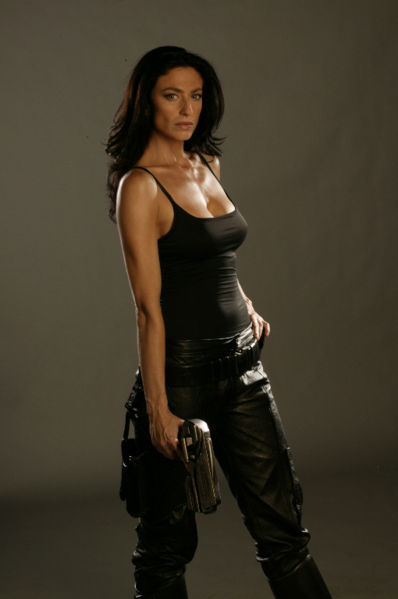
Source. This ass-kicking geek goddess was Morrigan in Dragon Age,  voiced two characters in Mass Effect, was a  main character in both Stargate SG-1 and Farscape, has been in Gears of War, and was in Pitch Black. 

Why is this happening? 


It's a reasonably well-known fact that girls often base their romantic expectations on their interactions with their fathers from a young age. I don't have information on how this is affected by orientation, but it definitely has an impact on the relationship's longevity and health. When I was still in classes and studying for my degree, the link between healthy parent-child relationships and attachment to a partner was a big topic of discussion. Without delving too much into psychology textbook territory, the cliche that problems are usually rooted in childhood has a nasty tendency to be true.

We see the echoes of this in science fiction. The ladies I've mentioned here often choose strong alpha male heroes to replace their absent fathers. Their damaged histories make them more approachable, giving the hero a shot at winning their hearts. It's as though a strong woman can only be made by childhood trauma and an absent father. Is it really necessary to suggest that the only way a woman is accessible is if she's had a terrible childhood? Would a woman with a healthy background look twice at these heroes, or--worse--would she be even more of a threat to them? None of them really lead independent lives without their love-interest heroes, who are usually implied to be quite fine standing on their own without said girlfriends. It would be nice to even suggest that these women would be fine without the men in their lives having come by to save and 'fix' them.

I have to give Farscape and Mass Effect and Portal some points though; all of these explored issues with the female character's mother in great detail, as opposed to blaming absent fathers for all of the issues. I also loved that Bioshock 2 had the father figure as the nurturing one and the mother as the villain. However...mothers are often absent when fathers nurture. I've even done that in my own writing. It's clearly a tricky balance. So why are mothers the next go-to villain?


Source.  If you look carefully, you can see that GLADoS does look like a bound, tied-up woman, as the designers intended. Also, her voice actress is an opera singer! 

Mommy Dearest--the scariest villain


Mothers as villains tie right back into the stories of our childhood. Most fairy tales across cultures focus on evil mothers. In fact, the Brothers Grimm originally collected tales about evil mothers and only made them stepmothers to avoid offending their audience. There are few things more frightening than the idea of the ultimate nurturer turning against us, the mother eating her children for example (something that literally happens a lot).

When you realize in Portal 2 that GLADoS is made of Carolyn's mind and that Carolyn was apparently Chell's mother (it's implied by the 'take your daughter to work day' stuff and a tiny shadow of Chell in the portrait of Cave and Carolyn in in Cave Johnson's office) the entire story becomes far more horrifying and touching. It's one of the many reasons I absolutely love Portal and why it's an effectively frightening and creepy game.


Does it need fixing?


Well...yes and no. The fact that heroines in romantic relationships invariably have daddy issues is kind of disturbing. It would be nice to see a healthy girl fall for a hero for once instead of having that too-easy emotional vulnerability set up in advance. Also, it implies that even in the far future, women will always be hamstrung by our family's expectations and previous life damage. I'm not saying that family trauma has to go away completely...but what about some siblings? These girls tend to be only children as well.

The weird thing is that women hamstrung by their families are all in sci fi. I've seen less of it--so far--in fantasy. Leiliana in Dragon Age comes to mind. When it is not a family issue, it tends to be a sexuality thing. Consider Molly of Neuromancer, a former call girl, or the many prostitutes in Phillip K Dick's work. So...sex and family define women in the world of the far future. It's not exactly reassuring and suggestive of societal advance.

On the other hand, the fact that these women are still strong and that all of them resolve their family issues is pretty reassuring. That's a good thing. I mentioned Lexx as a program I liked earlier, and the fact that Zev does not really have a family and that her issues centre on her training to be a wife as well as body-image issues makes her a nice deviation from the norm. However, she is a rare exception and the sort that doesn't get nearly enough air time. 

One could also argue that it gives a voice to women who've been abused or have had these sorts of traumatic childhoods. I don't know if I'm qualified to give an opinion on that, so I'd appreciate feedback on it in the comments. I can say, though, that science fiction and fantasy do offer both escape and inspiration during life's dark times, and that their usefulness in that respect alone definitely merit an article. You can expect that in a future post. 

Admittedly sci fi is still kind of a men's field and a boy's game, so that is probably part of the reason. However, I'd still like to see this change. There are female sci fi writers--and we should gently introduce this change. We can do better. Lots of books do. This is our gender role issue, the same thing as the presumed misogyny in so many fantasy settings. Time to step into the 21st century. We are so much more than just our families of origin or our childhood trauma. The future should reflect that, not merely echo our past.


*****

Thanks for dropping by the nest once again. Don't miss any of the good kind of crazy. Find me on Twitter, Facebook, and on Tumblr. More interviews and witty commentaries are coming. Keep checking back to see those surprise posts, too. This is your darling SciFiMagpie, over and out! 
Google+