About Me

My photo
Author of queer, wry sci fi/fantasy books.
Showing posts with label culture. Show all posts

Monday, 8 March 2021

The Secret of Evil

 I'd been sitting on this concept for a while, and then I found myself relaxing on Youtube one night, watching a film reviewer's analyses - and I was jolted from my comfortable mood and into a flurry of expository frothing. 

Possible content warning for talk about cults, general acts of violence, the dark side of humanity, cops, abuse - you get the idea.


Now, I think Ryan Hollinger does a great job of analysing this giving the constraints of his expertise and knowledge. I generally love his channel, and would recommend it. However, the underlying concept of this movie bothered me so greatly that, well - here we are. 

What is evil?

For our purposes, "evil" refers to socially unacceptable, transgressive acts that cause harm to others. Examples include violent acts, sexual assault, murder, theft, fraud, lying - you get it. 

Now, as long as humanity has been living in groups, squatting near our little fires, we've quarreled and bickered and occasionally wronged or harmed each other - sometimes, more severely than at others. The call to understand both our own dark impulses and bad decisions and to understand those taken by others appears to be pretty universal. Narratives and folkloric tales about evil, good, punishment, and morality appear in every single human civilization and culture, from small subsistence clans and tribes to our modern era. 

I have a strong interest in cults, extremist groups, new religious movements, and that kind of thing. I've always wondered how "evil" came to be. It was a while before I understood that evil is a verb, not an actual force in the world. 

But writers - especially in Hollywood, but in the general creative sphere as well - don't all have degrees in the human condition. And while that's fine, what is not fine is the way that evil is portrayed and continues to be portrayed. Not to mention the fact that criminality is often portrayed as "evil," regardless of whether or not the criminal actions harmed anyone (i.e. an expired license plate vs a speeding ticket vs an assault charge). 

Now, fun, lighter-hearted portrayals of evil aren't really the issue here - I'm talking more about the serious portrayals, where a movie or story is really trying to Say Something. The silly portrayals of things, however, are rooted in the more serious stuff - so let's talk about what we see as evil.

There's no such thing as "born evil" 

Take a minute with it. If you already know that, and are going, "yeah, duh," then let me explain the whole "evil" thing in the context of murderers. I'm so tired of these bad, stupid true crime narratives about someone who just "wakes up and does bad things". They allow us to ignore the massive preponderance of people who a) commit crimes for survival purposes, b) the misunderstandings of how mental health issues and neurodivergence works (i.e. "evil autistic" etcetera), and c) socio-economic factors, not to mention d) the cycle of abuse. That's not even including e) cultural dehumanization of others caused by privilege - such as with wealth, perceived moral authority, or racist or gender-based ideas, to name but a few. 

Let me run through those again with examples. Now, I'm not saying these are actually all "causes of evil," but they're various examples of causes of harmful acts, that some people might label - fairly or unfairly - as evil. Some of these groups and people are especially vulnerable to maltreatment, and especially innocent of what they're accused of, but culturally, we don't usually act like that's the case.

a) survival criminality - doing something bad for either good reasons or personal safety. Example: stealing a TV to pay for a child's school fees; stealing to pay for drugs in the case of an addiction 

b) mental health issues and neurodivergence - people who experience impaired empathy and/or struggle to conform to societal cultural norms. Example: an autistic child slapping a caregiver during a meltdown, because they feel angry and/or threatened.

c) socio-economic factors - poverty is often criminalised, and some people - in Canada, that includes Indigenous, Metis, and First Nations people, and Black, African, and Caribbean Canadians in particular - are disproportionately accused of and suspected of crimes. This can lead to being forced into the prison system, loss of opportunities, prejudice, and murder. If you've heard the phrase "school to prison pipeline" regarding the way Black people are treated, you'll know what I'm talking about. (If you don't, look it up; it's very important. Also horrifying.) Example: a store manager points at a Black child for acting "suspicious," assuming the child has stolen a candy bar. (Depending on the portrayal, either the child will be implied to be "evil" or the store owner will be "evil".) 

d) the cycle of abuse. Abuse survivors who don't deal with their experiences in some way go on to abuse others. Example: a man who is assaulted by his uncle may later go on to assault his daughter's friend in her teen years. Alternately, an abused child may go on to abuse her spouse in adulthood.

e) cultural dehumanization of others caused by privilege - such as with wealth, perceived moral authority, or racist or gender-based ideas, to name but a few. The trope of the Evil Rich Executive from the 80s is a good example. See also, President of the US #45 for abundant and horrifying examples of dehumanizing and abusing others. 

Does evil even exist? 

I mean, colloquially, sure. As a primeval force? No. Even companies that profit from true crime content will, with some bashfulness, admit that a significant majority of the "terrifying killers" they love to portray are just severely abused people who've ended up lashing out in the worst possible ways. In the exceptionally rare cases where multiple murderers aren't actually abused in childhood and/or suffering severe adverse effects, there's often neurological damage involved. 

However, as you can see from this brief analysis, it's pretty clear that evil is more of a verb than a state of being. Someone's actions can be evil, but defining a person as "evil" assigns a certain kind of evaluation that is both dehumanizing and oddly absolving. I won't dive into the depths of Christian theology about evil right now - but even in games like Dungeons and Dragons,  confronting the question of "evil races" (yikes) has required some updates and changes. And frankly, that's a good thing. 

How do we write about bad things and evil, then? 

Don't take this essay as the vituperative howling of an inveterate killjoy. Rather, it's a plea for authors to realise that the old stories we've been telling are not only dusty and boring from overuse, they're deeply inaccurate. The real world's cues are so much more interesting and fertile, and trying to tell the same old mortality tales that have already been explored - without adding to them - is both artistically annoying and actually pretty harmful. 

All of these things can still make for incredible, nuanced, interesting, gripping stories...but NoOoooooo, Hollywood still loves, "but what if just pure evil?" At this point, the thought experiment side of it is no longer a good argument. It's become the predominant understanding of how crime, especially murderers, work - and that's really, really bad.

We learn about the world from the narratives we take in - whether that's pursuing true crime tales late into the night or listening to harrowing tales of social justice and fights against societal forces, or even just watching a fun, dumb horror movie. Luckily, there's a lot of wonderful work that's been coming out that does take these nuanced, complicated stories into account - to list some podcasts I love, How We RollDungeons and Randomness, Campaign: Skyjacks, The Adventure Zone, and Critical Role all tend to feature plenty of nuance in the "evil" characters, as well as in the "good" ones.

So ask yourself - who are the heroes in this tale, and in the world? Who do you instinctively take the side of when you see a real-world conflict? Although we all pride ourselves on being able to tell the differences between facts and fiction, our construction of the world comes from stories - and that means we have to be honest about who we label "the bad guys," and why.

***
Michelle Browne is a sci fi/fantasy writer and editor. She lives in Lethbridge, AB with her partner-in-crime and their cats. Her days revolve around freelance editing, knitting, jewelry, and learning too much. She is currently working on other people’s manuscripts, the next books in her series, and drinking as much tea as humanly possible.
Find her all over the internet: * OG Blog * Mailing list * Magpie Editing * Amazon * Medium * Twitter * Instagram * Facebook * Tumblr * Paypal.me * Ko-fi

Tuesday, 2 April 2019

Put a Cross on It: Christianity, Capitalism, and Appropriation

I'm taking a quick break from my series about sugar scams to revisit an old hobby-horse: appropriation and cultural theft. This nightmare of the left won't stop cropping up. People can't keep their hands or their inspirations to themselves, so here we go again. 


Ceci n'est pas un croix.
Why the yin-yang? Keep reading.


For example, it's no secret that Ariana Grande has joined the ranks of pop starlets getting flak for doing something in a weird/inappropriate way. In her "Seven Rings" music video, the actress and Disney Channel alumnus used the visual language of Nicki Minaj or Cardi B to add a little flair and flash to her style. 

Here's the thing - a white girl (Ariana is Italian; despite previous prejudices, Italians have been bundled into the artificial construct that always has been and currently still is "whiteness") talking about buying her hair, having everything, and draping herself in diamonds and consumables has a different meaning than, say, a black woman, Latinx woman, or another person from a similar background making those same statements. And dressing oneself up in the subtle visual language and signifiers of another group for the sake of borrowing their "cool" and prestige is, at best, impolite. 

But this kind of weird impersonation and cultural thievery - not exchange; that would imply some sort of trade and equality, or a voluntary element to the transaction - is common in whiteness. Now, I'm sure it won't escape readers that I, obviously, am white. But I don't intend this and my other musings to represent some kind of internalised self-hatred - instead, I want to ask, why are we like this? And how can we be better? 

Put a yin-yang on it 


(Or rather, please don't.) Anyone who was alive in the 1990s might recall the prevalence of "hippie" imagery spattering the cultural landscape. "Girl power" and other commodified phrases were printed on lunchboxes, jewelry, or bejeweled onto denim clothes. Among the various decorative symbols that attained prominence - the peace sign, smileys, suns, hearts, and a plethora of flowers and daisies - were yin-yang symbols. 

Now, a good friend, Joych Chng (Jolantruhttps://twitter.com/jolantru on Twitter) posted a frustrated note about white people using the yin-yang willy-nilly. Having studied religions of the world in a cursory way, I knew the yin-yang wasn't merely decorative, but had symbolic meaning in Taoism - but I was surprised at the thought of its decorative use being offensive or bothersome. 

A quick Wikipedia research trip affirmed what I already knew about its symbolic meaning, but also deepened my knowledge. Clearly, the symbol has nuances, and it's not just a pretty shape with interlocking curves. It represents several philosophical constructs, and isn't meant to be tossed about. The issue isn't all interlocking designs - after all, there are tons of Celtic ornamental squiggles that look similar, but don't have the association - but rather, that the yin-yang has an actual meaning. 

Throwing it into designs at a whim because it's symmetrical and attractive is a bit like plastering random quotes from "Thus Spake Zarathustra" or "Man's Search for Meaning" onto lunchboxes because they sound pretty, completely disregarding any context. (I'm not a Nietzsche fan, but I did like Frankl's work. That aside, you get the point.) 

What's god got to do with it? 


But then I asked myself - why am I surprised by this? Why would I assume that a sacred symbol needs to be confined to its proper use, rather than proliferating or being thrown around? 


Obviously, I'm culturally Christian, even though I'm a non-believer. I have grown up in a society with Easter, Christmas, and Biblical iconography in abundance. But part of modern Christianity interlocks with capitalism in an unsettling fashion. In addition to proclaiming and recruiting new followers to the religion and philosophies, Christianity makes use of branding in very strong ways. 

It doesn't take any work whatsoever to find something cross-patterned at a local store. Even completely secular items, like jewelry, clothing, wall decorations, and similar things will often feature either directly or indirectly Christian iconography. Anything angel-related or with a cross on it is technically making use of Christian iconography. A sacred symbol is rendered not merely prosaic, but ubiquitous - and purchasing and displaying goods that feature such iconography is accepted as demonstrative of belief. 

Let's sit with that for a minute. Someone who shows off their faith with accessories is performatively more Christian. Capitalism makes strong use of branding as it is - and the cross is just another brand. It's a way to showcase loyalty and affiliation - and more importantly, to demonstrate correctness and adherence to one's beliefs. But even though it's professed to be sacred, it's also completely acceptable to use in totally decontextualised situations. 

What's sacred?


In non-Christian cultures, the sacred actually has a space of its own, sometimes apart from worldly cares. However, remembering that other people don't just slap symbols of their beliefs onto everything in reach can sometimes feel vaguely offensive to Westerners who crash into this conflict of beliefs. 

As the poet Bryan Thao Worra once put it, not everything is meant to be known or shared. We were talking about Lovecraft at the time (Worra's work on transformative interpretations of weird horror is stellar; check it out) but it feels applicable to many other cultural topics. 

 "Well, some things no one on any corner of the earth is meant to know, other than that it's there to not be known, contradictory as that sounds." 

So if any of my fellow folks are going, "Oh no, what do I do with this beautiful thing that I now understand is Bad?" I would say - try to spend some time understanding it. Approach things from other cultures with reverence and politeness. Maybe you already bought the problematic item, sure - but you don't have to buy more, and you can try to research or learn about something. Recontextualise, don't rob. Find out what the thing means. We live in the era of information, with ubiquitous smartphones and internet access, and it is foolish not to make use of those resources. Even a skim-read of an article or two can enrich your life and make you a better person. 

 In the meantime, if someone says you should keep your hands off, maybe listen to them. It's hard not to be offended by refusal when one's grown up with a sense of entitlement - and even had that entitlement rewarded! - but we must be better than our greedy and acquisitive impulses. If we are not, nothing will change, and frankly, that would just suck. 


***
Michelle Browne is a sci fi/fantasy writer and editor. She lives in Lethbridge, AB with her partner-in-crime and Max the cat. Her days revolve around freelance editing, knitting, jewelry, and learning too much. She is currently working on other people's manuscripts, the next books in her series, and drinking as much tea as humanly possible.

Find her all over the internet: * 
OG Blog * Mailing list * Magpie Editing * 
Amazon * Medium * Twitter * Instagram * Facebook * Tumblr * Paypal.me * Ko-fi


Friday, 15 June 2018

The World Belongs to You: On the Sunset of White Supremacy

Hello hello!

On a whim, I found myself working on a short story today. There was a contest for a podcast I love, I Don't Even Own a Television, and I decided to actually take a shot at it.

(On a related note, I know that for those of us on slender budgets, rationing out meds is sometimes required - but take your meds, everyone. It's good for you, and good for your creativity.)

For the story, I found myself thinking about a positive comment or two one of the hosts made about Sun-Ra. As a different friend of mine has been inspired by the seminal poet and musician's work for some time, and has been tracing his effects on Afrofuturist literature, Sun-Ra's been on my mind. That and the ridiculous prompt soon blossomed into a tongue-in-cheek skewering of nostalgia-bait. The story itself featured three Black characters trying to run maintenance checks on habitat craft while asteroid-mining on the belts around Saturn, and ended with Tasia, the main character, happily considering her future in the infinite space around her. 

While penning the vignette, I got to thinking about an awkward topic I've been wanting to blog about for a while. As a white person - never a good way to start a sentence, but bear with me - I think about white supremacy and injustice issues a lot. Accepting my place in that system and the place of people who look like me can be thorny. 

So - how do those of us who are white emotionally cope with the historical and present burden of accepting that our ancestors and relatives were and still do wreak havoc and enact violence on so many others?


The Evil Empire 


Maybe it's a little silly, but one of the ways I have reconciled with this is by thinking of it in Star Wars terms. Obviously, this fandom is full of toxicity, and it's pretty illustrative in this instance. 

Being white, particularly in the post-European cultural mishmash of North America, means being the inheritors of the benefits of colonialism. That stolen land and wealth was given to us. And sure, our lives can be hard in different ways - but in others, in fundamental ways, we have been cushioned. 

More so, culturally speaking, white people still dominate in both American and Canadian culture, and in terms of representation. Sure, we're nominally a majority, but if you're reading my blog, you are probably also aware of how disproportionate that representation has favoured us, or at least, people like me (since you, dear reader, may not be white).

But in order to deconstruct that hegemony, those of us who are white have to let go of that heritage. 

Imagine, if you will, being born into the Empire in Star Wars and developing Rebel sympathies. Admitting that everything around you is basically wrong can leave one with a heavy heart, but the only way to fix the world and culture is to face and internalize this fact.


The Sunset of the Elves 


Here's the thing - it's okay to have mixed feelings about that, and to be like, "wait a minute, is this evil? Has my culture, my country, have my ancestors perpetrated and enabled evil?" 

Seeing evil as a verb rather than a state of being, the short answer to that question is "probably, yes." 

While that's rough thing to accept and process - nobody wants, truly, to think of themselves as bad - it also means that we have a chance to gracefully fade. I'm editing a project that deals with white supremacists and racists right now, and seeing things from inside that has given me a surprising empathy for them. However, as both the author and myself agree, violence and fear are not the way to protect that legacy. 

For one thing, Black people and other people of colour aren't particularly out to destroy all remnants of European cultural heritage, and more specifically, of whiteness. But - those of us born white should do that for them. 

It's not that I'm saying we ought to destroy every celebration, or that things like pagan traditions should be forgotten, but we absolutely have to let them become less prominent and make room in culture for the expressions of others. And maybe there's a tiny bit of romance to playing our part in letting the sun go down on evil, and watching others flourish. While the elves are not conventionally evil in Tolkein's Lord of the Rings, the metaphor of transition still works decently, at least for my mindset.

And maybe it's okay for the empire, and us, its children, to recede and fade a little. We've dominated so much for so long - to the detriment of our own compassion and humanity, because that dominance came about through no natural means; only violence and control. (And I reject the proposition that violence and control are a "natural" way to live or some mark of triumph among a species that is, by evolution and fate, as pro-social and inclined to altruism as humans are.)


Shown: just one of the cultural groups I didn't even know about until a couple weeks ago.


But what do we get in exchange? 


Selfishly speaking - as most of this post is - it can be hard to let go of power. But we are still allowed to witness and, when invited, participate in the joy of others. 

The problem with whiteness - not merely European-ness, but whiteness, the construct - is that it is inherently restrictive. For those unfamiliar with its precedent, whiteness is an artificial invention devised by slavers to distinguish themselves from enslaved people. Specifically:


"The Virginians legislated a new class of people into existence: the whites. They gave the whites certain rights, and took other rights from blacks. White, as a language of race, appears in Virginia around the 1680s, and seems to first appear in Virginia law in 1691. And thus whiteness, and to a degree as well blackness, was born in the mind of America."

Let that sink in for a moment. Whiteness has erased European cultural heritages, flattened out shared heritage - for after all, if one is to benefit from whiteness, one must supuress and avoid any sharing or serious investment in other cultures, be they Indigenous, Asian, Black, or anything else - and only dabble with them, not engage.


The fight for equality


Even more perniciously, letting ourselves fear the safety and sanctity of whiteness - an artificial construct, as with racism in general - keeps us divided from other oppressed people and even just our neighbours. If we fear, hate, or deride others, why would we invite them to our table, or show compassion for them, or help them out?

We are stronger together. The world we live in, and the world of the future, will continue to be beautiful and diverse and amazing. And within that word, "diversity", there are more colours and shades and cracks and crevices than we can even understand. Multiculturalism doesn't mean a weird, indistinct melting pot - it means that people with thousands of years of history in their own rights can come together, share, discuss, and create new things. It means that people can live in different places, and come up with new foods, and that nobody ever has to be bored again. 

I'm not sure how to express just how beautiful humanity is, or how many different ideas and histories and experiences there are in the world.

It's truly a matter of going from a monochromatic view of the world to full-colour. It's dizzying, and wonderful, and sometimes even painful - but there's so much to share and enjoy. And yes, there are still points of friction, because rejoicing in our shared humanity and differences doesn't mean we can forget the legacy of all this pain and violence - but the future is, and can be, so bright.

As I said to one of my friends this afternoon, "the future belongs to you."

***
Michelle Browne is a sci fi/fantasy writer. She lives in Lethbridge, AB with her partner-in-crime and their cat. Her days revolve around freelance editing, knitting, jewelry, and nightmares, as well as social justice issues. She is currently working on the next books in her series, other people's manuscripts, and drinking as much tea as humanly possible. Catch up with Michelle's news on the mailing list. Her books are available on Amazon, and she is also active on MediumTwitterInstagramFacebookTumblr, and the original blog. 


Thursday, 30 July 2015

How to Act Like A Writer--A Brief List (Part 1)

Hello hello!

So *blows dust from blog* this really isn't the best year for regular updates so far, is it? Well, never fear, because I have an hors d'ouvre to keep you satisfied while you wait for more gripping, meaty content. Or tentacles. Or gripping, meaty tentacles. Where was I? Ah, yes.

In the event that you find yourself impersonating a writer, I have compiled a few handy tips to ensure that the deception is perfection itself.

How to Act Like A Writer


1. Procrastinate. Deadlines should not only whoosh past, you should be able to make impressive Youtube videos recording their colour shift and Doppler effects as they fly by. In fact, they should fly by so quickly that the sound of their passing merely follows behind them.

2. Pants are for the weak. Writers do not wear pants. Socks, stockings, leggings, skirts, kilts, pyjamas, sure--but never true pants.

3. Alcohol is a food group. One near the bottom of the pyramid. It's made of grain, right?

4. Alternate between dominating all conversations with discussions about your book, and refusing to talk about it.

5. Any success should be met with an outburst of joy and gloating, followed immediately by crushing self-doubt.

6. Cultivate a rakishly unshaven look--regardless of your gender--and then skip a couple more days of shaving and personal grooming. If necessary, iron your clothes at weird angles to get the appropriately rumpled chicness down.

7. Show up either half-dressed or wearing something slightly odd. Maybe an in-jokey t-shirt. Look disappointed yet perpetually hopeful when people ask you to explain the shirt--someone might get the reference eventually.

8. Bust out peculiar archaisms or cross-linguistic swears at every opportunity.

9. Caffeine is also a food group. It supercedes water itself. Whether you drink tea, coffee, energy drinks, or the sputum of ginseng-eating monkeys from the Southeast Amazon, caffeine is how books are made.

10. Hiss when people damage books in public, such as by dogearing or, gods forbid, spilling something--then drop your Kindle, phone, or paperback in the bath while you're reading.

11. Treat all agents, opportunities for publicity, and book-signings like precious morsels of food that will keep you from starvation--because they well, technically.

12. Be broke. Even if you have money, find a way to not have any.

14. Be absolutely terrible at math.

15. If these steps fail to work, or already describe you, resort to actually trying to write something. When that fails, read rather a lot of books of every genre, go back, and write it again.

16. Love writing, and actually work hard at it, rather than just complaining about how hard you work while you flip through Facebook and search for alien dildoes on Etsy.

Next time--you'll learn how to impersonate an editor, and after that, a graphic designer! Stay tuned!

***
Thanks for dropping by the nest once again. Leave your comments, rebuttals, and vehement agreements below. Don't miss any of the phuquerie--get on the mailing list. Find Michelle on TwitterFacebook, and on Tumblr, and find her work on Amazon. Check back on the blog to see when one of the irregular posts has careened onto your feed. This is the one and only SciFiMagpie, over and out! 

Sunday, 17 August 2014

Hipsters: The Cultural Circlejerk, Part 1

 Hello, hello!

So, this article came out not long ago. And more recently, we saw this one. And this one. And this one. Like emo kids from the early/mid-2000s, hipsters are the well-worn punching bags of the internet. And of course, formal media sites also love to take shots at them. From claiming that they're using moral high grounds to dispense the most obnoxious kind of liberal hypocrisy to claiming (ironically) that they're killing culture with overuse of irony, we love to hate on hipsters.

Why hipsters? Why are bearded, skinny-jeans-wearing, paperboy-hatted, fixer-bike and typewriter-using, soy-latte-drinking, occasionally androgynous, infamously Tumblr and Instagram-addicted twentysomethings getting so much heat?


Source.


Clothes (and beards) make the punching bag


But the real issue is actually just something very familiar--a vintage issue, even--dressed up in a flannel shirt and thrift-store fur coat. The hate on hipsters is about class warfare and the backlash against the social ruling elite, a fight against the arbitrary and frustrating realm of coolness.

It's fashionable to look "poor" and to dress like the blue-collar workers, even to drink their beer--Pabst Blue Ribbon was originally the "working man's" beer. This might have started as a backlash against the trappings of wealth, but in the context of irony-worship, it has a nasty undertone to it. I'm just going to offer the phrase "ironic poverty" and leave it there for you to dissect and unpack.

Hipster culture also comes from university students, who are in the unusual economic bracket composed of people just well-off enough to attend university or college, but who often have to work their fingers to the bone in order to afford attendance. Thus, the fashion statements hipsters make, with thrift-store aesthetics as chic must-haves, actually result in offering more flexible fashion options for people who can't afford new clothes.

So how the hell did this become a subculture, and why "contaminate" other subcultures by saying that hipsters are just repeating the mistakes of those who came before?


Source. The terrifying thing? The term "hippy" came from the word "hipster".


What makes a subculture?


 Consider a few other famous targets of a backlash, with eras. These groups comprise people who were both idolised and derided. All of these terms were used--and sometimes still are used--as perjoratives as well as descriptors.

  • Emo kids (mid-2000s)
  • Rappers and gangsta kids (mid-2000s)
  • Jocks (90s)
  • Yuppies (80s and 90s)
  • Hippies (60s and 70s)
  • Beatniks/Hipsters (50s)
  • Jazz fiends (30s and 40s)
  • Flappers (20s) 
  • Bohemians (1830s onward; resurgence in 60s, 90s)

Obviously, this could be further refined, but you should notice an interesting and very consistent trend. The mechanics of the trends share a shocking amount of overlap. These include wealth-restricted items, such as craft beers, brand-y designer shoes, fancy coffees, and weird knick-knacks; unusual clothing that is imitated by the mainstream designers but also rejected by them mainstream culture, and a sense of common culture between people who participate in the movement that also involves rejecting the 'normals'. The rappers, punks, and some of the fiends were definitely associated with poorer populations, but it was the rich who made the trends, well, trendy.

A bunch of them--the Jazz fiends, Bohemians, Rappers, Hippies, and Yuppies--also tended to rest of borrowing elements of their trends from non-Anglo-Saxon cultures. Jazz fiends and Rappers lean on the experiences, music, and stylings of African-American people; Bohemians and Hippies (as well as some Yuppies) borrowed from Indian, First Nations/Indian American, and Asian cultures in their aesthetics.

Maybe it's also about a coping mechanism for wealth and white privilege--camouflaging oneself and playing dress-up in an (admittedly problematic and strange) attempt to understand other people's lives and experiences. However, the line between participating in someone's culture and dressing up as that culture, especially in the context of the weird ironic racism thing, is a pretty easy-to-define one. Sure, culture-hunting makes a certain amount of sense, and learning is good--but minimal-effort learning and, as I said, "playing dress-up" are really bad things.

However, this is running a little on the long side--next time, let's talk about how the whole thing got started. There's a few hints here, but of course, I'm not going to stop here. Tune in next week!

*****
Thanks for dropping by the nest once again. Don't miss any of the phuquerie. Find Michelle on TwitterFacebook, and on Tumblr, and find her work on Amazon. Check back on the blog to see when one of the irregular posts has careened onto your feed. This is the one and only SciFiMagpie, over and out! 


Saturday, 2 August 2014

Comparatively Analyse This: American Psycho vs American Psycho vs Banksters, Part 2


Hello hello!

This is a continuation of a three-way comparative analysis of American Psycho the movie vs the book vs an indie parody/standalone called Banksters by Nic Wilson. Obviously, there are some epic

SPOILERS SPOILERS SPOILERS


ahead. Round one is here, but let's get to round two. This is a three-way fight--book vs book vs movie!


It's like the internet!

Portrayal of Characters


Banksters has more female characters, and the side characters feel more real than the ones in American Psycho. Obviously, this is intentional, because the human cost in Banksters actually feels higher. They both have a detached prose style, but you can still get a glimpse of humanity in the first one. Like Patrick Bateman, Mark Danes is a misogynist, but his casual objectification is less grating and repetitive, and like a shark, he just doesn't care about his victims. It makes the book a lot easier to read, but the characters also stand alone from the American Psycho cast quite well. Alice and Elizabeth, in particular, are great, and his secretary, Petra, and the head of security, Julee, were both memorable, too.

The thing about the characters in American Psycho is that the detachment comes back to haunt the author--Jeannette the secretary and Luis Carruthers were fairly human, and even Courtney and Evelyn were somewhat unintentionally sympathetic, but the other yuppies are just so interchangeable and dully horrible that you don't even mind much when bad things happen to them. Again, that's the point, but it's still annoying. And poor Bethany--I liked her so much for the brief time we spent with her. It was a damn shame.

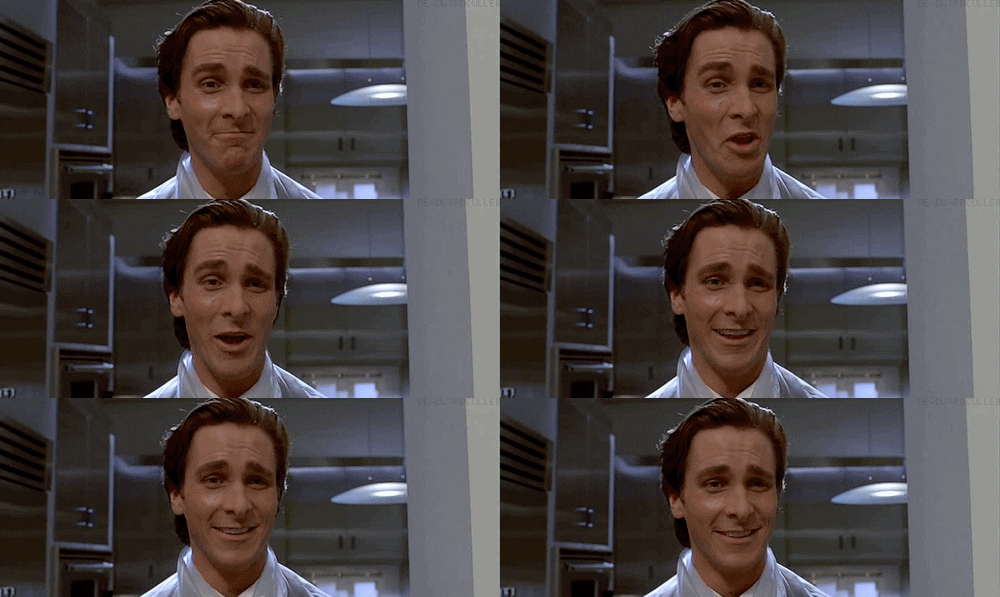
In the movie, the detachment comes across too, but the characters are still a bit better and more carefully treated, and there are fewer, too, which makes for a less confusing flow. Of course, you can also see some of the points the book is trying to make--I mean that literally; Bateman's physical similarities to his friends are clearer. Christian Bale and Willem Dafoe and Reese Witherspoon all do a great job bringing the characters to life, and they lose none of the humour from the book. Well, it's a little blunter, maybe, but it works better, and it's a fair tradeoff for all the damn torture porn in the original.


Source. I feel like Bale had too much fun with this role. Seriously. Too much fun. It's scary.

Ending 


Banksters has an evil but satisfying...happy ending, I guess? I don't want to spoil that, actually, in spite of my warning, because it is the indie book and most people won't know about it. However, I will say that it was narratively satisfying.

My biggest problem with American Psycho, in contrast, was the ending--it was not narratively satisfying, it felt rushed and sloppy, and it didn't really have enough of a payoff after all the build-up. I literally threw down my phone (I tend to read on my Kindle app) and yelled, "WHAT THE PHUQUE?" when I was finished. Then I had to listen to Evil Dead: The Musical and read Charles Dickens until my soul felt cleaner. It was gross and infuriating and hopeless, and not in a way that was appreciable, either. Sure, madness narratives aren't really where you go for a happy ending, but they don't have to be letdowns either.

Now, the movie has to cut so much from the book that it's much more compact and tightly paced, and for the most part, that works to its advantage. There is a big change, though; Jean finds Bateman's crude scribbles in a dayplanner, and they don't really have a relationship. Also, Bateman's lack of resolution is left intact--but here, again, the metaphor for the corruption in Wall Street and the human cost of it, and the meaninglessness of a single person's attempts to reform all come across more clearly. It's the same, but it's better.

Final Verdict 


Over all, I think I liked the movie most, but Banksters bruised my soul a lot less, and that counts for something. Oh, they're all brutal, but I think it's a mark of style and panache if a book or movie can scare you more by doing less. The ultimate horror film, I think, would be rated PG for gore alone (Parental Guidance, for non-Canadians, is basically a G rating with a few swearwords) but leave you awake and shaking in bed for days. Banksters was disturbing in a way that lingered, and it had the least gore of all, though there is a graphic rape scene at the end of the book. I'd have to call this one a tie between the movie version of American Psycho and Banksters. 

Here's the breakdown:

American Psycho--book: 4/10
American Psycho--movie: 8/10
Banksters--book only: 9/10

Basically, I only enjoyed two thirds of the experience, but it was still worth it. So, on that note, I'm going to go watch My Little Pony: Friendship is Magic or some Jane Austen or something to cleanse my soul.

*****
Thanks for dropping by the nest once again. Don't miss any of the phuquerie. Find Michelle on TwitterFacebook, and on Tumblr, and find her work on Amazon. Check back on the blog to see when one of the irregular posts has careened onto your feed. This is the one and only SciFiMagpie, over and out! 

Google+