About Me

My photo
Author of queer, wry sci fi/fantasy books.
Showing posts with label fiction. Show all posts

Friday, 8 August 2025

Hi, everyone. Here's what comes next. -

 Happy Friday.


I was born on a Friday, and I’m thinking it might be a very good publishing day. What do you think? When do you usually read your newsletters and emails? (No, really, sound off and tell me.)

So, one thing about the blog articles I used to write, before I took basically a two-year hiatus, is that they were very structured and kind of formal. Now, I’m not saying I’ll never write essays like that again, but I think I need to change up my style because not everything that comes to me readily presents itself in that format.

Now - I want to try and publish regularly. This is how writers survive, after all. Although many writers affect reticence or suffer from social anxiety, we’re still a sort of artist, and all artists perform and communicate to some extent; and without attention, we dry up and wither away like a forgotten houseplant.
(Just a moment, I need to water my plants.)

Right. So, I’ve spent this week wrapping up my editing practice - contacting clients, deleting my website and Facebook page, and kind of saying goodbye internally. But that means I’m now freed up to, you know, actually pay attention to things like both writing and marketing (and writing articles again, something that got awfully thin on the ground over the last few years).

What will go here?

In addition to returning to non-fiction essays and opinion pieces, and in addition to a less formal style for quite a few of them, I’m going to be serializing my next work, Prairie Weather!

Prairie Weather?

My Canada Council of the Arts Grant-winning novel project is 155,000 words long. A cozy academia with many PoVs, it’s about exploring queerness, coming of age, and navigating friendship, love, and heartbreak. Set in my hometown of Lethbridge, Alberta, It’s a fun and sweet romp with plenty of interpersonal drama.

I mean, as long as your definition of a fun, sweet romp includes things like a stabbing, revenge, and a men’s help group going deeply awry.

I’m thinking that, since the trilogy is complete, I’ll post a chapter each Friday, and essays or nonfiction on Tuesdays. Partly to warm up the space and break in my Patreon and Substack, I’ll be posting some of my best works from the archives - possibly with updates and commentary.

I’ve also been reading actual books lately (gasp!), so I might talk about that a bit, especially where it relates to my creative journey(s). Right now, I’m enjoying a “Gothic Girl Summer,” where I’m getting around to a whole bunch of gothic horror novels I’ve been meaning to tackle for a minute. It’s giving me some serious ideas for the style and direction of the bottom-up rewrite of my trunked first-ever novel, then called “Synchronicity”.

Not just writing?

For the Patreon specifically, I might also post about my art, but if people are into it, I can do that elsewhere. If you don’t know, I make jewelry and knit, and I’m getting a little more serious about drawing, too, for the simple reason that I’ve always wanted and meant to, and now I’m doing a drawing challenge. (Follow that on Instagram!)
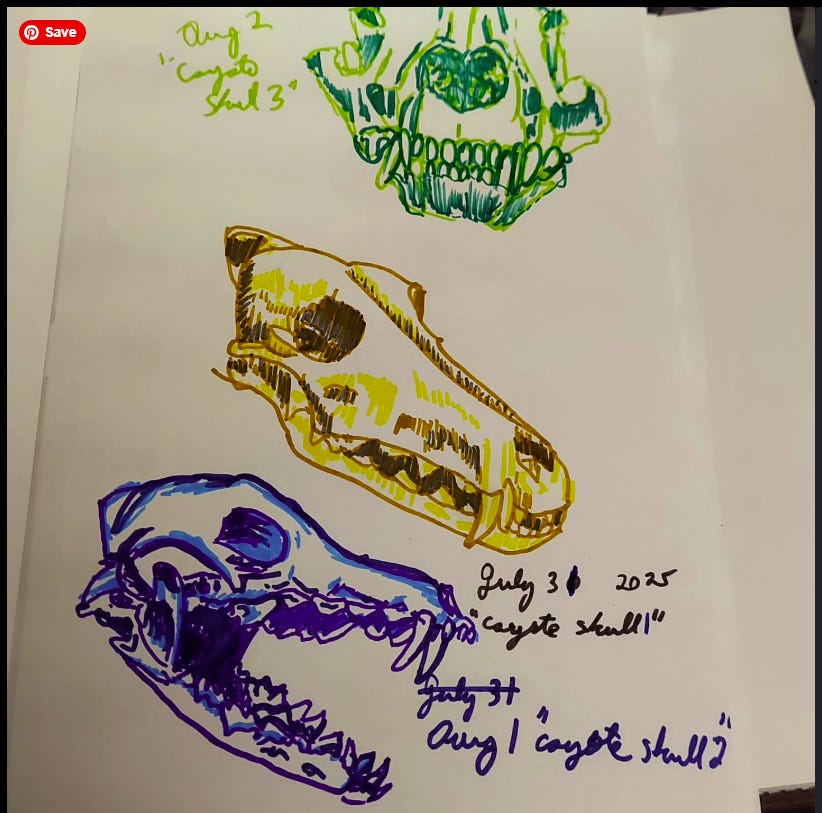
That should be everything for now, but I’d love to hear from you! If you’ve been following me for a while, what would you like to see more of? Less of? If you’re new here, say hi!

***

A writer and artist, Michelle Browne lives in southern AB with xer family and their cats. Xe is currently working on the next books in her series, other people's manuscripts, knitting, jewelry-making, and drinking as much tea as humanly possible.

Find xer all over the internet: *Website * Amazon * Substack * Patreon * Ko-fi * Instagram * Bluesky * Mastodon * Tumblr * Medium * OG Blog * Facebook *

Wednesday, 7 September 2016

Dungeons and Dragons and Storytelling

Hello hello!

For the last few months, I've been not only playing a Dungeons and Dragons campaign again, I've also been listening to a couple of podcasts about campaigns. Critical Hit and The Adventure Zone are both wonderfully funny, interesting stories told by avid and active gamers and players.

One of the many reasons I love D&D is that it scratches my theatre itch. I love musicals, and I did some theatre back in high school, but I wasn't quite passionate enough/was told I had to take too many science classes in order to pursue it further. The combination of performance and audience around one table, of participation, and of both organization and improv is absolutely wonderful.

The thing is, Dungeons and Dragons relies on a lot of different things to go right, but it's pretty hard to make a session go wrong. As I've listened to these podcasts, I've definitely picked up on a few key points.

Collaborative storytelling has to be collaborative


Not all types of storytelling  - comics, movies, video games, and of course, books - rely on audience input. But in the case of D&D or other group projects, it's improtant for one person not to hog the spotlight. As the group leader in our games, I often set up a situation and then put the spotlight in other players. I've tried to make an environment where people feel comfortable speaking up and suggesting something, and that seems to have worked pretty well. It's important to rotate the focus so that the quiet person (who might be incredibly witty and be a voice of of reason) gets a chance to speak up rather than being stuffed in the closet.

That said, it's okay if some voices are stronger than others, as long as the voices are rotated. Maybe Person A gets a spotlight in one session, but Person D gets a lot of attention in the next, and Persons B and C stay about even in both sessions.


Happy mediums rule the day


The Dungeon or Game Master can't yank the reins too hard, but also can't let their players run everywhere. Some railroading is necessary to make sure a story actually happens. When I relied on creativity alone to write regularly, I got dick-all done for months at a time, then a few things done in a burst. Now, I'm creating far more often, and enjoying it a lot more, because I give myself several kinds of structure to lean on. But sometimes I do just jump on the unicorn of fanciful whim and ride into a cybernetic sunset, because it's what I feel like on that particular day. (Note to self: cybernetic sunset and unicorn need to go in a story some time.)

Sometimes you have to cut loose


In both D&D and written fiction, it's awfully easy to fall into the trap of trying to create mounting tension. But at some point, being reckless and having an interlude with humorous or ridiculous tones can be very beneficial. Writers who tend to plan - like myself, these days - need to cut loose once in a while and do something silly and impulsive. The improv element of D&D can be very helpful for this, and the ways that DMs have to adjust their plans when characters move away from them can also be instructive.

One thing I have and still struggle with a bit is figuring out how to pace out action and time spans. Whether it's a long series or just one novel, like Bad Things that Happen to Girls, balancing action with a sense of naturalism can be tricky. A good DM does this well, and can provide guidance with
skipping over the boring parts without making it feel too rushed.

And again, sometimes you just have to jump on the back of a giant mutant rat and try to ride him, climb a giant gold chain, cut some of its links, and make an improvised parachute to land safely, or pick up random crap and turn it into friendship bracelets of sending for the rest of the party.

***

Thanks for returning to the nest. Leave a comment and say hi! I want to hear from you. Keep up with the new releases by getting on the mailing list. Buy my books on Amazon, and keep up with me on TwitterFacebookTumblr, and the original blog. This is the one and only SciFiMagpie, over and out!

Friday, 2 September 2016

Writing Sucks: It's Okay to Hate Your Art Sometimes


Hello hello!

Now, all the writers I know can anticipate what I'm about to say, but for those who prefer consuming media to making it, it may be a surprise. Art sucks. It's not just that drawing symmetrical eyes is difficult. Sure, there are fandom politics to deal with, as a recent ridiculous blow up in the Steven Universe fandom demonstrated. But sometimes, writing a storyline is just plain brutal.

A good example of this is The Underlighters. Sure, I enjoyed writing it, but sometimes, I didn't. I just had to write it. Same goes for After the Garden. Both of those books have scenes that were just emotionally hard to write. I won't include any spoilers, because of course, I'd prefer that you buy and read them for yourselves, but people who've already read one or both will probably know what I'm talking about.

But why is writing--or art in general--so hard? Well, there are basically three reasons. 

Writing and art can be tedious 


Art takes time. Right now, I'm working on a new productivity method--fifty words a day, fiction or blog, no matter what. My birthday? Halloween? Christmas? Doesn't matter. I will still have to write fifty words, at a minimum, that day. Sometimes I blow past this goal and write five hundred or even two thousand words, and sometimes, I just barely squeak by with the two or three sentences required to make my goal.

I tried higher word counts, and all that did was frustrate me. I tried a 'no zero' method, and that just resulted in a surprising number of zero productivity days. Something about fifty words a day really motivates me. A close pal of mine sets writing time limits. Chuck Wendig recommends three hundred and fifty words per day. Stephen King, as many people know, writes about two thousand words per day (link). I spoke to Emmie Mears recently, and they tend to write several thousand words per day over a very short span, then take long breaks. The point is, you might have to fiddle with your personal minimum, but finding it is the key to productivity.

I used to wait for inspiration, but when it didn't show up, I was lost, and I let my readers down. The funny thing is, once I get the engine going, the muse tends to hop in the car and participate the way I wanted her to in the first place. Using my new limit, I've been able to finish a first draft of The Meaning Wars, the long-awaited third book in the series of the same name.  Which brings me to...

Writing and art can be technically difficult and intricate 


OH GOD, SEQUELS. The writers are nodding and biting their lips and gnashing their teeth right now (hopefully not at the same time, because ow). Readers may be shrugging in confusion. The thing is, in addition to the famous "soggy middle" syndrome, there's a lot of stuff to handle in a sequel.

For The Meaning Wars, I had to advance and entwine character narratives, but I also had to introduce a huge new source of tension. How would my war be fought? It took me a long time to accept that I'm just not a boots-on-the-grouund military sci fi writer, and that traditional ways of describing combat and conflict wouldn't do the trick. Instead, I listened to the news and worked on chapters until the lightning bolt hit.

When I realised that I would have to use legislation and small details to convey the sense of oppression, fear, and restriction my characters would face, I got stuck again. How in the nine Hells was I going to do that without a lot of annoying exposition? Then I realised that even though I was writing in the third person, I could use epistolary techniques like news reports, letters and messages, and announcements or broadcasts. From there, it got a lot easier. I just had to think about specific, frustrating restrictions from the real world, and model obstacles accordingly.

Still, I will be working on book four soon, and after that, Monsters and Fools - the final book in The Nightmare Cycle (see above re: the Underlighters). I'm scared as hell of that sequel because the same problems will be presenting, and I have even more connective tissue to lay down! But I'm still here, still writing a blog post about it, and still refusing to give up. 

Writing can be emotionally demanding and exhausting


One of the projects I recently finished, Bad Things that Happen to Girls, was absolutely brutal. I've been pretty open about having mental illnesses, but referencing feelings from my turbulent youth and early adulthood was very taxing. The story isn't literally biographical, but it's got emotionally autobiographical elements, and that was hard enough. Some of the more vicious scenes of emotional abuse really took it out of me, and you don't even want to know how hard the ending was. But I'd been working on the story since 2006. It had gone through two full rewrites as I struggled to nail down the timeline and events, and then I had to get it edited. Compressing the timeline and wrestling the elements into place was bad enough, but the subject matter left me curled up on the couch more than a few times.

But I'd do it again in a heartbeat. I am so glad I've released these stories into the world, and I have so many more waiting to be set free. I will be in pain, frustrated, swearing, or just slogging away at a blog post in the future, and I can't wait. It's not that suffering makes you an artist--it's that being an artist makes you suffer. Creation can be gruelling and frustrating. And that's okay.

Special thanks to Emmie Mears, Chuck Wendig, and Delilah Dawson, as well as Sarah Dimento and Katie de Long, for letting me peruse their brains!

***

Thanks for returning to the nest. Leave a comment and say hi! I want to hear from you. Keep up with the new releases by getting on the mailing list. Buy my books on Amazon, and keep up with me on TwitterFacebookTumblr, and the original blog. This is the one and only SciFiMagpie, over and out!


Google+