About Me

My photo
Author of queer, wry sci fi/fantasy books.
Showing posts with label bad teen movies. Show all posts

Wednesday, 22 October 2014

Oh Gods, Please Not Another Teen Movie: Bildungsroman Movies, Part 2

Hello hello!

So, last time, I offered up my dignity and childhood on a plate to contextualize my lack of experience with teen movies. I also mentioned which movies I'd seen, which ones were not part of the format (Flashdance, Top Gun, Breakfast at Tiffany's, Dirty Dancing, and The Graduate) and were therefore only going to be touched on, and which ones were essential ( The Breakfast Club, Mean Girls, Clueless, The Craft, Pretty in Pink, Ferris Bueller's Day Off, Heathers, Say Anything,  Ten Things I Hate about You, American Pie, Footloose, and She's the Man.)

There are still MORE teen movies on Netflix and elsewhere, but these were some of the biggest zeitgeist defining films, so here they are. I suppose I could have included Napoleon Dynamite or even the Harry Potter series or Juno, but those have a different feel than these movies, or are too self-aware/parodic to count. Also, they weren't made in the 90s or 80s, which was an important consideration for defining the era. But what the hell was up with that era?


The 80s and 90s


Most of my readers were alive for these periods, so I'm not going to rehash history--literally. However, America, where all of these films were produced, was fairly peaceful, quite wealthy, and was experiencing a nostalgia boner of the sort that generally merits physician interference and a trip to the E.R. The 50s and 60s played a big role in the fashions of the era, and also in the priorities. After all, America had beaten the dirty commies and the Berlin Wall was coming down; Russia was waving the white flag and capitulating to capitalism, and the hamburger gut of poverty and malnutrition hadn't ruined America's high school quarterback figure yet. The other thing was that class stratification hadn't set in yet--rich kids still deigned to set foot in public schools, something that slowly ended as recession after recession hammered America. And of course, that whole 9-11 thing hadn't happened yet, so everyone in North America tends to have very rose-coloured glasses about the era.



ALL HAIL MAUD DIB--Wait, no, not that 80s movie. 'Scuse me.


The 80s


The 80s, however, were much darker than the 90s. It's significant that the John Hughes movies (Breakfast Club and Pretty in Pink) and Heathers were done then. Footloose, The Graduate, Flashdance, Dirty Dancing, and Say Anything also have some dark elements to them--and Breakfast at Tiffany's, though it's a couple decades older, totally nails the feel of an 80s movie in some strange ways. It even has a party, misbehavior, and an identity crisis. When you compare the goofy gothic tone of The Craft to Heathers, it's clear which movie is superior and more genuinely frightening--and hint, it's not the one with the Spice Witches. Ferris Bueller's Day Off also touches on this darkness a bit. Honestly, I didn't like DD or FBDO, and PiP made me want to serve Duckie up in a nice whisky glaze sauce with new potatoes on the side. He was unbearable. BC was okay, but Heathers, The Graduate, Breakfast at Tiffany's, and Say Anything were definitely my favorites--especially Breakfast at Tiffany's and Heathers. 

In this batch of movies, there's a lot of abuse, arguing with parental characters, (who actually get proper development in a lot of cases), a lot of death, guns, car crashes, screaming matches that actually seem threatening, religious extremism, murder, prostitution, abortions, and suicide. Not all of these movies are better than the 90s ones, but it's hard to argue that they seem to have more depth. They still give us the big parties and the arguments and the premarital sex, but there's more at stake, a lurking sense that these characters will grow up and that life will not just be a sort of fade into the sunset or a weird flying car from a fairground escape. (Yeah, yeah, Grease was a late 70s movie. Shut it. I already made an exception for Hepburn and I'm not doing it again.)


Yeah, yeah, there's more to the discussion. Don't walk off just yet. 


But what about the 90s?


You can probably see where I'm going with this. Sure, a few movies do allude to tough things, but Clueless doesn't have the same threat-level as the 80s movies. American Pie, Ten Things I Hate about You, latecomers She's the Man and Mean Girls, and The Craft are a lot tamer than their predecessors. There's more drinking, more partying, brighter colours, and less development of the romantic hole-filler boyfriends for the most part. FBDO was pretty meh about Sloan's development, but it at least hinted that she wasn't just a smiling floppy-haired shadow. She kind of was, but...you know. The 90s movies were clearly leaning on the 80s movies for style and support, and Mean Girls wouldn't exist without Heathers--but instead of murder most awkward, that had a nasty bus accident. Bullying is also a bit less threatening--mostly--in the 90s films, and is treated more jokily. On the up side, the 90s movies are less...the word that comes to mind is "patriarchal"...than the 80s films. Those tend to have a theme of female characters being handed off from father to boyfriend like shiny sports trophies.

At the same time, there's an optimism to the 90s movies that's really likeable. There's also a weird emphasis on virginity, though, something that a more recent movie, Easy A, re-created well. 80s movies were more accepting of protagonists who had sex and girls who put out, whereas the shadow of the conservative backlash was already looming in the corners of the 90s films. American Pie was a film about losing virginity, for example. That said, Breakfast Club and Pretty in Pink had jokes about rape and pregnancy, but the characters were mostly virgins there as well. Still, the 90s movies are mostly much more light-hearted and kind of innocent. I mean, there's The Craft, the barfed-up leftovers of the Satanic Panic, but as dark movies go, it's not even a decent teenager version of Practical Magic. I liked Clueless more than 10TIHaY and AP, Mean Girls was a lot better than I remembered. TC was an eye-rolling bore, and StM was a cute, fairly innocent movie for its subject matter, not unlike Easy A was. Both could have, amd perhaps should have, been much darker.


The 2000s and beyond


There's not much to say about these eras. The teen movies that have come out since are basically parodies at best, focus on more adult characters, or were just spineless, toothless inane party fests. The tropes got overused, washed out like a vintage t-shirt in the wash, past the point of chicness and into the point of developing sad little rips and losing letters. It could be The Event That Shall Not Be Named, (9-11), or it could have been TV series like Sex and the City snapping up the audience. Or perhaps the audience had simply graduated. I was a little too young at the time to know.

But still, I haven't gotten into which films are great, which ones are good, and which ones made me homicidal--or why. So, for our final installment, let's talk about quality--and why some films seriously lose their lustre, even with nostalgia goggles firmly in place.

Tune in next time for the final installment--because seriously, I'm not going all Rocky on this trilogy. Absolutely not. I have some decency.

Now it's your turn. What else did you notice about 80s and 90s movies, and how they related to the era? Am I missing out on some 2000s gems, or did they really just suck? Tell me in the comments!

***
Thanks for dropping by the nest once again. Leave your comments, rebuttals, and vehement agreements below. Don't miss any of the phuquerie. Find Michelle on Twitter, Facebook, and on Tumblr, and find her work on Amazon. Check back on the blog to see when one of the irregular posts has careened onto your feed. This is the one and only SciFiMagpie, over and out! 

Thursday, 15 November 2012

Breaking Yawn: How to Fix The Twilight Series

Hello, hello!

Today, we touch on a dark topic, one that has evoked the strongest of feelings for the last handful of years. For some, they are feelings of love, frenzied adoration, and longing; for others, passionate hatred and disgust. And for still others, they are feelings of pain in the lungs and abdomen after laughing too hard. I speak, of course, of that literary abortion, Twlight.

After perusing that pre-eminent page of perlustration, Reasoning with Vampires, I remembered something I'd conceived earlier in the year. Unlike Bella's demon-child abomination, this conception had some merit to it. Bear with me, here; I managed to find a sensible theme in Twilight as a series. It's a remote possibility, but it may be that Stephanie Meyer is smarter than she looks, and has thrown all of us for a loop. Twilight, you see, can be read as a heavily allegorical American fable about the downfall of the economy and the world today.

Oh, there's my monacle. Right, then.


Thanks, Leonhart! Not sure if subtle acting, to be perfectly true to book...or showcase of incompetence...


Bella: Airheaded and abstracted, her depressed state is a mainstay of the books. She is detached from the world around her, and even from the boy she mentions as an object of obsession. This is a fine representation of the current state of the youth of America. Disenfranchised, they pay lip service to ideals that are fading fast in the glare of modernization and a new world. Forks is represented as an old-fashioned town, where the modern young Bella is adrift--even though its inhabitants purport to be friendly, her poor self-esteem causes her to distrust and reject them. Her immersion in old-fashioned literature is remarkable for her lack of absorption and connection with it. In spite of being able to name-check many fine authors, she passes over them as if their work has had no effect on her, no emotional resonance. She becomes obsessed by a thing she seems to hate...that is...

Edward: He is clearly an embodiment of the American dream: to be rich, coming from a balanced and wealthy family, and envied by all. He is physically perfect, but not tame, still wild and independent: a perfect American hero as much as a Byronic hero. He is a cowboy-like Lone Star figure who cannot be captured without sacrifice. His vampirism represents the way this dream is sucking the life out of the youth of America, who cannot escape it and are oppressed by their obsession with it. He even sparkles, not unlike the glittering hopes of the nation. His arrogance, entitlement, and infuriatingly superior personality keep him out of reach, while his form and figure are described as the glass of fashion and as 'angelic'. Need I mention the hint of Lucifer-like characterization in this literally "dazzling" love interest? Add, too, his moral stances, romanticised chastity, and Christian beliefs; and clearly we see Meyer's attempts to show the allure of bygone principles.

Jacob: With his doglike aspect and the subordination he is subject to, is a representation of both First Nations people and the family. His heritage is heavily emphasized in the series, as is the conflict between his people and the American Dream team. He is constantly oppressed by the American dream and shunted to the side by society. Bella, representing the youth of America, finds him appealing and relateable, but ultimately dismisses his devotion and affection as uninteresting. (She frequently discards adoration from others in the same way, illustrating her alienation further.) This has actually happened in 'real America'; consider the cultural appropriation by hipsters of First Nations art and symbolism for aesthetic reasons. Consider, too, that other non-whites become white when they are made into vampires; Jacob, unable and unwilling to assimilate, must be conquered another way. He eventually is subservient to Bella and Edward, and is assimilated in this fashion. This is shown by the way he falls in love with their child, whom he is willing to care for even if she can't return it as romantic love.

Ultimately, though, the pursuit of absolute happiness is an ideal that is more destructive than hopeful. Bella herself becomes a vampire in the end, after much debate. Her struggle is unhindered by her parents, remnants of the unsuccessful older generation who long to capture the dream themselves. Still, she debates with herself, endlessly tortured--is it worth giving up everything she knows to chase a dream? It seems blessed by god, and sure to bring her immortality, but what is its price? When she withdraws from the world and bears a child, she dies. Clearly, bringing a dream into reality is painful, and often more destructive than it is creative. Edward himself is disgusted by the child and considers it an abomination. After the birth, Bella becomes one with her dream, and in doing so, loses everything. She has become a part of the American Dream, but at the cost of her own destruction.

...Either it was the most subtle metaphor ever, or it was just an over-rated piece of racist, heteronormative, misogynistic crap. I can dream, but ultimately, there is no way (I hope) that Meyer intended all those levels of subtext.


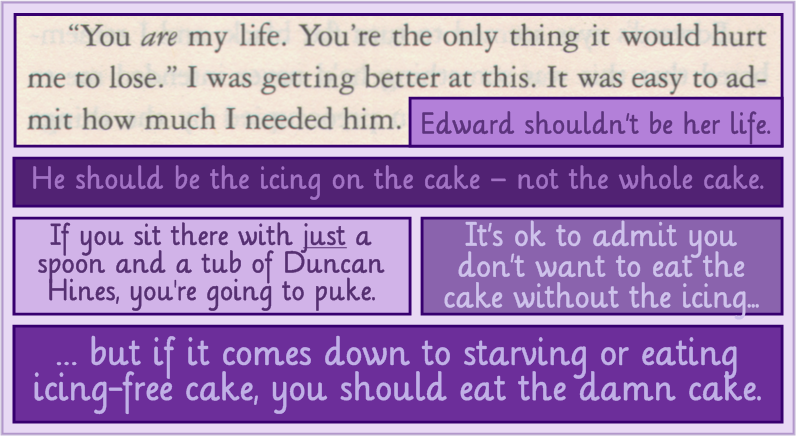
Source. Thank you, Reasoning with Vampires. Dana, you give the best relationship advice!


I did mention fixing the series, though, implying that apart from my rather dark and hopeless reading of the themes, it would be possible to salvage this pile of soppy, overly emotional dreck. After a late-night ponder with the boyfriend, I found some actual solutions.

1) Good Editing: I'm only going to mention the soul-destroying, hilariously awful writing of Meyers for a moment, because it's been done elsewhere. And done again, brilliantly. Still, the writing is really abominable on a mechanical level. Cut out the excessive descriptors and go all Wuthering Heights up in this bitch, and you'd get some very interesting results. That novel, by the way, is characterized by really good descriptions of weather and terrain. Not only are they exceptionally skilful, they advance the plot, augmenting it like a small diamond set next to a larger gem. Take note, aspiring writers; your descriptions can be useful, instead of so much literary fapping.

2) MOAR DARKNESS!: Cut out the crap about her boring family, the kids at school, and the Cullens, or make it darker. Bella is already mopey...give the bitch something to mope about, and something to fear! Give the enormous cast of minor characters some genuine characterization, and make it sinister. Forks is too innocent and boring, and it could use some shadows. Hell, even a few cheesy ghost legends would help a bit. No one, especially Bella, ever seems to have had anything at stake, and the worse things that have happened are a slightly sad divorce and a car accident. More blood and guts, please, with a side of trauma. Make it painful. There is a bit of gore, sure, and the whole 'my boyfriend may eat me and not in a fun way' thing, but the fact that Edward is abusive is far more frightening than his vampirism. That is not good.

3) The Love Interests Need to be Monstrous: imagine a world in which vampires don't sparkle, they kill. Yes, I know, it's Anne Rice's territory, but her work is bogged down by pornographic details. Emphasizing the Draculean monstrosity of Edward's hunger and personal magnetism would have made for a much more interesting struggle. Jacob, too, should have done more slavering and less whining and cringing. A little more horror--other than the horror of all of those superfluous commas and dashes--would have done the job so nicely. As it is, the stalking, obsession, and threats of danger are often hilarious and disturbing rather than really frightening. Instead of being swept up by her love, intelligent readers worry for Bella's mental health, as much as it's possible to worry about such a despicable character.

4) Bella Sucks: Bella, of course, is a monster for different reasons, but if she had had her naivety abused by Edward and Jacob, it would've been a very different story. Her jaded, strained, depressed persona would have to go, obviously. or else it would have to be contrasted with some genuinely likeable traits. Give her a history of abuse, or at least a reason to be such a tough, emotionally resistant broad. A dose of tomboyishness would work, for instance. She hates everyone, and they like her in spite of it; any analysis of her character reveals a frighteningly warped personality. Instead of acting as though her stupidity and meanness are normal...why not worth around these traits? Bella lacks self-awareness even more than she lacks self-esteem, and that's saying something. Granted, she's a teenager, but even the most difficult teenagers have not inspired so much hatred. A harpoon gun to the face is the only thing that would improve Bella Swan at present, and there has to be a better way.

5) Atmosphere: Well, I have to give Meyer this much: she did a good job at establishing an atmosphere in spite of herself. Now, while I am tempted to regurgitate my supper at the mere admission that Meyer got something right, I have to underline this. The meteorological descriptions and scenery are, at heart, not too bad. The erotic tension in the book is also interesting, although the puritan approach to sex is a serious downfall. More sexytimes--less than Anne Rice, but more than what is currently shown--and more storms, with better descriptions, would have really enhanced the power of the setting and mood.

There's probably more that could be added here, but as entire blogs have been devoted to the subject, I'll leave my two cents here.

*****

Thanks for returning, ladies, gents, and people in-between. For more delightfully witty commentary, you can find me at Twitter and on Tumblr. This is your SciFiMagpie, over and out!

Google+