
About Me

My photo
Author of queer, wry sci fi/fantasy books.
Showing posts with label debates. Show all posts

Wednesday, 19 June 2013

The End is Nigh, Part 1: The Biomass Revolution and Other Tales

Hello hello!


As those of you who’ve strayed near a movie theatre in the past couple of weeks may have noticed, there is a very noticeable trend to this summer’s hits. My Facebook feed has been on fire with reports that This Is The End is hilarious and gritty; The Purge has been racing through theatres as well. Catching Fire (which I plan to both re-read, watch, and review) has been advertising itself frequently, as has World War Z, which has been putting much more of an emphasis on the end-of-the-world bits than the zombie bits.

Trend-counting time: we had vampires and werewolves, then a slight interest in dystopias (especially with a dose of romance), a raging surge in zombie fiction and media, and now, we’re hitting a wave of proper dystopian works. What’s up with that? I had some theories before—basically, ‘challenges are fun and so is destroying stuff’—but it’s time to re-evaluate and see whether more forces are at play. I’ll be name-checking some of those previous references in this round, so don’t be surprised if my recommendations and examples have some overlap.


This is going to be a two-parter; in the first half, I’m going to give you some terms and some media, and in the second, I’m going to talk about why everyone is in love with the end of the world more than usual.

Without further ado, let’s talk about some terms.
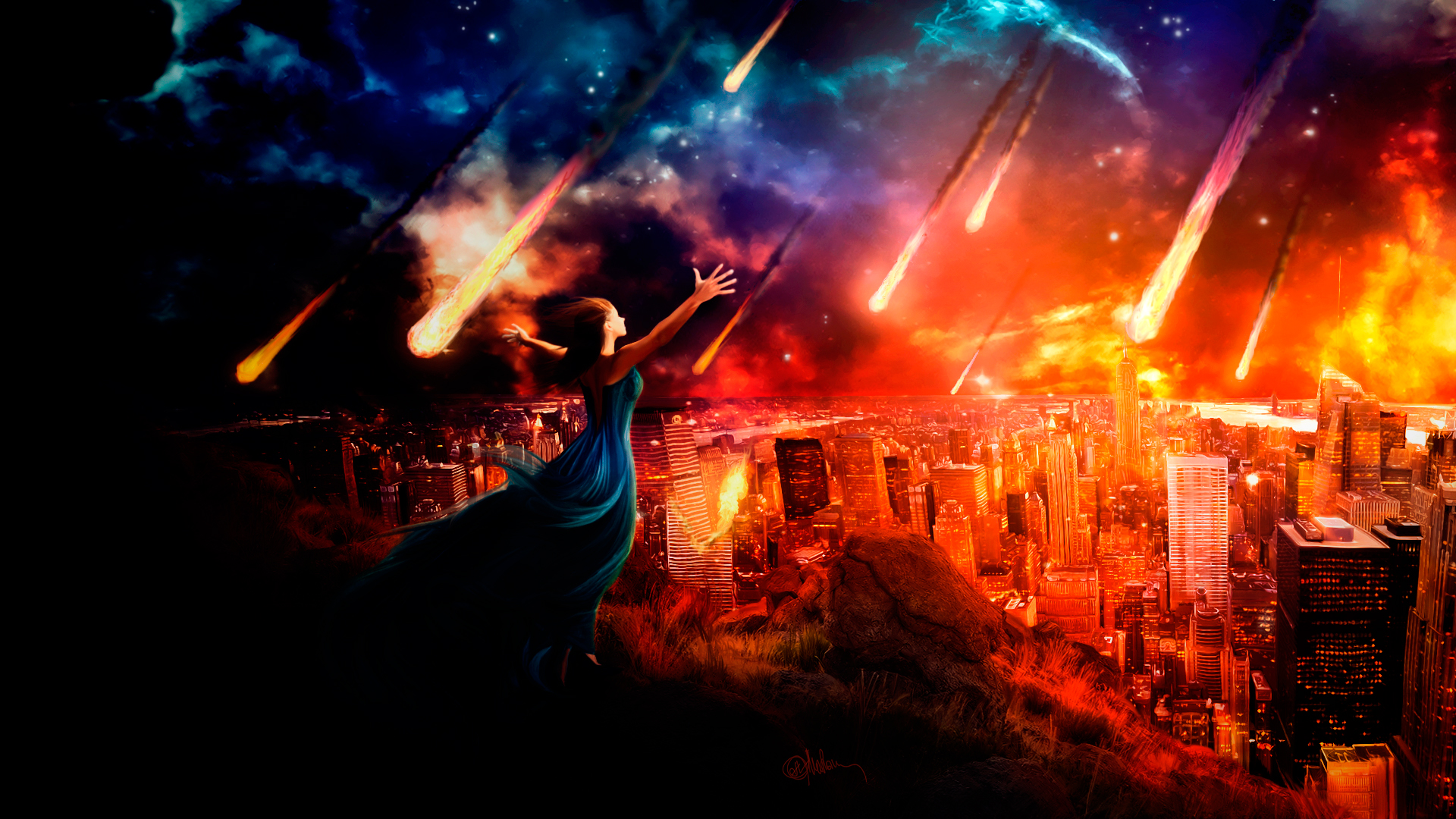


Source. This really sums up my feelings on Dark World sci fi. 


Learning new words is fun!

In my last article, I deliberately blurred the lines between cyberpunk, dystopia, and apocalyptic/post-apocalyptic fiction. Cyberpunk is often a style feature in both apocalyptic/post-apoc and dystopian fiction. All three of these tend to be more planet-centric than galaxy-centric sci fi; where some media (Mass Effect, Star Trek, Doctor Who, Dune, Star Wars) focus more on building a big, shiny universe to play in and tour around, these three genres tend to stick to one planet or even one city. I’ll get to a couple of exceptions to the ‘limited travelling’ idea in a minute, but let’s lay the terminology down first.  Also, you might want to keep Google or GoodReads open in the side so you can look up some of these titles.

In case cyberpunk just sounds like the word you’d use to describe your smart-ass IT guy, I’ll clarify—cyberpunk is fiction with a heavy focus on mixing analog and futuristic technology into daily life. It tends to be gritty, noire-influenced stuff with an existential bent. Transhumanism and equality issues are often themes, as well—the nature of humanity, of reality, changing social roles, and all the ‘fun stuff’ that comes with it. Think of BladeRunner, Johnny Mnemonic, the Sprawl series by Gibson, the anime Ghost in the Shell, or, of course, The Matrix trilogy. It’s sort of a heavily 80s/90s influenced version of steampunk. I’m going to avoid a discussion on all the ‘punk’ subgenres, and get back to the other types of dark-world fiction.


Apocalyptic fiction can be loosely described as fiction about how everything goes to hell. Post-apocalyptic fiction (such as The Road by McCarthy, Brown Girl in the Ring by Hopkinson, or many zombie books) takes place after everything’s gone to hell already. Desert Punk is another anime example; the Fallout series is probably the most famous post-apocalyptic game set out there, though Metro 2033 is a very good one too. The Terminator and Tank Girl also technically count as post-apocalyptic fiction, too.


A dystopia is, as mentioned in this article, a ‘bad world’, often characterized by totalitarian governments, personal controls, lack of freedom, poverty, and a struggle for survival. The Fade by (author) is a good example. Of course, 1984 by Orwell, Brave New World by Huxley, Fahrenheit 451 by Bradbury, A Clockwork Orange by Burgess, Lord of the Flies by Golding, and I Have No Mouth And I Must Scream by Ellison are famous, even ‘classic’ dystopias. For film media, Dark City is a pretty excellent dystopian movie, and Metropolis (both the black-and-white and animated versions) also serves as another fine example. As mentioned previously, even the two Portal games (part of the Half-Life series) fit into this category.


All of these together fall into the realm of ‘Dark World Sci Fi’, though fantasy elements sometimes sneak in. For obvious reasons, they often overlap heavily; it’s easy to have a post-apoc book that involves a dystopian government or living situation, and survivors might use cybernetic implants (a cyberpunk element) to get by in fights to the death. The Mad Max series, The Ballad of Halo Jones, Firefly, Lexx, and a novel I’m going to review a bit today—The Biomass Revolution and its companion, Squad 19, by Nicholas Sansbury Smith—all make use of overlapping aspects of the terms I mentioned above.


I'm focusing on it because I liked it. 


Oh hey, another book!


Shameless plug time—I came across this remarkable book and then got to help a little with its development; it’s very timely, and I’m about to explain why it’s both a) awesome and b) relevant to the points about why dystopias have gotten the limelight lately. The Biomass Revolution kind of sounds like a sci fi diet plan if you glance at the title alone, but the pretty wasteland cover and the poetic opening immediately tell you which genre you’re in. Biomass combines the ripping thrills of a technothriller with the darkness of a dystopia. The moments of beauty in its atmospheric descriptions can be heartstopping--a unique book, that show itself to be far more than it appears at first glance.


The thing that got me about this book is the fact that it wasn't just a technothriller sort of romp. I was expecting that from some parts of it--charge through wasteland, shooting baddies, being big damn heroes. The book focuses on corruption and makes no bones about its political stance, but little details like the dead wives of the leaders really come back to haunt one. Even the 'bad guys' are people. And when civilians get caught in the crossfire, they aren't just meatbags of dramatic convenience. They have names. 

The tone is nicely dispassionate, and Sansbury Smith does a good job of referencing reasonable technologies and current issues. They're hauntingly familiar issues; energy, resource wars, conservatism echoing the non-interference Monroe Doctrine of the early World Wars, and, ultimately, the desolation that results. There are haves and have-nots. Immigrants and deviants are treated badly, while people in the right places get off scot-free. It's heavily inspired by its predecessors, but still manages to add to the genre. I'll admit that some of the content has a video-gamey feel to it, which might turn some readers off, and a lot of the characters are very big and very muscly types. However--it all works. It strives for cinematic rather than silly details, and it works. 


Getting back on topic...


The thing about DWSF (Dark World Sci Fi; see above) is that the entire field is built on societal subversion and questioning the system. That makes it one of the darkest types of entertainment, almost as dark as horror (an entire field devoted to primal fear responses) and sometimes darker. DWSF is about how wrong things are in the world, and how characters attempt to fix them. Unlike other books, the heroes don't necessarily succeed, either. Sometimes, they just ameliorate things temporarily, but are eventually screwed over by the crushing weight of the world.

There's always that glimmer of hope, though, and it is a little brighter when the surroundings are bleaker. I'd like to think that the reason people love Dark Worlds stuff is that they like a taste of hope that's sharper than usual. However, my suspicions are more sinister. Tune in soon to find out exactly why I think people really dig the dark stuff.


*****
Thanks for dropping by the nest once again. Don't miss any of the phuquerie. Find me on Twitter, Facebook, and on Tumblr. More interviews and witty commentaries are coming. Keep checking back to see those surprise posts, too. This is your darling SciFiMagpie, over and out! 


Wednesday, 10 April 2013

Borderline Stories: The Grey Zone of Fan Fiction

Hello hello! Time for a thinky bit. It seems particularly relevant for fantasy month, since fantasy is rife with this sort of thing, and trust me. This post has been a long time coming.

It's no secret to my followers and friends that I am less than fond of fan fiction. Sometimes I poke my head into other forums and discussions just to talk about it with people. Its defenders have some strong arguments (and some not-so-strong arguments too). For years (literally, years, not figuratively) I despised it. My first exposure was the infamous fanfic.net, known for some of the absolute worst writing to grace the internet.


What is fan fiction, you ask? 


For those who haven't encountered fan fiction, or 'fanfic' for short, it falls under a couple of definitions. Simply put, it's work written by fans of a pre-existing story or universe. It relys on the canon stories of that universe, but is technically outside canon; the vast majority of it is written without permission by the creators of said works. Books, movies, television series, and comics are just a few of the media used for fan fiction. It's extremely controversial, and in the past, I've made it clear that I'm one of the many people who despise it.


Let me revise my opinion on this: Fanfiction is a legitimate form of expression that deserves a place at the literary table, instead of being sent to the kitchen to eat on its own. It's not going away, and given the history of literature, some of it has actually contributed to the world.

"How!" you demand incredulously. "Why!" scream others. Have I betrayed my cause somehow? Changed my morals? Taken up bath salts?


While your heads spin about this 180 degree shift in opinion, I'd be delighted to explain why it's come about.


Source. No, unlike Regan, I'm not possessed. I promise.  

The prosecution makes its case. 


To be fair, the fan world deserves some of the notoriety and spleen vented upon it. A few examples of the worst come to mind: the infamous 'head canon' fans who insist that their version is better than the author's, and the (mostly teenagers) who write improbable gay 'ships' (imposed relationships) on characters and describe 'M-preg' (male pregnancy) story-lines--and worse, more ridiculous things. Fan fiction is also known, by and large, for poor craftsmanship of prose, cliched and recycled ideas, misunderstanding of characters, general sloppiness of creation, and a lack of proper critiquing and dialogue within the community. 

There's also the simpler issues of confusing newcomer fans, who may not realise they're reading fan fiction at first. Some people have been turned off of series by the fan fic they've resulted in--for instance, my partner had a very poor experience with Harry Potter fic. It can clog up search results when one is looking for information about the original story--this has happened to me, when I was trying to find a particularly vile poem from the Dragonlance original trilogy and spent hours wading through fan-made crap, trying to find the original source material. 

There's also the simple fact that fan fiction rarely stands on its own. Where The Stars, My Destination did not require reading The Count of Monte Cristo first, the majority of fan fic is completely unreadable without prior knowledge of the existing canon. Not unlike the TV Tropes website or other meme bases,       the layers of culture and in-jokes are so deep that newcomers can get completely lost very quickly. And god help you if your interpretation of something differs from someone else's; fan fiction flame wars (internet ego battles, in case you're unfamiliar with the practice of flaming or trolling) are legendary in size and scope.

And yet, I have a deep love for retellings of fairy tales and other stories--truth be told, I've even done both, with a retelling of a few fairy tales and a riff somewhat inspired by Crime and Punishment making their way into my most recent book. So, am I allowed to criticize? Sure, but only with the awareness that a broad and liberal definition of fan fiction kind of includes my own work. 

Before the screaming starts (I assume it has already, of course) let me also present some supporting evidence for the defense of fan fiction. It's had a huge impact on literature as we know it, and even defined some of the greatest ideas of our time. 


Let the defense rise!


For instance, there's the damning fact that the King Arthur mythos had Lancelot added to it after the fact. Or the instances of Wicked and The Stars, My Destination, which are, respectively, re-writes of the Oz saga and The Count of Monte Cristo. Both are utterly superb and provided new perspectives on the existing works, making them both more enjoyable and adding complexity. Or the cases where famed authors--H. P. Lovecraft and recently, Hugh Howey--openly welcome fans to write things within their universes. Other authors, long dead and consigned to public use licenses, often have their works rewritten and retold--consider the many rewrites of Pride and Prejudice, for example. Or the cases where fan advice is used by authors to enhance their stories. The examples go on, and they all fall into a sort of moral grey zone as enthusiasts find ways to add to the canon universes, and the canon universes accept their additions.


Source. "I'LL TAKE THE CASE!" comes to mind immediately...


What's the big deal?


Naturally, there are also many instances of authors who hate fan fiction deeply. Terry Pratchett and Robin Hobb have both been extremely vocal about their refusal to have fan fiction written about their work--much to the chagrin of many fans. In numerous other instances, fans just write it anyway, and the authors are mostly powerless to stop them. For every reverent fan writing a tribute, there are a pocket of others that scream bloody murder when forbidden to write in the universe without permission.

The issue partly stems from copyright issues and the idea of intellectual ownership. While an author nominally owns their work, fans may disagree with decisions, may want more (or MOAR) in a universe that's closed and finished its story-lines  may have wanted different romantic pairings, or may want to see characters play in entirely different circumstances than they originally existed. Parodies and crossovers are another favorite subject. While the characters are technically the authors' and creators' intellectual property, the fans always acknowledge this, and under parody laws, their work technically is entitled to protection. They can't legally make money from it, but sharing and distributing their works for free? It really is a grey zone. E.L. James merely replaced names in her Twilight fan fiction, Master of the Universe, and...well...I think it's fair to say most of you have heard of 50 Shades of Grey. If you haven't, read my blog post here and here about it and save yourselves the trouble of reading it. (Or don't, if you enjoy books that are so awful you have to laugh through them. That works too.)

Fan fiction has made its way into the wider streams of internet culture. A surprising number of people (mostly female, or at least, they're the only ones I've seen admitting to it) like to read erotic versions of stories or just browse for fun rewrites of things they like. Some of these stories are, I suppose, technically competent enough, and some are alleged to be quite good. For myself, every attempt to read fan fiction online, no matter how renowned and liked, has ended in near-concussions from Head-Desk Syndrome, so I'm a pretty poor judge of likeability. Generally, I can see the fan's writing bleeding through and the marks of imitation on the craftsmanship, and I'd be a liar if I said it didn't bother me.


Source. This was one of mine. 

How do we fix it? 

It wouldn't be a SciFiMagpie post if I didn't offer some potential solutions to the issue. If fan fic can pull its collective britches up and show the rest of the world that it deserves attention because it's capable of good things, it can definitely get somewhere. It even deserves that. However, as in the famous AA line, the first step is admitting that there is a problem. The problem is that lots of it is irredeemable sewage.

It's not that people never write a bad story. My partner Disarcade and my friends will attest that there are times I've literally yelled, "HOW DID YOU WRITE THIS CRAP, PAST ME?" at my computer. Some of this yelling (and giggling) made its way onto Twitter. Not everything we write will be perfect the first time. Some it will just be unpublishable.

To help with this, many authors claim to use fan fic for practice. I haven't done it, but it makes sense----because it gives them a storyline with pre-made characters and the opportunity to develop their own, while they slowly practice descriptions of a known world. Personally, I find it sloppy, but I can't deny the impact of inspiration and the desire to play in a sandbox. At some points, the line between 'inspiration' and 'fan fiction' gets uncomfortably thin. Metro 2033 inspired parts of The Underlighters, to point the gun at my own work, and Neil Gaiman has had a huge impact on my writing. Pretending otherwise, and the idea that 'non fan fiction' stories exist in a magical vacuum, is simply codswallop at best and an outright lie at worst.

However, the self-affirming attitude and reluctance to criticize that plague both the indie writing community and the fan fic community are hurting the market at large. Screaming tantrums and reluctance to be criticized are two of the infamous traits of both markets; add poor technique, and you have the reason that it's just about impossible to simply browse through Amazon's Kindle market these days. People take the lessons learned in the fan fic community and from excessively uncritical supporters and end up plagued with a mix of insecurity and overblown egotism. One can sail a ship on the waves of crap churned into the marketplace. And fan fic, whether its community acknowledges that or not, plays into part of the problem.


"But not everyone who writes fanfic wants to be an author or a professional," protested my friends. "People write for different reasons!"

To that I say: tough cookies. Even if it's free, you published it. That gives the rest of us, your readers and consumers, the right to critique and judge it on its merits, regardless of your feelings. I know people rely on fan fiction and the communities for support and self-gratification--and I really don't care. All creative work and creative communities have those elements. (If they don't, get out!) It doesn't mean that one's work is above criticism. I certainly don't expect everyone to like everything I have written--in fact, I am rather stunned and mildly uncomfortable when I don't see negative opinions. It makes me suspicious and vaguely worried. Much as I do sit there and read through my five star reviews to buoy my ego on a bad day, I rely on criticism to improve myself--as must all writers and artists. Anyone in doubt of the vital need for critique should go examine Deviant Art, another website infamous for the mix of competent and awful art on its thousands of pages.

So, fan fiction has a place, but it needs to work to earn that place.


Your move, fanfic community. Show us what you've really got. Brush off that grammar and spelling checker, maybe pick up a style guide on your way in, and impress us. Don't just rehash things--reinterpret your worlds and share that love with the rest of us.

We--I--will be waiting.

 *****
Thanks for dropping by the nest once again. Don't miss any of the good kind of crazy. Find me on Twitter, Facebook, and on Tumblr. Watch out for my fantasy-themed spring: interviews with fantasy authors, content related to fantasy films and reviews, and some political commentary--the phuquerie you've come to expect from me. Keep checking back to see those surprise posts, too. This is your darling SciFiMagpie, over and out! 
Google+