So, you might have noticed a bit of a lack of blog posts over the winter. Well, this time it's not (just) depression eating me alive. I made a thing - two things, actually.
Consider this a soft reboot, and a perfectly good starting point in the series. Book 3, The Meaning Wars, follows two characters: Sarah, the weary Behavioural Criminal arrested for associating with dissidents, and Crystal, a wormhole engineer dissatisfied with her marriage and the safe, boring jobs she's been taking. Linked by friendship and their Martian origins, the two women fight ongoing trauma to reclaim their senses of self.
Book 4, Poe's Outlaws, finds Crystal and Sarah pursuing intersecting paths. Sarah has become a smuggler, wrapped up in a rescue mission to save a revolutionary leader (who happens to be her inspiration and her crush). Crystal is taking a much-needed vacation, but an old flame, the one who got away, is about to throw her life right back into chaos. The only way out? Friendship, teamwork, and possibly, a revolution. It's a beach episode featuring queer love, aliens, and derring-do.
I'm working on book 5, A Jade's Trick. I'm past the halfway point, but for a few months, I got completely stuck. Part of it was debating on the tone for the ending. War threatens, and I had no idea how to resolve the conflict. Should I choose something idealistic, where the corrective safeguards of the system work, or something drastic and grim, a more realistic vision of power dynamics? I couldn't choose, and it felt like a very abstract question.
Then war came to Ukraine, and I got a tiny taste of what it might be like to stand in Crystal's boots.
Apocalypse Turducken
Being in the late? portion of a pandemic, as very hurried politicians insist we are, and having that pandemic overlap with the disruptive attack on the American election (followed recently by a halfassed attempt to do the same here in Canada, with the farcical embarrassment of the trucker protests) [links], I wasn't exactly expecting more calamities. But the universe isn't really into following scripts or plot arcs or anything sensible like that - no, those are human constructs meant to carve chaos into coherence. I wasn't counting on a paranoid, ruthless dictator deciding that the lull after the second pandemic Olympics was the perfect time for his colonial power-grab.
And I really wasn't prepared for the war to affect me personally. In addition to the fact that my male partner is Ukrainian, a very dear friend is a Kievan native. She has been displaced by the conflict, and she and her mother are scrabbling to make ends meet in a different city. Hopefully, this displacement won't be permanent.
We've set up a fundraiser to help her and her mom while these events are going on. This is a fundraiser to help her and her mom not only get a tablet for her to work on as a graphic designer (her laptop is in Kyiv...), but also to help them get by for the next while. Her mother's job at the library is kind of out of commission right now, and it's possible that they'll have to emigrate elsewhere for safety.
Before this whole war thing got started, I also knitted her a sweater inspired by Yoongi of BTS's famous - and expensive - designer yellow sweater. Proceeds from the sale of the pattern will also be going directly to Katya, to help with resettlement costs. There is a chance that we're going to have to help her migrate to Canada, so anything you can give will be greatly valued.
Thank you all for reading my work and checking out these fundraisers. If you can't give, please share this article on social media.
***
Michelle Browne is a sci fi/fantasy writer and editor. She lives in Lethbridge, AB with her partners-in-crime and their cats. Her days revolve around freelance editing, knitting, jewelry, and learning too much. She is currently working on other people’s manuscripts, the next books in her series, and drinking as much tea as humanly possible.
So, people who remember the 90s and early 2000s, or even the early 10s, might remember the recurring cultural fixation on being "unlike other girls." A Youtuber I particularly enjoy just put out an excellent video essay on the topic, and it covers a really interesting angle that isn't necessarily being talked about much.
A quick note about gender to preface things - some of the people who look like "other girls" are either transgender or non-gender conforming, and the issue of gender for trans people, especially re: gender performance for both personal reasons and survival reasons, is really complicated. I don't experience dysphoria for my presented or physical gender, but I wanted to mention that when I say "women" and "men," I am primarily talking about cis people - but I am aware trans people can also experience periods of trying desperately to conform while hiding their inner selves/real gender. (The real gender is the one by which someone identifies, just to be clear; also, genders and the expression/performance thereof can shift over time.)
So, with that note out of the way, kindly consider the latest iteration of feminine cannibalism.
The thing is - it wasn't so much the actual "popular girls" who were nasty. It was mostly their seconds-in-command or the girls who wanted to be them. The invisible middle-layer of girls who were neither social outcasts nor truly universally liked. In the brutal hierarchical world of junior high (and sometimes high school), clawing for attention, especially from guys, is a vicious game.
The thing is, parents also made some of these comparisons. Something absolutely burned into my mind is the moment in the Muppet Cinderella, featuring Brandy, when her aunt says, "you look like a girl from one of those rap videos!" in a dismayed and scolding tone - and the character's uncle comments, "you look like a girl from one of those rap videos" in a significantly warmer tone, while looking his niece (!) up and down. It was a tiny moment, but I can still recite those two lines of dialogue from memory roughly sixteen years later...and that says a lot.
Authors, we need to knock it off
Being that I'm not only a writer, but that I also edit in the industry, I can absolutely confirm that a ton of romance books written for adults and by adults still have this internalized misogyny - including books by queer men. A lot of people are starting to unpack this deep-seated and knee-jerk hate, which is pretty great, but quite a few people still don't - and it sucks. A nemesis who may be promiscuous, blonde, shallow, vicious, or all of the above crops up quite often. Romance moviesare so, so bad for this - and what shocked me was that most of those terrible romantic comedies I saw growing up were written, directed, and produced by men, especially men who sneered at the whole format. So...basically, men were presenting a "cool girl" and saying that she was better than other women. And as Aonso and some of the other creators linked in this essay put it, we wonder why women hate each other and themselves.
When it changed for me
Two things happened when I was a teenager that made an important crack in my understanding of other women - first of all, I started to be attracted to girls. It's possible to hate people you're attracted to; look at incels, for example. Hell, that term was coined by a bi woman and was used by her and other queer people who felt undateable, and were trying to fix themselves so they could find love. (As usual, the worst kind of men invent nothing, and make what they steal, worse.)
The other thing was - after a terribly unpleasant stint in private school in eleventh grade, which was a terrible five-month period, I returned to public school - but I started to dress the way I had always secretly wanted to. That meant (sigh) the boy-jeans that fit me under sarongs, long circle skirts with embroidery, peasant shirts, and that kind of thing. I had always loved clothing like that, and a brief stint of wearing a uniform made me decide firmly that I was going to wear the clothes I loved, damn it.
And somehow, people not only thought that was cool - but they liked me and were friendly. It helped that the high school had a reputation for being nerdy and academic, but it was still an inner-city school, which made for a diverse population. And here's the twist - not only did I not get bullied, I had a great year and a half there, and I even friendly relationships with some popular girls. Finding out that pretty girls, even actual teen models, could be fun, smart, and sweet changed everything.
I had a bad period with my counselling faculty in university as well, which sparked a nearly fatal depression - but that didn't make me hate all other women. The thing is, "nerdy" and "unconventional" girls can be just as vicious and mean as the "popular" ones - and to my later surprise, men can be every bit as petty and vicious and underhanded. I've seen it in professional communities, both my own and in the medical and business worlds, and I've even seen this kind of backbiting in queer communities. So why does it keep happening?
The core of the problem
In psychological terms, it appears that most girls and plenty of women (and men) seem to not only view others based on their external interests - but as Aonso puts it, they assume that other people aren't as genuine about their interests, and are either "faking it" or doing it for "clout" or "attention". The thing is - a lack of theory of mind, understanding that other people have their own inner worlds, combined with a presumption of an external locus of control (i.e. letting the world's judgements determine what's important to you and what you should do), perfectly describe the things we assume about other women. But - it's easily disproven by talking to these "other girls". One of the greatest revelations of my life was discovering just how many "dumb" girls were pretending to be stupid just to avoid intimidating men and others.
A fundamental lack of empathy for "other girls" is the justification for hating them. In the earlier decades, bullying definitely was an issue, but it doesn't fully explain why this hatred for the "other girl" is so deeply encoded.
Combined with the mournful loneliness of societal prejudices experienced for failing to conform, as well as social rejection, plenty of "not like other girls" girls/people turn inward and try to find something about themselves to like. Being unlike one's tormentors is generally the first thing to notice - and accepting one's differences, especially if they result in being othered, can be comforting.
However, just because it's a coping mechanism doesn't mean it's healthy. Destructive social dynamics are the price of being a member of a social species. The only way to deal with it is fighting the internalized social protocols of Western culture (i.e. don't talk about what's Important to you, don't say things that will make waves, even if they're really nice compliments; be innocuous but not too boring, etc). The patriarchial standards based in the most toxic core of North American culture, especially WASP (White Anglo-Saxon Protestant) and whiteness culture, are killing all of us. But they don't have to, because we are already more than what we've been taught to be.
What I think now
In addition to this, a memorable social psychology class of mine focused on the ways that "alternative" people - which, I suppose, includes yours truly - still conform to dress codes within their own subcultures. When one considers an "alternative" girl next to, say, a sports team, of course she looks different. But stick that girl on tiktok and look under the right hashtags, and it's easy to see more visual similarities between clothing styles of alternative people. So - those "other girls" just need to band together and enjoy each other's company and similarities, and with the internet, that's possible like never before.
So, other girls? They're great! Finding out that first of all, pretty girls aren't actually vicious monsters out to destroy relationships and friendships, was wonderful. There are a lot of other people who adore reading, writing, talking about social justice issues and politics, tabletop RPGs, knitting, moody folk and rock music, true crime of the cult and con artist variety, history, shiny rocks, magic, making jewelry, baking and cooking, fashion, drawing, tea, and learning languages (to cite most of the interests I can think of at this exact moment). Not only that, I've learned to present my interests more appealingly in conversation, so they're more approachable and so I can hit the highlights for people who are interested but less knowledgeable. Discovering the joy of shared interests and the skill of sharing my interests has made my adulthood a rich and socially satisfying period, and I can only hope others can attain this level of warmth, friendship, and support.
Next time that little nasty whisper rears its head, or next time some guy mentions that a woman is "not like other girls" - ask, "what's wrong with other girls?" Embracing the shadow-side of other-girlness, and learning how to do makeup, dress provocatively, and appreciate one's own sexuality (or lack thereof) will not magically turn a woman into a brainless zombie or a soul-sucking, seductive vampire. If anything, we should explore these societally-shamed tropes, and appreciate the diversity of people who both identify under and branch out from the feminine gender. We have barely even begun to create societal roles for nonbinary people, but trans and nonbinary folks are also bringing forth a lot of creativity and wonderful content. Masculinity and femininity should be umbrellas, not cages - but self-hatred has never unlocked a cage from within.
***
Michelle Browne is a sci fi/fantasy writer and editor. She lives in Lethbridge, AB with her partner-in-crime and their cats. Her days revolve around freelance editing, knitting, jewelry, and learning too much. She is currently working on other people’s manuscripts, the next books in her series, and drinking as much tea as humanly possible.
In the last six or eight months, I've fallen in love with podcasts. I started off just listening to Welcome to Night Vale, courtesy of Tumblr, and The Thrilling Adventure Hour soon followed after they ad a crossover. Following Mara Wilson's Twitter feed led me to I Don't Even Own a Television. From there, I started to poke around, and talked to a few friends, like Louisa (blog link). I got hooked on Sawbones and Oh No, Ross and Carrie. My Brother, My Brother, and Me became my nightly comfort, the McElroy brothers' voices lulling me safely to sleep. Listening to a happy, healthy family kibitz and bond over Yahoo answers and social niceties has made dark times that much easier to endure, and helped me step back into the light.
Of course, I seek more than comfort and the joy of new information. These days, I often enjoy horror rather than fearfully avoiding it, and one of the best creepy podcasts around has to be Lore. As always, however, one can only binge-listen to a cast for so long before running out of episodes, and I sought alternatives and supplements to my fix. The HP Lovecraft Literary Podcast caught my attention as well, and after I'd run out of episodes of that--no mean feat, but I tend to listen obsessively to shows I enjoy, rather than just taking them in once a week or every two weeks--I had to find more horror and fiction podcasts.
Where did I go next?
I haven't finished them or listened to much of them, so I will not yet link Psuedopod, Drabblecast, or Knifepoint Horror, but they come well-recommended. TANIS and The Black Tapes are also moderately popular, though have mixed reviews. Perhaps one of the best known is the Reddit-sourced NoSleep podcast, based on the subreddit of the same name.
I have not yet completed the podcast's run of back episodes, but my favorite episodes of NoSleep, and the ones I consider the best, are the following. I have included notes about the entries.
Episode 1--the very first story is perfectly chilling and one of the most unnerving I've ever heard. Episode 3--the first story is the best, once again. Episode 7--only We Don't Talk about Sarah, though. Episode 8--My Best Friend's Grandmother; again, the others are meh. Penpal Part 1--generally, both parts are an interesting and suspenseful mystery, but see below. Penpal Part 2 Episode 14--the whole thing is pretty great. Episode 18--both stories are rather good, but the last one is remarkable.
Normally, I wouldn't include so many links, but I want readers to understand my sources and references before I shovel conclusions over them like so much grave dirt.
What is it about horror?
I've come to like horror because it allowed me to frame my own demons in a more useful way, and to get in touch with the dark side of my imagination. Many authors have written about the appeal of horror, and I would be redundant to ask why the world of shadows and fear calls to so many.
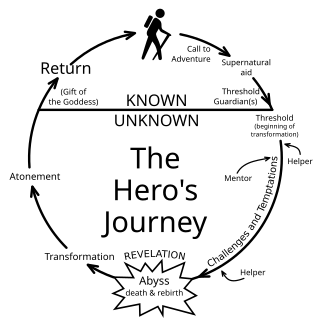
I would suggest, however, that in addition to expressing personal darkness, the appeal of horror is partly in how it inverts some expectations. Most stories involve things ultimately going right; horror is about things going wrong. The Hero's Journey structure (see below) becomes inverted, and often foreshortened abruptly by disaster.
Source. This is allegedly what all stories come back to.
In a horror story, the hero's journey still occurs, but there's no guarantee of redemption, just further horror and loss. Readers, viewers, and listeners derive a weird comfort from facing their fears about the worst thing that could possibly happen.
Meet the new boss?
The exciting thing about the NoSleep podcast is that it's a trove of unknown and developing writers, rather than old hands and established experts. Sometimes the writing is mediocre or amusingly inept, but the variety is a real pleasure.
These authors tend to use an X-Files sort of sensibility--setting mysteries in the local environs, even in office buildings, subdivisions, and backyards. Narrators/protagonists are often relatively innocent, rather than being guilty of violence before the narrative's events take place. Surprise encounters dominate most of the events, or narrators become the victims of more powerful and often abusive, stalking forces.
Unreliable narrators are common, and it is often difficult to determine whether the main characters have a loose grip on reality or are truly experiencing paranormal events. This is enhanced or exacerbated by circumstances of shyness and social isolation; protagonists are usually lonely, ordinary nebbish types--not just Everyman sorts, but updated ones, often labouring under the kinds of crappy jobs that so many Millennials and Gen Xers take.
But not everything is intriguingly updated. With many modern sensibilities come unwelcome old friends.
One might not expect that so many younger men would reinforce gender stereotypes as strongly as these writers do, but an interesting thread through even my favorite stories tended to be gender essentialism. Female characters were usually mothers, were depicted as more fearful and physically weaker than male characters, and tended to be subjected to far more violence.
Female antagonists, however, are common, and usually tend to be lurking spectres or haunted children. They present menace but rarely enact the actual violence. Other antagonistic forces are often either genderless or somewhat male-coded, and tend to be far more violent.
This being said, lady writers do occasionally contribute, and often focus on issues of mental health and abandonment, or lack of physical safety. Stalking also crops up. These elements are really interesting, and I'd love to see more of them. Perhaps the next seasons will deliver that!
***
Thanks for returning to the nest. Leave a comment and say hi! I want to hear from you. Keep up with the new releases by getting on the mailing list. Buy my books on Amazon, and keep up with me onTwitter, Facebook, Tumblr, and the original blog. This is the one and only SciFiMagpie, over and out!