About Me

My photo
Author of queer, wry sci fi/fantasy books.
Showing posts with label 1984. Show all posts

Sunday, 17 December 2017

The Success of Failure

Hello hello!

This month, I have an analysis of a friend's beautiful art exhibit. Bonnie Patton is an artist from Edmonton, AB. Originally from North Dakota, they came here for university, and fell in love with Canada. Conceived before Donald Trump's rise, the project has additional layers of resonance now...

 An Analysis of Bonnie Patton’s 1984 Cranes


At the heart of traditional dystopian fiction is a theme of failure.  1984 is a prime example of this: the failure of Outer Party members to resist their training, the failure of proles—thus far—to protest, and the failure of Winston Smith and Julia’s love. At first glance, it would seem to have little in common with the children’s story Sadako and The Thousand Paper Cranes. Patton’s art finds the links between these books and explores them, creating a poignant visual essay.

Patton started folding cranes from the last page of 1984. Like Sadako and The Thousand Paper Cranes, the tragedy and appeal of both books comes partly from foreboding and the knowledge that both characters are ultimately unsuccessful. Sadako, who suffers from cancer and hopes the gods will grant her wish of being cured if she folds all one thousand cranes, dies before she can complete her task. Winston Smith fails to resist indoctrination by Big Brother, and ultimately betrays both his lover Julia and himself under the pressure of torture. One character dies physically; the other, spiritually.


Photo credit: Bonnie Patton, used with permission


The fragility and ephemeral nature of papercraft highlights the fragility in the struggles of characters in these books, as well—by reducing 1984 to its very pages, Patton has, in a sense, destroyed it, just as Winston participates in the constant destruction of information and documents, erasing history. His glass paperweight, representing his soul—“so fragile after all” is crushed and broken by the state, literally and figuratively. And yet, because the pages are folded, made into something new, there is an element of transformation and memorial tribute—the cranes are bespoke, handmade objects of beauty, made from a book that is literally about the destruction of beauty by ugliness and industrialization gone awry. The book itself was printed through industrial processes, and Patton has reduced and transformed it into a sculpture, a tribute to the young Japanese girl who wished so hard, she inspired millions to remember her.

Then, too, just as the cranes themselves are symmetrical, there is a dark reciprocity created by the linking of these two books. Oceania wages war against Eastasia (as well as Eurasia). Published in 1949, 1984 was written with full context of the Second World War, and strongly inspired by it. In both Sadako and The Thousand Paper Cranes and 1984, it is the civilians who suffer. Sadako is one of the thousands of Japanese people who suffered from cancer (and other health complications) as a result of the atomic bombs. Winston, arguably, is one of the people who plays a role in the dropping of those bombs, reinforcing the importance of the constant war and supporting it with his actions. By using Sadako and The Thousand Paper Cranes to literally reshape 1984, an inherent criticism of colonialism is displayed. It is also a reversal, with the cranes “overpowering” the structure of Orwell’s book—after all, the text can still be read, but the dominant visual impression is of the cranes, rather than the book from which they were formed.


Photo credit: Bonnie Patton, used with permission


Although the delicate cranes—which could be tangled, ruined by a strong breeze or wind—are few in number, and unable to fly, their embodiment of failure is not without a hopeful aspect. In 1984, Orwell writes, “if there was any hope, it lay in the proles.” Winston fails, but also hands over the torch to the bulk of Airstrip One’s population—showing that while his personal revolution fails, it need not truly be the doom of Oceania. The book has become a symbol of the fight against censorship, oppression, and jingoistic wars. Sadako’s cranes have become a symbol of peace across the world, and thousands of cranes are still hung on her memorial every year. According to the book, she herself was unable to fold all the cranes, but many others have done it for her. August 6th has been named International Peace Day in her honour. The cranes, in a sense, show an allegiance to peace and transformation. Though there are only a hundred and twenty-seven, they speak powerfully about two stories that have shaped the world, and connect them across time and distance. A project predicated on the failure of two books and their themes, then, is ultimately a tribute to their success. 


Photo credit: Bonnie Patton, used with permission

***

Thanks for returning to the nest. Leave a comment and say hi! I want to hear from you. Keep up with the new releases by getting on the mailing list. Buy my books on Amazon, and keep up with me on TwitterFacebookTumblr, and the original blog. This is the one and only SciFiMagpie, over and out!

Tuesday, 30 July 2013

The Stolen: Two Short Stories (Book 2 of The Meaning Wars)

Now available on Amazon, Barnes & Noble, Apple iBooks, Smashwords, and Kobo eBooks


The city of Corinth is beautiful, but a cancer eats at its soul. Sarah Jean White is that cancer. The tube city is a tranquil, clean paradise--exactly the wrong place for her. She steals words, swears, and indulges in forbidden vices. When someone finally notices her heresy, her status as a threat to peace of mind will be dealt with...


A strict Caste system rules dry, distant Indus. Clarice dares to break through the taboos the old-fashioned way: with sex. Finding herself at a moral rehabilitation facility once again, she doesn't expect things to be much worse than before. Soon, she figures, she'll be back outside, free to 'sin' privately once again. Then her classmates start to disappear... 

When Sarah and Clarice reach for basic human rights and challenge the law, their playful indulgences are treated as dire crimes. The peace and harmony in their separate worlds comes at a horrifying price.

Wednesday, 19 June 2013

The End is Nigh, Part 1: The Biomass Revolution and Other Tales

Hello hello!


As those of you who’ve strayed near a movie theatre in the past couple of weeks may have noticed, there is a very noticeable trend to this summer’s hits. My Facebook feed has been on fire with reports that This Is The End is hilarious and gritty; The Purge has been racing through theatres as well. Catching Fire (which I plan to both re-read, watch, and review) has been advertising itself frequently, as has World War Z, which has been putting much more of an emphasis on the end-of-the-world bits than the zombie bits.

Trend-counting time: we had vampires and werewolves, then a slight interest in dystopias (especially with a dose of romance), a raging surge in zombie fiction and media, and now, we’re hitting a wave of proper dystopian works. What’s up with that? I had some theories before—basically, ‘challenges are fun and so is destroying stuff’—but it’s time to re-evaluate and see whether more forces are at play. I’ll be name-checking some of those previous references in this round, so don’t be surprised if my recommendations and examples have some overlap.


This is going to be a two-parter; in the first half, I’m going to give you some terms and some media, and in the second, I’m going to talk about why everyone is in love with the end of the world more than usual.

Without further ado, let’s talk about some terms.


Source. This really sums up my feelings on Dark World sci fi. 


Learning new words is fun!

In my last article, I deliberately blurred the lines between cyberpunk, dystopia, and apocalyptic/post-apocalyptic fiction. Cyberpunk is often a style feature in both apocalyptic/post-apoc and dystopian fiction. All three of these tend to be more planet-centric than galaxy-centric sci fi; where some media (Mass Effect, Star Trek, Doctor Who, Dune, Star Wars) focus more on building a big, shiny universe to play in and tour around, these three genres tend to stick to one planet or even one city. I’ll get to a couple of exceptions to the ‘limited travelling’ idea in a minute, but let’s lay the terminology down first.  Also, you might want to keep Google or GoodReads open in the side so you can look up some of these titles.

In case cyberpunk just sounds like the word you’d use to describe your smart-ass IT guy, I’ll clarify—cyberpunk is fiction with a heavy focus on mixing analog and futuristic technology into daily life. It tends to be gritty, noire-influenced stuff with an existential bent. Transhumanism and equality issues are often themes, as well—the nature of humanity, of reality, changing social roles, and all the ‘fun stuff’ that comes with it. Think of BladeRunner, Johnny Mnemonic, the Sprawl series by Gibson, the anime Ghost in the Shell, or, of course, The Matrix trilogy. It’s sort of a heavily 80s/90s influenced version of steampunk. I’m going to avoid a discussion on all the ‘punk’ subgenres, and get back to the other types of dark-world fiction.


Apocalyptic fiction can be loosely described as fiction about how everything goes to hell. Post-apocalyptic fiction (such as The Road by McCarthy, Brown Girl in the Ring by Hopkinson, or many zombie books) takes place after everything’s gone to hell already. Desert Punk is another anime example; the Fallout series is probably the most famous post-apocalyptic game set out there, though Metro 2033 is a very good one too. The Terminator and Tank Girl also technically count as post-apocalyptic fiction, too.


A dystopia is, as mentioned in this article, a ‘bad world’, often characterized by totalitarian governments, personal controls, lack of freedom, poverty, and a struggle for survival. The Fade by (author) is a good example. Of course, 1984 by Orwell, Brave New World by Huxley, Fahrenheit 451 by Bradbury, A Clockwork Orange by Burgess, Lord of the Flies by Golding, and I Have No Mouth And I Must Scream by Ellison are famous, even ‘classic’ dystopias. For film media, Dark City is a pretty excellent dystopian movie, and Metropolis (both the black-and-white and animated versions) also serves as another fine example. As mentioned previously, even the two Portal games (part of the Half-Life series) fit into this category.


All of these together fall into the realm of ‘Dark World Sci Fi’, though fantasy elements sometimes sneak in. For obvious reasons, they often overlap heavily; it’s easy to have a post-apoc book that involves a dystopian government or living situation, and survivors might use cybernetic implants (a cyberpunk element) to get by in fights to the death. The Mad Max series, The Ballad of Halo Jones, Firefly, Lexx, and a novel I’m going to review a bit today—The Biomass Revolution and its companion, Squad 19, by Nicholas Sansbury Smith—all make use of overlapping aspects of the terms I mentioned above.


I'm focusing on it because I liked it. 


Oh hey, another book!


Shameless plug time—I came across this remarkable book and then got to help a little with its development; it’s very timely, and I’m about to explain why it’s both a) awesome and b) relevant to the points about why dystopias have gotten the limelight lately. The Biomass Revolution kind of sounds like a sci fi diet plan if you glance at the title alone, but the pretty wasteland cover and the poetic opening immediately tell you which genre you’re in. Biomass combines the ripping thrills of a technothriller with the darkness of a dystopia. The moments of beauty in its atmospheric descriptions can be heartstopping--a unique book, that show itself to be far more than it appears at first glance.


The thing that got me about this book is the fact that it wasn't just a technothriller sort of romp. I was expecting that from some parts of it--charge through wasteland, shooting baddies, being big damn heroes. The book focuses on corruption and makes no bones about its political stance, but little details like the dead wives of the leaders really come back to haunt one. Even the 'bad guys' are people. And when civilians get caught in the crossfire, they aren't just meatbags of dramatic convenience. They have names. 

The tone is nicely dispassionate, and Sansbury Smith does a good job of referencing reasonable technologies and current issues. They're hauntingly familiar issues; energy, resource wars, conservatism echoing the non-interference Monroe Doctrine of the early World Wars, and, ultimately, the desolation that results. There are haves and have-nots. Immigrants and deviants are treated badly, while people in the right places get off scot-free. It's heavily inspired by its predecessors, but still manages to add to the genre. I'll admit that some of the content has a video-gamey feel to it, which might turn some readers off, and a lot of the characters are very big and very muscly types. However--it all works. It strives for cinematic rather than silly details, and it works. 


Getting back on topic...


The thing about DWSF (Dark World Sci Fi; see above) is that the entire field is built on societal subversion and questioning the system. That makes it one of the darkest types of entertainment, almost as dark as horror (an entire field devoted to primal fear responses) and sometimes darker. DWSF is about how wrong things are in the world, and how characters attempt to fix them. Unlike other books, the heroes don't necessarily succeed, either. Sometimes, they just ameliorate things temporarily, but are eventually screwed over by the crushing weight of the world.

There's always that glimmer of hope, though, and it is a little brighter when the surroundings are bleaker. I'd like to think that the reason people love Dark Worlds stuff is that they like a taste of hope that's sharper than usual. However, my suspicions are more sinister. Tune in soon to find out exactly why I think people really dig the dark stuff.


*****
Thanks for dropping by the nest once again. Don't miss any of the phuquerie. Find me on TwitterFacebook, and on Tumblr. More interviews and witty commentaries are coming. Keep checking back to see those surprise posts, too. This is your darling SciFiMagpie, over and out! 


Sunday, 27 May 2012

It's The End of The World as We Know It (And Why That's Fine)

Hello hello! Thank you for tuning in to this episode of Radio SciFiMagpie, your source for goofy reviews, insight, genre fiction, and quotable fuckery related to all of the above.
Today, we're talking about dystopian fiction: I have mentioned my love for it in previous posts, and since the Hunger Games is still warming the front shelves of book store windows, I figured it was time for a review of why some of us love talking about the end of the world.
Dystopian fiction--Wait, what?: Sometimes also known as social science fiction, takes its roots in the idea of a dystopia, literally a "bad world" (Greek "dys", meaning bad, and "topia", world). A story centred in or around a dystopia tends to have a hint of horror or suspense, but is generally more psychological than action-packed. It is very seldom, if ever, that you will get a propery fantasy seting with this fiction type. Sometimes the setting will be post-apocolyptic; it is pretty impossible to distinguish them, since disasters of various kinds are usually the driving force behind the development of a dystopia. The old stuff was generally centred around a world that was ruined by government control, but technically any vision of the world that is a) bad and b) vaguely futuristic or "not right now" counts as a dystopia. And lately, of course, the hottest trend in teen literature has been a re-tread of the "star-crossed lovers" theme with the state or world acting as Romeo and Juliet's interfering parents. We'll get to that in a minute. Have some theme music first.

Here, have some examples!: Say "dystopia" and the one most people think of is 1984, George Orwell's famous work about a communist police state. It's nightmarish, violent, dirty, and grimy: this is not a shiny future filled with fast cars and elegant technology. In contrast, Aldous Huxley's Brave New World has the shiny technology and a tidy, beautiful world, but the darkness comes from the lack of freedom from the caste system and the meaninglessness of the lifestyle there. Do Androids Dream of Electric Sheep?, a.k.a Blade Runner, and pretty much everything else Phillip K. Dick has written are also good examples of dark, ugly worlds torn by ideological conflict, environmental ruin, and class war.V for Vendetta or The Ballad of Halo Jones by Alan Moore are graphic illustrated dystopias, in case you want something with a little more visual detail. If Politics don't turn your crank, Nick Sagan's Idlewild series and Feed by M.T. Anderson are fast-paced, short, and teen-friendly options in the 'world sucks' area. There are also more anime and manga options than can be safely mentioned by a sane person, if you want something other than the Euro/American flavours.
Before you fall asleep or skip back to the blog about Space Boobies, I ought to mention that the dystopian perspective is not restricted to rectangular paper things or those files that are clogging up your Kobo. Portal and Portal 2 are both, technically, dystopian games. Everything in the Resident Evil series would also count, as would the world of Bioshock, Metro 2033, and, of course, the beloved Fallout games.
(If you aren't familiar with any of these games, google "Steam games", find the game website, and buy all of them for your computer. Alternately, find a friend who likes them and have them play while you watch. Or, if you're a lazy fuck, and shame on you, go read about them on Wikipedia. Each one of them represents a fine and rich gaming experience and excellent story-writing, or in the case of the the Resident Evil games, writing so bad, it's good.)
So, now that we've established what dystopias are, and that there are lots of good ones for you to enjoy, why the hell do you care? A lot of people find them unpleasantly hopeless. Darkened settings are part of sci fi, but a dystopia is something a little more hopeless and strange and distant than the usual faraway planet or not-so-distant future. They have come in and out on a regular basis since the 1980s, more often in books and games than movies, but a really pure dystopian story isn't all that common. Or rather, it wasn't, but they've gotten a lot more attention recently.
Why? Between environmental destruction and its effects, rapidly more apparent, and political uncertainty, we have the basic ingredients of the end of the world. (I'm not going to derail this into a political rant, because you can probably judge the importance of those factors for yourself.) And yet, there are billions of us, the technology of movies and television has become real enough to hold, and there is a sense that we, humanity, are too big and heroic and important to fail. It is impossible to picture the end of the world as it is now, because so many endings are possible. The urge to explore the method of our own destruction is irresistible, the human impulsive curiosity about death. Like Narcissus, we stare into the pond's mirror in fascination, unable to abandon the deadly and tempting image of ourselves.
Of course there are less serious reasons: the technology is damn cool. In the pre-assembled world of developed countries, jury-rigging ersatz tech and clothing is cool as all get out. Alternate times have always interested us; the idea of magic or a now-and-not-now world compelled us as soon as our brains were complex enough to think about it. A world really and truly working against the hero is both more relatable and a higher-stakes game than usual. it is more fun to be in love when the world is falling apart, too, because the struggle of the characters seems more important and less so at the same time, a pleasing contradiction. Maybe it is even related to the joy in destroying things: everyone loves a good disaster.

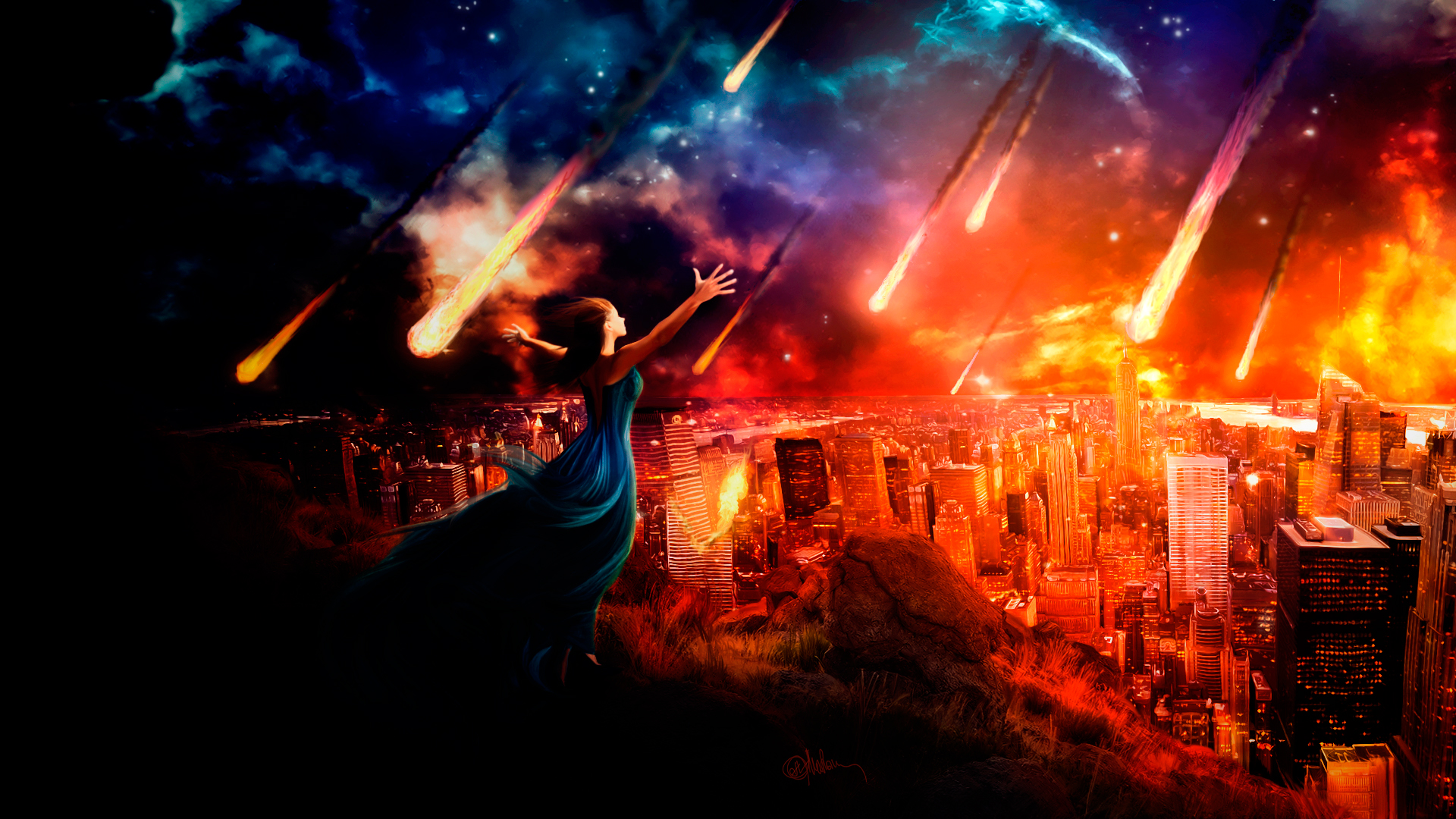
Source. Ahhh. a destroyed New York. It is as soothing as peting a fluffy kitten. Made of rainbows.
Or, just maybe, it is because we are playing through our nightmares and trying to defeat them. One theory about dreams suggests that the brain creates them partly to play through its fears and develop alternate coping strategies, solutions. Dystopias, strange as it may sound, are always about surviving. If you can think of a dystopian story with a genuine unhappy ending, bring it back. The rest of us will wait.
As for me, I love thinking about, experiencing, and talking about every possible way the world could end, and what it would look like. I love it. Odd technology, traumatized characters, personal interactions that matter to survival instead of just existing to amuse, a cut-throat world, and, ultimately, a crazy kind of hope that makes protagonists persevere: these are ingredients of epics, both great and minuscule, and in the dystopia, they get a special sharpening. I think what keeps me coming back to the end of the world is a mixture of all of these things, of the factors that make us as people long to explore them, and the challenge of making it realistic. Expect more end-of-the-world/evil world settings as you keep reading my releases.
Well, every love song needs a coda, and I have come to mine. Unless the world actually ends, and we end up huddled around campfires again, you can expect a steady supply of these settings in entertainment for years to come. Until then, I'll be working on this hydrogen-cell-powered double-engine deathmobile, just in case. Actually, before you go, could you pass me the duct tape?
Thanks for coming to visit again. More hilarity and occasional brilliance can be found on Twitter, at SciFiMagpie. Until then, this is your SciFiMagpie, over and out! Unless, that is, you want to trade some fuel cells for sexual favours and this cabbage...

Saturday, 19 May 2012

The Long-Awaited Tease

Hello hello, everyone!


Well, as those of you who've been reading for a bit know already, I have a novella by the name of "And the Stars Will Sing" available on Kindle and now, Smashwords. Here are the links to that, in case you missed it:

Kindle

Smashwords

Since it has lots of amusing dialogue, space pirates, a charming romance, and alien cuisine, you should go download it now, and review it, too. I'll wait.

Now that that's done, I'm going to let you in on a taste of what's to come. Back on Terra, at the other end of the galaxy, a friend of Crystal's is slaving away at an Orwellian workplace filled with peace, love, and light.


For the one-hundred fifteen-thousand, six-hundred ninety-fourth time since she'd begun working at the Langplex, under DOLMAC, Sara wondered why she'd taken the job. Once again, the usual answers presented themselves: I needed money, life on Luna was sucking because they made all those infrastructure cuts, I wanted to see more of the solar system, my Literature degree was only in demand out here, Tranquility University was having budget cutbacks...blah, blah, blah, blah. And still, a job at one of the hole-edge diners was starting to look pretty good...

Just then, someone knocked on the door, interrupting her mental bitch session. “Come in!”

“Hey,” said Julia. “How are you?” Sara’s blank face relaxed. Julia quietly closed the doorlet.

“Umm….what am I supposed to be doing again?

“I think you’re writing a recommendation on whether or not Heartbreak House should be totally eliminated from the Shaw canon, or whether it can be modified enough to maintain the integrity of spiritual love without the suggestion of too many base, unevolved sexual desires.”

“Wow, Julia. Your grasp of the TorYoBiKo never fails to amaze me,” she said, confining the irony in her tone to a delicate suggestion.

“Well, must maintain the image of orthodoxy, musn’t we?” Julia mouthed. “Watch out or they’ll can you. Try to fake reverence, Sara, or they’ll never let you out of here alive.”

Sara beckoned to Julia with one crooked finger. Julia slipped over and behind her. Onscreen, Sara typed,

Somehow I doubt that. Anyway, I can think of a few people who’d get plenty of shaudenfreude out of that. Fuck it, Julia, let’s have some fun. Round up Andie and Trops after work. Let’s go out for a drink.

Julia shook her head and shooed Sara’s fingers from the keyboard. Deleting everything that had just been written, she typed her response.

Will you at least pretend to do some work? You don’t want to lose café privileges. If you have to work in solitary for any length of time, that’s a black mark on your record.

Julia shook her head, and Sara skirted her away.

Yeah, right. Miss the blandwiches for a month? I’m shaking in my grav boots, baby. Loosen up. I have to go kill Bernard Shaw. Are we on for after work?

Well, you know about the alcohol rationing—

Fuck it. There are other things we can do. Not even coffee?

Did you forget about the embargo on products from Phoebus?

Chikusho! Yes, I did. Right. Tea? Or we could get some rotgut.

Are you swearing in Japanese to impress me?

Oh, Julia, honey, why do that when I can swear in German, too? Ch gebe nicht einen Scheiß! It’s all about flouting regulations.

You’re going to be fired. And so am I, if I don’t run. Seven o’clock at the Old Museum?

You got it. Now I have to delete this before someone sees it. They’re all Corinthenkackers, anyway. 

Okay, okay, extra points for the untranslatable pun. Aren’t we supposed to be killing words like those?

No shit.

Gotta run.  Don’t get into too much trouble.

Julia slipped out, straightening the folds of her uniform for a moment. Returning to her own cube, she glanced around, and Sara watched her disappear. So far, so good. Not too much time lost: she would be able to stay under the radar, unlike last week. Julia could be officiously rule-abiding, but that didn’t mean Sara wanted to see her get in trouble. 


...and if I see some comments, you guys will get another excerpt! So, get writing, people! Wordthieves, the story this excerpt was taken from, will be up on Kindle and Smashwords soon. A release link will be up on the blog as soon as it's done. Keep your eyes peeled!


Well, that's the long and the short of it for today...for more updates, funny crap, and interesting things, follow me on Twitter, at SciFiMagpie. SciFiMagpie, over and out!

Saturday, 3 March 2012

Wordthieves: An Intro

I promised a few teasers about a work I'm currently editing (read: putting the boots to) that will be related to And The Stars Will Sing. Well, this much more grown-up work is called 'The Wordthieves'...and that's all you know about it so far. So, I'm going to tantalize you by telling you about the idea behind the idea. 
There are as many different visions of the not-so-far future as there are authors in science fiction. However, quite a few of these visions tend to overlap in a science fiction world type known as the dystopia. I absolutely love dystopic, post-apocalyptic fiction. The Giver and Gathering Blue by Lois Lowry formed my first introductions to this sort of world. After these baby steps, 1984 by George Orwell, Brave New World, Farenheit 451 by Ray Bradbury, and The Handmaid's Tale by Margaret Atwood continued the slow journey into the end of the world and what happens after that. 
Then, I found myself wondering about a different kind of dark world, beyond the governments ruled by an iron fist and overt violence, such as V for Vendetta's setting. I hungered for diversity--surely not every government would be soul-crushing in the same way? 

Happiness (tm) by Will Ferguson powered the curiosity, really, and gave me a good lead. Being surrounded by a very interesting dominant culture in my second-year university classes gave me the rest of the direction for my setting. You can only be surrounded by New Age-y Neo-Buddhists in a department ruled by an iron fist for so long before you have to go eat a steak and make fun of Jung. Meditating, talking about chakras, and discussing self-actualization as you investigate life trauma will drive even the most patient people up the wall eventually. I'm patient, but I wasn't patient enough...

Anyway, I started to wonder...what if...the 'nice' people, like vegans and hardcore hippies, became the ruling heads in a totalitarian regime? 

More seriously, the current political situation in America, with the religious right's frantic suppression of contrasting ideas, provided further food for thought. Atheism and freethinking are on the rise, along with other dirty hippie liberal egalitarian pinko socialist ideas like gay marriage, but the old systems are putting up a good fight. However, much as I tend to spend a lot of time on the left side of the spectrum, it's impossible to avoid noticing that rhetoric-spewing nutbars exist in every part of the political spectrum. So, say that certain elements of the liberal continuum finally won out in the ideological wars...how much would they end up mirroring their former opposition?
These are some of the questions I've explored in Wordthieves. It started as an homage to dystopias and dark science fiction, and became something more. I hear you screaming, 'what's the plot? It's nice to know what inspired it, but tell us what we're in for!" 

Well, friends, let's say that it involves some of my signature wit, hamsters, coffee, foreign languages, hipsters, and tofu. Lots and lots of tofu. Are you scared yet? 

Tune in next time for more hints, sneak peaks, and more thinky talky things. And don't forget to follow me on Twitter, https://twitter.com/#!/SciFiMagpie and to share this blog on Facebook and with friends! 
Google+