About Me

My photo
Author of queer, wry sci fi/fantasy books.
Showing posts with label ethics. Show all posts

Friday, 30 August 2019

Political Oroboros: Why Marx Is Not Enough


First of all, I realise the title of this piece is inflammatory, so let me lay out some caveats.

I am absolutely not conservative. (One of the first things to know about leftist fighting and discussions online is that 'liberal' has two different meanings; the broad sense in which conservative commentators use it, and the more specific and technically correct sense that leftists sometimes use it - as well as the tertiary sense of, "anyone who isn't quite radical enough.')

I wouldn't necessarily call myself a liberal in the sense of condoning a capitalist system; I do find the most common ground with proponents of democratic socialism. However, some elements of communist ideology do seem solid, although I tend to like many of the ideas I've seen from anarcho-syndicalists more.

Confused by those terms? You're not alone, but some of the hippest trends among the youth of today are not just trap music and street wear - it's political and philosophical discourse. Different streams of communism and anarchism and debating the concepts of idealists through the ages is pretty great, but treating those ideas as a firm road map and, perhaps, the only acceptable solution or map, is not so excellent.

After several weeks of careful surveillance and investigation, I also came to some unsettling and unsavory conclusions.

Source 

There's a weird and disconcerting mix of progressive and regressive ideas in this new wild west of a political movement; using "gay" and "retard" as insults in this year, and talking about second-wave feminist gender concepts (Penis =  man! Vagina = woman! are not scientifically validated ideas anymore, even if they have held sway for a long time) as though they're based on reality is...a special kind of confusing, frankly.

The person mentioned below isn't actually the "leader" of Antifa (antifacism is a general belief and approach, not an organization; the Black Bloc is something different) but the points they're making shouldn't actually have to be made. And yet, here we are. (To clarify: this person's opinion is, as far as I'm concerned, correct, because it's a summary of historical facts.)


We can try to tweak the perspective on things and change the way someone is seen, but facts have this tendency to assert themselves. And when those facts take the form of thousands of dead bodies, politely covering them up or scootching them out of the way is a bit harder. In the case of leaders such as Winston Churchill, it's been easier to laud their successes and forget the death toll because they were victorious, but it doesn't erase his contributions to the Bengal Famine and his decision to test gas weapons on Kurdish villagers.

Yet even when we debate the value and leadership of dictators, history tends to reassert itself.

“History isn’t like that. History unravels gently, like an old sweater. It has been patched and darned many times, reknitted to suit different people, shoved in a box under the sink of censorship to be cut up for the dusters of propaganda, yet it always—eventually—manages to spring back into its old familiar shape. History has a habit of changing the people who think they are changing it. History always has a few tricks up its frayed sleeve.” ― Terry Pratchett, Mort

Nobody is good enough


Of course, just because someone agrees with history (!) and is willing to unflinchingly consider mass murderers as guilty of their crimes doesn't mean they'll avoid participating in the cannibalistic discussions of leftist politics. A particularly difficult issue has been criticism of the Youtuber Contrapoints, who has both been lauded for her very real effects in de-radicalizing extremists, and criticized for fumbling her way through understanding non-binary genders (and struggling to deal with the flood of online criticism afterwards.) But merely liking a figure who is problematic (or worse, Trash, if they have failed one time too many) can be grounds for a friendship breaking up or the sort of extremely tense, stressful discussion that keeps one awake for hours afterwards.

As I said on Facebook one night, "Whiny comment of the night: it would be easier to unite the left if the radicals weren't so dead-set on everyone just converting to their beliefs as much as possible.And Seems like you can learn about Marxism, cultural history, feminism, and all of that...but it's impossible to unlearn American cultural hegemonic approaches and seeing violence as the default/best option."

But to clarify, this isn't speculation without sourcing. I did a bit of an investigation into a few leftist pages, and it was really unnerving to see the number of pro-gun and "eat the rich" and "fetch the guillotines" sorts of remarks and posters. The thing is, we've all done that dance before, and it's going on in other countries at the moment. Riots and protests are excellent when they work, but sometimes, they don't - and we don't talk about what happens when they don't.

The risk of small government


At the risk of sounding like a cranky old lady, smaller governments are still governments. People who think some military junta of kids with guns can replace all the architecture and organizational levels of "the state" are welcome to try working in a city planning office as an admin assistant some time. Having done that myself, I would welcome anyone who wants to just replace and rewrite all those land laws, which by the way exist for reasons, to maybe take a civil engineering course or two.

And if you DON'T want to replace all that architecture, just get rid of the bad stuff - congrats, that's actually just reformism, which is still a far cry from "just accepting things the way they are."

As a fan and casual scholar of cults, I've had many opportunities to see examples of small, ideologically-driven communities turn rotten. Frankly, I wouldn't trust my own town to just secede and govern itself, even though I'm very pleased with our mayor's decisions. I know too much about white people and sociology and Christianity (as well as other religions and groups) to trust that small, self-governing, autonomous groups will be fine on their lonesome. We're kinda in a globalized society with many, many supply chains. If you don't like that, get working on a time machine.

Yet even if one were to travel back in time, we've always had international trade and whatnot, and isolationism has never worked especially well. Also it's how you get fascism in the first place, so...history says it's how you make the exact monster you're trying to fight. Worst of all, these defenses of fascists and murderers do nothing but divide us along sectarian points of conflict.


What do we do? 


Honestly, my approach lately has just been to ignore Leftbook and debate spaces and not engage. Trying to discuss theory and concepts has led to some arguments over the applications of violence that have, honestly, made me stop trusting and just lose certain friends altogether. One otherwise brave and locally committed person said, "violence is neither good nor bad. It's a tool." Although I agree that self-defense actions are not exactly violent, I just don't think we should glorify aggression, or be eager to shed blood. It tends to lead to bad results, and it's uncomfortably similar to the stance we're opposing. My take?

Personally, I don't trust anyone who thinks the problems will all be fixed if we just kill a few of the right people.

The people who sit around day-dreaming about 19th century revolutionaries aren't necessarily the ones helping to, say, actually fight the battles that need fighting here and now. It may seem ridiculous to say, "hey, watch out for this," and also, "but you can basically ignore it," but frankly, that approach has worked extremely well for me in real life.

The key is this. What do you want to accomplish, in practical terms? Forget about "praxis" and "theory"; what are the concrete, fundamental changes you want to see, and the results you want in society and your community? Every change comes incrementally. Evolution is unavoidable. However, we have an existing system that we can use - and dare I say it, that we can apply our strength to if we're determined enough.

How to change the world 


Writing actual letters to politicians in my city, province, and country, engaging in the community fight for preservation of a local Safe Consumption Site, signing petitions for various environmental protection causes, and applying pressure to politicians, as well as keeping an eye on actual local white supremacists, fascists, and extremists has done more and had a greater impact than anything in my decade or so of arguing with people on the internet.

My only regret is that I didn't start using my skills in the real world much, much sooner. It turns out that all the people who insist that those in power won't listen to "us" are, unequivocally, wrong. And while I do have white and cis privilege to thank for some of my results, I would also argue that we on the left must not presume our own helplessness and confine ourselves to training arenas online.

Get out there. Talk to politicians. Stay up to date on the news and follow multiple sources, rather than reading 150-year-old essays. And above all, embrace the power of both individual actions and solidarity.

I have more to say about this topic, but instead of creating another series, a few essays may be cropping up. Until then, however, I have real work to do, both in the political world and out of it. For one thing, books aren't going to finish themselves!


***
Michelle Browne is a sci fi/fantasy writer and editor. She lives in Lethbridge, AB with her partner-in-crime and Max the cat. Her days revolve around freelance editing, knitting, jewelry, and learning too much. She is currently working on other people's manuscripts, the next books in her series, and drinking as much tea as humanly possible.

Find her all over the internet: * 
OG Blog * Mailing list * Magpie Editing * 
Amazon * Medium * Twitter * Instagram * Facebook * Tumblr * Paypal.me * Ko-fi


Monday, 24 July 2017

Diversity Isn't Enough: The Importance of Radical Inclusion

Hello hello!

Well, a friend of mine has now been to 78 agents and gotten as many rejections. Surely, this indicates that the book is simply Not Good Enough, right?

That's the thing. I've read it, and the book is excellent. Featuring a character with PTSD, who is both gay and from a mixed heritage background, it's full of funny moments, intelligent thought experiments about robotic consciousness, and has a very solid mystery through the core. The cast is populated by well-rounded and differentiated characters - of mixed abilities, genders, ethnic heritages, and sexualities. And in this setting, their societal and work crew composition is pretty normal. So in addition to featuring a robot love story and a murder mystery, there are plenty of moments where the night crew assembles, and a deaf character sits at a table with a young hijabi clinic worker and her mechanic girlfriend, and two divorced people who remain friends, as well as the main character - all so they can play cards in the park, out of the sight of a nearly omniscient AI.

The thing is, while audio-visual projects - which often spring from book series these days - such as A Wrinkle in Time, American Horror Story, Sense-8, American Gods, The Adventure Zone, Welcome to Night Vale, Penumbra, Who Fears Death (Nnendi Okorafor), Steven Universe, Blackish, Dear White People, Master of None, Switched at Birth, Fresh off the Boat, Luke Cage, Dark Matter, The Expanse, and Westworld include cast members of many shades, there's still a focus on able, attractive, mostly straight people - not to mention that in more than a couple of these, white characters still end up dominating front and centre roles. Yes, this is getting better, but there seems to be a genuine fear of addressing the (surprisingly large) populations of trans and genderqueer, aromantic or asexual, Deaf, visually impaired/blind, and visibly and invisibly disabled people. Not to mention that a lot of these populations intersect. I personally know plenty of people who are people of colour, genderqueer, and disabled. I've read articles by a surprising number of genderqueer, mentally ill people of colour. Add present and former sex workers to the mix, and you have a pretty good sampling of humanity.

So what's the problem?


The problem is that these diverse shows, which are not radically inclusive yet, are only the tip of the iceburg. Producers and studios and publishing houses tend to hire just one or two people to demonstrate their wokeness, and keep the rest their content steaming along as though it's business as usual - teen YA love triangles, stubble-covered male power-fantasy thrillers, gritty sex murder mysteries, soft and juicy chick lit, spicy supernatural sex romps, and tooth-gritting fast ship space porn.  I've edited these books, read them, and enjoyed them - but the fact remains that the market's determiners keep orienting themselves to what they think is a safe bet, an easy seller. 

We still live in a world where an alternate history series where the South won was greenlit by HBO. So yeah, Nnedi Okorafor's series is getting a production deal, but so is a slavery fantasyland series. So is Ready Player One, too. A Minecraft book by Max Brooks is at the top of the bestsellers right now. So yes, diversity's making inroads, but The Problem Is Not Fixed. Radical inclusion, i.e. just treating people like people, and writing stories where non-white, non-able, non-cisgender, non-heterosexual, non-Christian people are allowed to exist and be in starring roles is absolutely revolutionary. 


Ready Player What, now? 


For those not familiar with RPO, it's basically a pop culture slurry of references; another Teenage White Boy Saves The World book, with virtual reality, and somehow he's the only one who knows Stuff About the Eighties - and Steven Spielberg is attached. You'd think he'd pick a more challenging project or have better taste, but no, fanboy fantasy it is.

The biggest problem is that people think Ready Player One is like, subversive somehow? Or self-aware? But it absolutely isn't. It's sincere. Max Brooks is one of the guys who launched the zombie craze--he's very good at commercial writing, to the extent that he's actually a Name, but yeah, he's not exactly known for challenging or artistically mold-breaking projects.

And all of this would be fine, except that it, and the dozens of imitators who crop up to try and skim that flavour, crowd out the more innovative and interesting projects.

Is this another Commerce vs Art rant? 


Absolutely not. It's not that Commerce and Art are Enemies. Heck, it's *fine* to monetize the daylights out of something. Art's relied on Commerce for basically all of modern history. If it wasn't Commerce, it was religion. But - the problem is *how* those selections are done, and the way people trust their preferences to be free of bias. Which just isn't the case.

It's OKAY to have biases. The problem is that we treat a certain kind of bias as objective, and it gets far, far more sway over the stories that get told than anything else. To the point where just including people is considered revolutionary and gamechanging. Simultaneously, there are so *few* of these inclusive stories that individual properties are often torn apart for being 'not good enough'. Yet meanwhile, mainstream stories with sparkling white casts somehow get a break.

But including people is how you GET different kinds of stories. Now, to be clear,  I LOVE the Hunger Games. A lot. But we have a market where agents are like, 'eh, this sold, let's get ten more that are basically variations of this flavour'. There's very little willingness to risk the core of the market, and it becomes a self-fulfilling cycle of, well, crap. 

Like, if you go to a corner store you can buy some chips. And chips are good, I like chips, but even if you put zesty spice or cool ranch or sour cream on them, they're *still* chips. they're not zucchini chips, or sweet potato crisps, or whatever, ya know? The problem is that the market tends to focus on chips, and assume nothing else will sell...

Wat do? 


The solution is simple. Readers have to step outside their comfort zones - unfortunately, the readers who might not even read this blog are the ones I'm addressing - and writers and publishers have to band together. There is definitely a need and an audience for diversity, and moreso, radical inclusion. People often talk about 'not seeing colour', which is an issue I won't even get into right now, and complain that they want stories that are 'normal', and aren't focused on 'identity politics'.

That's the most bitter irony of all - these stories exist, and they're fun and delightful. And yes, inequality issues do crop up in some of them, because of how those issues affect people's lived experiences - but a lot of the time, people across the ability, gender, ethnicity, and sexuality spectrum just want to have fun.

A transgender plus-sized psychic lady who talks with the dead to solve murder mysteries? Yes. A deaf Chinese-American engineer who discovers the secret to time travel and accidentally changes the course of history? Definitely. A love story featuring an asexual mobility-impaired Indian woman and a Zulu warrior king from an alternate world? Why not? 

***

Thanks for returning to the nest. Leave a comment and say hi! I want to hear from you. Keep up with the new releases by getting on the mailing list. Buy my books on Amazon, and keep up with me on TwitterFacebookTumblr, and the original blog. This is the one and only SciFiMagpie, over and out!

Saturday, 18 February 2017

God's Away On Business: Moral Ambiguity in Sci Fi

Hello hello!

Been a while, hasn't it? I have an enormous backlog of ideas, but I'm letting my fragile brain rest after completing a draft of The Meaning Wars, so that means it's time to return to my blog. I'd love to write more often this year, and any reader suggestions or requests for content are very welcome. What do YOU want to see?

Until I know the answer to that question, I'm going to share some thoughts that are, shall we say, pertinent to the current sociopolitical situation in the world. Specifically, when it comes to science fiction, who calibrates the heroes' moral compass? To understand authoritarian organizations and to resist them better, it doesn't hurt to look at a couple of the 'nicer' examples. It's hard to fight what one doesn't understand, and unlike a Lovecraft story, fainting isn't going to get us out of this situation. So let's talk about goodest of the bad guys!


Who are we rooting for?


Sure, it's easy to romanticize the rebels, but what are the consequences of that action? I'd argue that giving protagonists in dystopian fiction carte blanche in terms of resistance methods is a bad idea. People have to do what they have to do, but let's be honest about those actions and their cost. Still, doing the nice things or not punching Nazis isn't always an option. Every dictatorship story requires a cast of tough, ethically grey people in the spotlight, because the nice people tend to be the collaborators.

In the case of The Hunger Games, the resistance movement has some very fractious members who seem keen on seizing power. In Rogue One, it's clear that the Alliance isn't as tidy and unified as it seems in the later films. Cassian's actions, which I won't spoil, also make it clear that horrible tactics aren't out of the question. In my beloved Farscape, the storyline soon makes it clear that while Peacekeepers are sometimes hypocritical or oppressive, they do have some ethical standards, and are still often less evil than some of their employees or collaborators. However, standing up to them drives the characters to steal ships and sabotage infrastructure, as well as kidnap people. Sometimes they even just walk away from a situation when the more morally correct answer would be trying to interfere and support the people in fixing it.

However, the balance between altruism and self-preservation in dystopian settings is one of the things that makes them so captivating. Therein lies the appeal. As in real life, even good people have to make bad decisions, and the lingering popularity and love for Firefly over a decade and a half later show that people need imperfect heroes. But one of the interesting things about the show is that the organization the heroes are resisting, The Alliance, isn't...all bad, and the heroes are highly questionable.

 And Mal isn't exactly a portrait of consistent ethical actions and good decision-making, so the Firefly crew certainly count as somewhat unreliable narrators. The treatment of Shepherd and Inara is really unsettling, and the show frames them both as somewhat whiny or demanding - even when they are being reasonable.


Not bad (Or even drawn that way) 


The Alliance allows sex workers to control their own situations and at least tries to make sure colonists have food. Obviously, the secret science torture program and the initiative that created Reapers are bad, but the rest of the systems exist in a functioning democracy that doesn't have to bow to warlords like Niska, To put it another way, there aren't all that many differences between The Alliance and Starfleet.

In the context of authoritarian benevolency, Starfleet deserves a mention. They do have a lot of power within the interspecies alliance, and sure are happy to let their somewhat colonialist explorers to regularly break the Prime Directive ('we don't interfere except that it's what we do on every episode').  They have good intentions and mostly function well, but have done some really sketchy things. All governments have dirty laundry. It doesn't justify crimes against humanity, but what about times when crimes against humanity are the 'solution' to taking down an enemy? Certain events in Iraq and Afghanistan come to mind, and the Japanese internment camps of WWII or the bombing of Hiroshima and Nagasaki are vitally important real-world instances.

The ends of taking down an oppressive state may justify the means, but how far? The collaborators deserve what they get, but how far does that go? There is a point where the demand for justice shifts into a thirst for revenge, and the reasons for this are perfectly understandable. The thing is, a state IS its people. Rebelling against the state does also mean fighting people with wives and kids and pet dogs at home. Yes, they chose to be there, but questioning why and how can also help prevent further mobilization of bigotry and injustice. If, that is, the (usually white) heroes can restrain themselves from gleeful payback time.


The price of peace and stability


One of the reasons dystopian governments are often very controlling is that it's perceived as the trade off for mere survival. Warhammer 40K and the Cthulutech setting both make use of this, so that there are no 'good guys' and one ends up rooting for the totalitarian side just because they're ultimately working for preservation. In this respect, there's an uncanny overlap with a lot of rebel factions, in that ends do sometimes justify the means.

Sometimes, however, the price is far greater than the results; the populace in 1984 is in poor health, tends to die in the army, and is very ignorant. At least many dystopias, such as the one in The Giver, try to justify their techniques by pointing to the over all health and sustainability of the population. Even then, the government in 1984 is very ineffectual in its way. It's NOT a stable system. The government keeps a huge chunk of the population ignorant and keeps the intellectuals working so hard on propaganda that they can't question what's going on. The crumbling infrastructure of plugged sinks and stinking cabbage and food shortages - in contrast, to say, the Alliance's elegant infrastructure in the Core - shows how badly this particular system is running.

Are dystopias hyperbolic and foolish?


However, all of this may sound very objective and distant, a problem that does plague sci fi. Talking about monster hoards and invasive alien species and plagues and sexual and reproductive control can feel ludicrous in the context of current events, which aren't usually as lurid. And sometimes rebelling in fiction quells the urge for real action when necessary, imply naysayers.

There's a lot of salt and contempt for dystopias these days, partly because people assume that they are frivolous make-believe experiments in losing privilege for mostly white readers. That's not entirely without merit, but considering how many dystopias are aggressively post-racial and diverse, I'd argue that it's more about showing oppression in more than one context.

And finally, fiction offers opportunities to explore both sides of a discussion without having to invoke real atrocities or cheapen them, which can be stressful for survivors. Israel and Palestine's relationship certainly looks like a modern-day dystopia, not to speak of the current American government, but trying to talk about ethics in that context seems insensitive at best. Fiction allows us to explore possibilities without exacting a human cost for the experiment. And because of that safety, understanding how the rise to power happened can just be easier and less horrible when viewed through the lens of sci fi. And that is important, because seeing institutions as a group of people rather than an immobile and immortal bloc also makes them easier to defeat.


***

Thanks for returning to the nest. Leave a comment and say hi! I want to hear from you. Keep up with the new releases by getting on the mailing list. Buy my books on Amazon, and keep up with me on TwitterFacebookTumblr, and the original blog. This is the one and only SciFiMagpie, over and out!


Sunday, 20 January 2013

A Shady Dive: An In-Depth Analysis of The Bioshock Games

Hello hello!


Well, I'm definitely late to the party on this one--last Sunday involved far too much work and phuquerie. However, I'm here now, and ready to give you what you really want. That's right...it's time to bear it all, for...THE BIOSHOCK REVIEWS!


Andrey, the long-suffering and patient gamer and partner, lets me sit in when he plays an RPG. When he finally bought Bioshock 2 on sale, and mentioned that Bioshock Infinite will be coming out in a few months, I decided there was no time like the present to remind the internet why these games are amazing and worth a replay. Sure, they're well put-together, but you've already read the blogs about combat mechanics and design. Today, we're going to use brains.

Hey! Come back here! I promise it won't hurt. Put down the crucifix. That's better. Now, let's get cracking and figure out why we all love these damn games so very much. There's more to it than the gameplay, I assure you.

The review is loaded with spoilers, so if you haven't played it yet, look at the pictures and skim read. Play the games, and THEN get back here to enjoy the discussion. Good? Good.

One more round. SPOILERS SPOILERS SPOILERS! SPOOOOOOILERS! There.

So, why is Bioshock so interesting and so appealing? 

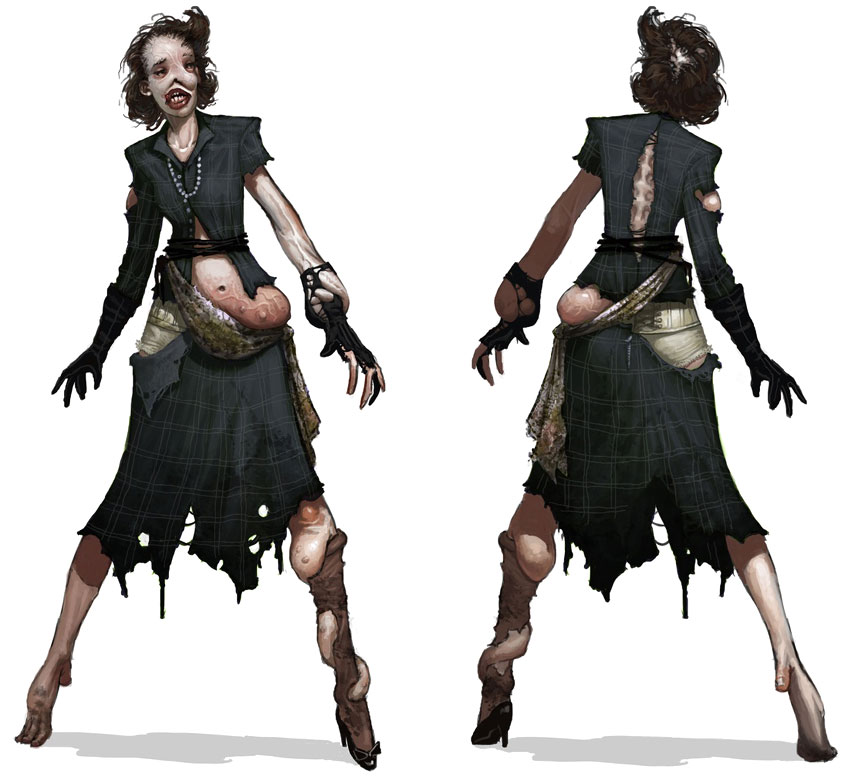
Most people, when asked, will shrug and cite a good storyline, or the gorgeous dieselpunk (not steampunk, thank you) setting, or the fact that you get to clomp about in a giant freaking tank suit. The design is admirable, and we'll get to it in a moment, but there's a lot more to the games than scary little girls and freaky, deformed monsters. Whether you've played these games or not, we're going to find out why they're good. By the end, you'll know why you need to either a) run back to your computer and replay them, or b) find a friend who likes to play, and sleep over at their house until they finish a marathon of both games and you dream of roaring bronze monsters and crave sushi constantly.

So, what's the big deal?

This.


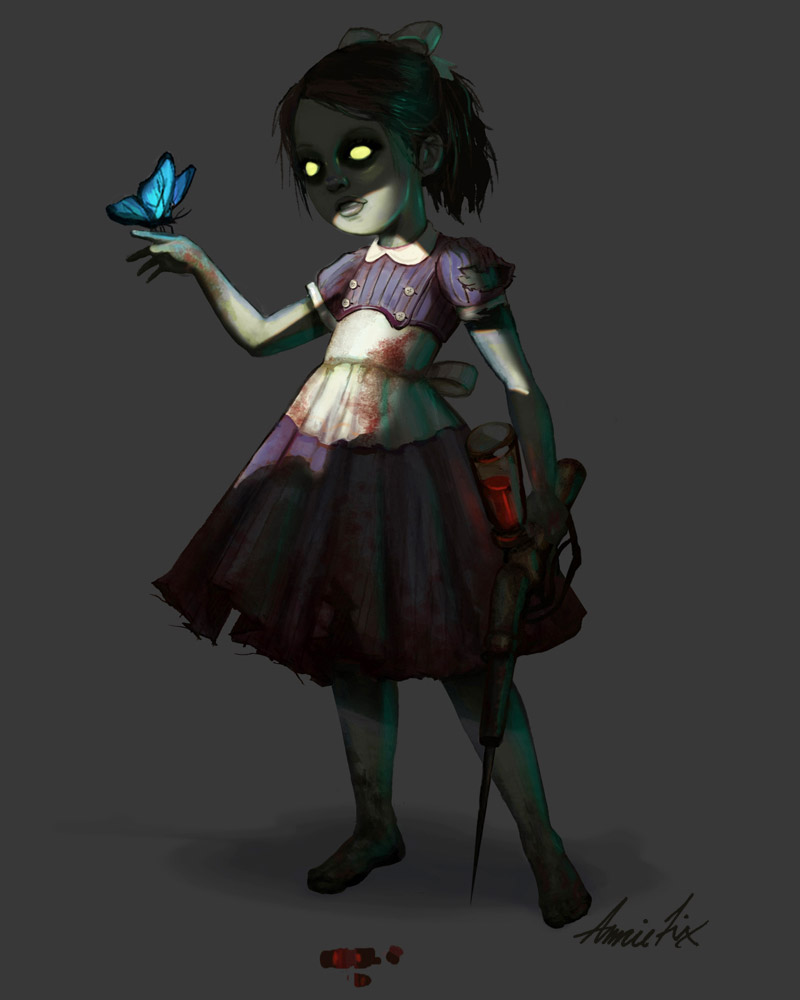
Source. Welcome to Rapture. Population: who knows, but they all want to kill you.


First, it's too damn pretty to ignore. 


We'll start with the aesthetics, because they're easy. For those unfamiliar with dieselpunk, the descriptor is best applied to that between-wars look with lots of rivets and shiny bronze and brass. There's a decopunk element as well. Artistic elements in Bioshock all match the game's themes, taking the gloss and elegance of an earlier era and twisting and warping it. The leaks in Rapture represent the holes in any ideal paradise, and like a classic dystopia, the things that made it elegant soon become horrible. The grand city no-one walks in, the moulding wallpaper and grim-eyed fish swimming around the towers, call to mind Cthulu and Dagon as much as Atlantis. In this modern Atlantis, with its Greco-Roman themes, the effect is closer to Limbo than Heaven.

The ideals Rapture was founded on are just as leaky and imperfect as the city, and are, at their extremes, just as much of a deathtrap. They belong to an earlier era, and are preserved there, unchanging. We all love seeing beautiful buildings and settings, but seeing them destroyed is even more appealing. When you get into the head of a Little Sister in Bioshock 2, and you see the world through their indoctrinated eyes, everything is well-lit, luxurious, and elegant. Seeing the world without the girl's eyes in the way only heightens the effect of the nightmare, and I couldn't decide whether the falsely sweet image or the ruins were scarier. There's something compelling about gorgeous ruined buildings. It's a sort of poke at mortality, not just our own, but the eventual inevitable mortality of culture as well. We know it will all be over, and seeing it in an imaginary way is irresistible.

There's all that stuff about peering into the abyss and it looking back to you. In Rapture, those metaphors have a nasty tendency to get literal. It sits on a precipice both figuratively and literally, lost in its own conflict and ultimately doomed, rather than being the intended precipice of a new era. The only 'hope' is a lighthouse in the middle of the sea. Think about that. The middle of the phuquing sea. Who's going to find it? Rapture is a dead end, as any paradise is, and the long hallways that lead to corpse after corpse only confirm this. However, as with any near-death experience, Rapture also offers rebirth for both your character and a few other decent souls, like Tenenbaum. In this way, Rapture is also a womb, another symbol linked with the sea and death.

But wait, there's more! Act now!


What really captivates in Bioshock, though, is the literary merit and moral struggles. An underwater war of morality with few clear rules is interesting enough, but the literary and cultural references really make the game. It's the ultimate showdown between Ayn Rand and hippie Communist neo-Buddhists. No, really. Both Bioshock games focus on societal theories and what happens when they're enforced as perfectly as possible. I'm not the first commentator to notice this, but I'm not going to jam the literary references down your throat the way most commentaries do. Good? It's okay. You can come out of the corner of the room now.


Freedom Will Kill You: Bioshock 1


In Bioshock 1, we're introduced to Rapture. Andrew Ryan, your standard mad/eccentric gajillionaire, decides that he's had enough of them damn government controlling types and those assholes who believe in ethics. He decides he'll build his own paradise, with blackjack. And hookers. The thing is, Ryan also believes in freedom of all kinds in all degrees. The repression of the self is ultimately at the cost of betterment of society, the social support system breeds mediocrity, and that science should be allowed to advance unhindered. I probably don't have to tell you that the logical extremes of anything tend to be really, really poor decisions.

Of course, Ryan's attempts to give people ALL the freedom result in having to go in the opposite direction to quell the inevitable chaos, and Rapture turns into a police state, complete with martial law and secret police. The lesson is that fascism isn't actually that far from semi-anarchic libertarianism, and arguably, is one of the only possible direct results. There's sort of a Nietzschain theme here, with the 'every man kills the thing he loves' idea being demonstrated in heartbreaking clarity. Ryan wants freedom for all intellectuals, but he refuses to understand his actions' results, and therefore loses it.

The experiment was doomed to failure, but throw in selfish applications of science, and you have the reason Rapture unravels. The ideology was 'leaky' enough. When combined with the discovery of plasmids and ADAM, the access to instant personal enhancement and superpowers of various kinds really makes the system fall apart. Not only do people become addicted to plasmids, scientists develop a weapon to control the insane and mutated addicts that is just as horrible as the addiction's effects on the Splicers. I'm referring, of course, to the Little Sisters.


Source.  While evil little girls are nothing new, Bioshock reminds you that it'snot actually okay to kill them.  


The Little Sisters are followed around by their protectors, the Big Daddies, who were conditioned to be their protectors in the most painful ways possible. They're living examples of science gone wrong, logical extremes of experimentation when the test and results outweigh the method. The 'evil scientist' stereotype here is softened by Tenenbaum's attempts to free the girls she experimented on. In the first Bioshock, you literally become one of the monsters you're trying to save, and in the second, an indoctrinated 'ubermensch' girl who bonds with you shows the humanity beneath the terrifying mask.

The really interesting thing in Bioshock one is that the society starts as a lovely, civilized world, and it's science, technology, and growth unrestrained by morality that result in a huge leap backwards. The game gives us a nice tour through the corruption in Rapture, but doesn't really preach a particular doctrine while it condemns Ryan's philosophy.

Perhaps that's not entirely true--it does preach that there are certain lines of morality that shouldn't  be crossed. It's not that ADAM itself is evil--though the slugs do represent the fruit of knowledge--but the way it's used, for vanity and cheap thrills, is condemned. Most importantly, though, the game wants us to know that hurting children is bad. Really. The kids are cute, and you have countless opportunities to save the girls rather than ripping the ADAM-loaded slugs out of their throats. Getting a happy ending requires sticking by moral principles based on human decency. You can harvest the little girls for ADAM and get the power you need to defeat Ryan, but if you do, you'll pay for it and Tenenbaum will condemn you.


Source. Stare at this for a while and try to sleep peacefully. Good luck. I didn't.

Confessions of a Former Neo-Buddhist Infatuation and Psuedoscience Junkie: Bioshock 2


Of course, as we all know, the best solution to going too far in one direction is becoming an extremist in the other direction. Sophia Lamb, a psychiatrist, is brought to Rapture by Andrew Ryan in order to treat the population. Going against his doctrines and anti-religious, anti-compassion ideals, he imports the good doctor and she sets about going into full-bore psychobitch mode.

The doctor's techniques, of course, end up resulting in the development of a religious cult and Lamb deposes Ryan once he's passed away. Her followers are somewhat protected, but her package of love and self-understanding is still candy-coated poison. She's sort of communist, but her society's underlying morals are meaningless in effect; she ends up running a world too similar to Ryan's for comfort.

In addition to that, her attempts to create an 'ubermensch' daughter to 'redeem' the splicers, and the constant use of her blue butterfly symbol in-game feed into more themes. She refers to love as a 'chemical' process and continues the Evil Heartless Scientist schtick from the first game. Of course, Eleanor has developed a conscience, free will, and is not interested in Mommy's ideas about forcing people to be saved. She comes to you for help, invading your thoughts, and with the help of Tenenbaum and August Sinclair, justice is served and lives are saved. Oh, and Rapture finally falls into the abyss, taking the few Splicers you haven't killed with it.

We interrupt this examination of idealism to bring you...Daddy and Mommy Issues! 


I haven't really addressed the fact that the Little Sisters' protectors are known as Big Daddies. In the first game, your nameless chain-tattooed character becomes a Big Daddy with Tenenbaum's help, and after he kills his own father, Andrew Ryan, becomes a father to the Little Sisters he saved, raising them in the normal world and giving them normal lives. At the end, he dies of old age and happiness. The second game explores a mother's attempt to mould her daughter into something perfect, and their competition, as well as the way your character 'fathers' Eleanor the saviour. There's a bit of a negative portrayal of mothers in both games; at best, they're ambiguous characters with huge flaws. Father figures--Ryan excepted--are the heroes.
The fact that the game manages to dodge the 'creepy predator' or Lolita dynamic so well is testament to very careful writing, but even with the Big Sisters added to the roster in the second game, it's still a 'dads as heroes' bias. I'm not saying that's wrong, but I do think it's interesting that fathers in video games tend to be traitors, ambiguous characters, or absent. In a way, Bioshock returns us to a fairy-tale style morality system. Eleanor is even shown asleep in a glass chamber, with her 'wicked witch' mother standing guard and ready to strangle her. Not cool, game.

I'd like to see a lot more heroic mothers in gaming, period, but it's sort of nice to see the paternal side of the dynamic portrayed in a healthy, pleasant way. I do have mixed feelings about some of the heavy-handed applications of morals, though, and it still bothers me that the Splicers can be killed pretty indiscriminately while you save the girls. Ultimately, the hellish 'family life' of Rapture is something that can be overcome for a normal life, and even if you've done evil things, you're worth saving and redeeming (since you can keep Sophia Lamb alive). Still, there are some elements there that make me twitch, such as the 'little girls are perfect and innocent' theme. Hopefully, Bioshock Infinite will go in a different direction, though I'm fine with the 'killing children is bad' motif sticking around, personally.


Source.  More kick-ass armour is okay, though, in the next games. My only regret with the Big Sisters is insufficient playtime to try them out


So, why do we love it? 


In a world of RPGs that force you to come to your own conclusions and actually reward dickish behaviour, the non-judgement of Bioshock and its hardline 'don't hurt people' morality is really refreshing. There are lots of rewards for being a good person and lots of symbols and ideas to think about while you romp around, fighting Splicers. Even the most horrifying characters are granted a degree of humanity and have good reasons (sort of) for their actions. It's impressive, moving, and likely to make you tear up.

Furthermore, as I've explained, it's a game that will stay with you. I wouldn't have analysed all this--and neither would the other thousand or so bloggers--if it hadn't resonated with us, moved us. The replays are worthwhile just for the sake of enjoying the nuances. The antagonists and protagonists have layers. The voice acting is damned good. And ultimately, no matter how awful things get, redemption is there. There is a happy ending, where love triumphs and idealism doesn't matter a damn bit. The idea that common humanity can overtake all the crap we put each other through, that's something everyone across the political spectrum can enjoy.


*****
Thanks for dropping by the nest once again. Don't miss any of the good kind of crazy. Find me on TwitterFacebook, and on Tumblr. I've got a few reviews to catch up on, more news coming, and even some fantastic interviews with fellow authors. Stay tuned and please share. This is your darling SciFiMagpie, over and out!

Tuesday, 7 August 2012

50 Shades of Finished: Reflections on A Bad Romance

Finally, at long last, I have returned!

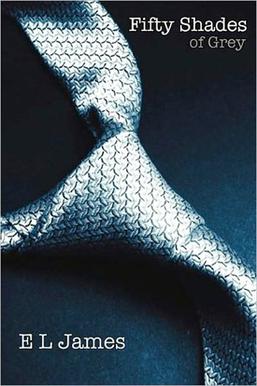
As those who have been following my Twitter feed for the last couple of weeks have discerned, I am finished the Fifty Shades trilogy. That's right--I've conquered Fifty Shades of Grey, Fifty Shades Darker, and Fifty Shades Freed. If you somehow missed out on the horrifying and amusing social phenomenon of the hour, I'll give you a brief run-down. Fasten your seatbelts and get a good, stiff drink: we're heading into the dark and miserable world of fan fiction.


Thanks, Wikipedia! Now I can advertise this thing that has been polluting best-seller stands at airports and convenience stores everywhere.


Fan Fiction. Hold on, people. We're about to go balls deep. Or ovaries deep, if you like.


Clker is my hero tonight. Thank goodness for fair use and free images of ovaries! This made my night.


I'm not sure how many assumptions I should make about you, my beloved readers; after all, given that you're on the internet and that you found my blog, you are probably familiar with geekery on some level. Just in case that isn't so, I'll explain what I'm talking about and why I'm about to throw a miniature temper tantrum. Still, I can't make accusations without a damn good case, and without a review of the evidence.

Fan fiction is usually composed in written media, though occasionally it extends to webcomics, films, drawings, paintings, and other media. The written stuff--everything from short stories to monstrous epistles longer than the source material--is the area I concern myself with.

What is fan fiction, and why do I care?: I'm going to to my best to keep this rant really short. Fan fiction is a polarizing and contentious area because it involves extending, modifying, or retelling existing stories, or the creation of new work within their universes. It exists in an awkward grey area of creativity, since it relies on not merely inspiration by, but actual use of other authors' and storytellers' creative property. Some of it is glorified shitastrophic porn. Some of it attempts to tweak a story to fit the author's own idea of how the plot should have played out; some of it retells the story in a different setting altogether. Still more fan fiction attempts to fill out the universe's plot holes and expand the world. It's impossible to fairly condemn all fan fiction, especially since some of it is created with the author's express permission. Lancelot was a late addition to Arthurian legend, and he adds a lot to the world. Lovecraft's friends often wrote in his universe, and helped spread the fame of the Cthulu mythos. Gregory McGuire, one of my favorite authors, retells and reinvents fairy tales as well as having created Wicked, an renowned reinvention of the Oz series. Clearly, then, fan fiction can lead to creation of something new, or add something to the world. What's the big problem, then?

Let's touch on that 'intellectual property' issue. Using characters in an unauthorized fashion and changing a story line technically violates copyright laws, as well as being in bad taste. Sometimes, leaning on pre-made fiction can be useful as a learning tool of new authors. All too often, it results in a perversion of the story that the original author finds downright offensive. This is a shame, and some authors go to great lengths to track it down and purge the internet of its presence. Others find it a compliment to their work.

Statement of bias: Personally, I am fine with stories set in the worlds I create, as long as the laws of the land are obeyed and consistent, and as long as the main story line and central characters I create are left out of it. Telling an author--not just me, any author--that you think your version of the main story is better when a few minor adjustments are made is, simply, an insult. Work can be based on a non-original idea, and a derivative can be really good or even better than the source, but something new must be brought to it. It is this that Fifty Shades fails at, and hard. Let the trial commence.


Wiki, you are the man. I'm a little teapot, short and stout, this is my judgment, just hear me out.


The crimes, and their degrees of guilt: Intent to imitate, 1st degree; borrowing of perfectly good ideas whilst not remaining true to their spirit, 2nd degree; hilariously poor descriptions plonked in the middle of sex scenes, 1st degree; poor, repeptitive sex scenes, 2nd degree; reckless failure to continue or properly handle side-plots, 3rd degree; and, finally, romanticising abuse, 1st degree.

The Prosecution: As stated previously, and by divers others, E.L. James borrowed her best ideas from the film Secretary, including the main character's physical appearance, her love interest's surname, the BDSM, and the Dominant blonde woman who ruins the male protagonist's life. Furthermore, James does so in a disreputable and awful fashion. Material was also stolen flagrantly from Twilight and its sequels; both crimes are committed and no credit is given. Also, she is guilty of some of the most hilariously awful mixed metaphors known to man, terrible plot structure, and using the term 'inner goddess' outside of a new age beauty manual. Defamation of the BDSM community and romanticising a number of unhealthy mental traits in an unacceptable manner are also serious issues.

The Defense:E.L. James' editor should have done something about this plot. Or, if something was done, more should have done. The story does differ from its sources enough to be on its own, and there are moments when it approaches insight and interesting sub-plotting. There is something underlying this, for all the poorly-implemented capitalist porn, that is interesting. (The capitalism porn stuff, incidentally, is eerily similar to some parody ideas I had about Twilight, which will be published in an upcoming blog.) Ultimately, there are moments when Christian Grey almost approaches a real, interesting character, mostly in the second book. It may not have been realised well, but there was a brief glimpse of something more lurking deep below the stupidity, and that is worth something.

Statement of the Judge:

Verdict: I'm going to have to agree with the majority of the intelligentsia and wits of the internet: this book series does, in fact, stink. It has moments of disgusting levels of anti-feminism, but the author does really try hard to make something worthwhile. She also published this as porn for herself, and was unapologetic about it. For all of its faults--and there are a lot--that deserves a little credit. Was it a good book? Not at all. Could it have been a good book? Perhaps; if it wasn't confined to imitation of the morally repugnant and hilariously awful Twilight series, or to poor and inaccurate imitation of a very fine and sweet film, Secretary. However, it was, and that--as well as blatant product placement and demonstration of disgusting levels of white privilege in mid-sex-scene--led to its ultimate downfall.

The Sentence: First of all, E.J. James needs to learn to write a coherent sentence, and when not to use fancy words from the automatic thesaurus function. I love words, and I love thesauri and idiosyncratic words. This was linguistic assault. Ten years hard writing labour and literary analysis of more than (gag) "Classic British novels" ought to do it. Shame on you, E.L.James, for profaning the names of Bronte, Hardy, and Austen. The books are sentenced to be read in the most hilarious fashion possible by Gilbert Gottfried, and to be mocked by the internet at will.


*****

Thanks again for tuning into my phuquerie. There will be more--updates about my writing, more feminism and literary criticism, and probably some movies. There might even be some politics and science! Keep an eye on new releases by following on Twitter and on Tumblr. This is your SciFiMagpie, over and out!

Friday, 20 April 2012

We Interrupt This Broadcast...

Hello, flock!

We interrupt our usual science fiction programming to bring you an important, if obvious message: pop music sucks.

Now, I can hear 90% of you crying, "why have you bothered to interrupt us with this terribly boring statement?" I'll keep this one short for the sake of not going over a topic that's been written about far too often. Still, there's something to say about it, and I want you guys to give it a few minutes of airtime on your own brainwave broadcasts.

You can blame Robyn for this thought trend; listening to her eponymous album, and a bit of Body Talk Pt. 2, I wondered why this Grammy-winner wasn't hitting the airwaves more often up here in The Great Multicultural North, Canada. Now, pop music being what it is, and retail zombiehood being what it is, I end up being subjected to popular music day in and day out when I'm at work. Virgin Radio is an especial culprit for overplaying the most recent big hits several times a day. When Gotye's Somebody that I Used to Know came on, I would breathe a sigh of relief before the next onslaught of Nicki Minaj hit me like an obnoxious tidal wave of cheap perfume and loud, poorly-applied make-up.

Now, I should clarify: I don't hate pop music.

Quite the opposite. There have been a few songs I couldn't help enjoying, of course--I am a sheepish Lady Gaga fan, I actually enjoyed Ke$ha's second album Cannibal a lot, and Usher's DJ Got Us Falling in Love Again is a song that makes me smile every time I hear it. I also enjoy old-fashioned hot jazz, Led Zepplin and other classic rock faire, punk, 90s alt rock, Leonard Cohen and other guitar poets like Neko Case, British soul-pop and rock (both Invasion era and modern), Canadian independent music, and a nice helping of Bizet every now and again. A pinch of thrash or some hip-hop complete my day. Point is, my tastes are at least somewhat diverse, and I'm willing to give almost any artist a fair shot.

Source.

Can't read her, can't read her, no we can't read her duck lip face. D-d-d-duck-face d-d-d-d-duckface muh-muh-muh-muh. I'm not even going to comment on the Justin Bieber I'm subjecting you to.

So why is it that Nicki Minaj, Bieber (shudder) and Pitbull make me homicidally annoyed and depressed about the fate of humanity? Well, it's not because people buy their mediocre work, or that they're successful. It's the fact that they are megahits. Now, the Spice Girls (anyone under the age of 15 might have to use Google to find out who they are) were almost equally mediocre, and they have not lasted. N'Sync also comes to mind. However much of a relief it is that these artists have had little-to-no staying power, their megahit contemporaries may be a bigger menace. No-one is saying that Nicki Minaj, for example, is a Great Artist, but to look at music stores and magazine covers, it's hard to find anyone capable of competing with her. The big companies are marketing her hard, and I think I've figured out why.

GET ON WITH IT!

Simply, the issue is this: stupid artists, who can sing and perform but aren't smart enough to cause trouble, are easier for them to advertise. Pitbull is never going to cause trouble by demanding to be seen as a legitimate artist in his own right. These singers are auto-tuned to death, and don't care about being taken seriously as creators of new ideas. We haven't had very many new ideas or approaches come out within the last few years that caught the limelight. It may be to early to tell--I hope--but the club music that's followed in the wake of that five-minute indie craze and the preceding wasteland of hardcore gangster rap we had in the early-to-mid 2000s hasn't given us anything new. In fact, quite a few artists who made their names in the 90s have been recycling their sound to make a comeback. And that is bad news for producing a good

Katy Perry, in contrast, may be heading in a different direction--for all the poppy sugar-coated fun and brainlessness of most of the Teenage Dream album, a good half of the album, which didn't hit the radio, was really dark and quite meaningful. Her most recent single, Part of Me, has an empowering, non-sexploitational portrayal of a woman joining the female division of Marines after a bad breakup. Given that this is coming in the wake of a nasty divorce from her husband Russell Brand, we may be in for a treat involving a new artistic direction and more than the bubblegum pop she's produced up to this point. if we're lucky, Katy Perry is going to be trouble.

Adele is another artist who holds some promise. If she can get over her general trend of hating on her ex-boyfriend(s?) we may see some interesting stuff come out of her. Either that, or she'll wash up badly. I give it ten years to go in either direction.

SNOB! SNOOOOOOOOOB! SNOOOOOB!

...I hear you cry. And it's true, to a certain extent. A good friend of mine brought up a decent point: the stuff that I think isn't all that challenging or controversial, such as Lady Gaga's music, could be a lot more so for someone else. And, we've had stupid popular music for years--why would having stupid music now change anything? I should point out that the friend in question has taste even more eclectic and generally exquisite than mine, so it's not as though she's a radio robot.

And frankly, it's a good point. This said, though, there's a lot less work involved in a Justin Bieber song than, say, an Offspring song, or even a James Blunt song. And no, not everything has to be either a) classical music, b) deeply emotionally moving and oh my god what is this, or c) the most musically or lyrically complex shizzle ever to rock the block. Sometimes, mindless, fun music is a good thing. But still--cheap, easy to make crap is easy to put out, and some intellectual and emotional challenges with our daily serving of beats would be nice.

Well, that's all the time I have for today. Hit me up on Twitter at SciFiMagpie for more funny, updates on new posts, and general fuckery. This is the one and only SciFiMagpie, checking out!

Thursday, 22 March 2012

Counting Grave-Stones: Reflections on Why Heroes Die

Sometimes, it takes a controversy about something barely related to inspire you. Originally, I had intended to do an entire post on the Mass Effect ending debate issue. I'm not even going to say the word 'spoilers', because at this point, given all the press, it's effectively moot. However, instead of a focus on the ending alone, let's get talking about the meaning of it.

Cue Fan Outrage: Unless You Kick Puppies (or Geth), Your Hero Dies.

In any case, the questions Bioware's writers stuck us with were inevitable but agonising. Should Shepard sacrifice himself for not only humanity, but all other species? Should you sacrifice an entire nation to save your own legendary hide? Is the Indoctrination Theory a legitimate idea or an attempt by fans to console themselves over bizarrely restricted writing? And, above all else, should we be enjoying the uncompromising finale or demanding they fix the strangely rushed and spiritually conflicted McGuffin-powered end?

There were some tears and long debates into the night while I considered the endings and their impact. More so, I marvelled at the emotional impact of the series. When people are so attached to a collection of pixels that they launch an all-out-offensive to save those pixels from untimely doom, one knows that there is no higher praise for one's writing. Bioware has been strong-armed into saying a few choice words about the whole fiasco, and those words, shock and awe, are formed in ways that suggest they will be tweaking things to make people happier. I'm undecided on my feelings about this--my inner child is happy that the hero may get a chance to ride off into the sunset, but the rest of me is debating about the ethics of the issue. There have already been some excellent writings on whether this is a precedent or just par for the course with a big company. There's no point in re-hashing more discussions about whether it violates the artistic integrity of the writers to change or add to the ending. This said, some interesting discussions about how much artistic control/integrity changes as a concept when you are involved in a large company have yet to be written...but that's a post for another time.

Now, where was I? Ah: the crux of the problem I have with the ending comes down to this. The unanswered questions are an issue, but above all, killing the hero is cheap. The 'Jesus' trope, also known as the 'sacrificial goat' archetype, stinks.

Photobucket

Problem, audience?

However, you can only sulk and cry for so long before you start thinking about why you're upset.

...And there I was, trying to piece together why it is that the death of a main character could upset me so much led to some hard thoughts. Back in my childhood, when the Matrix Trilogy was still being released, I recall a sense of agony surrounding the deaths of Trinity and Neo. Now I know that the reason this, and ultimately, Shepard's death and the death of all other heroes upsets us is that we relate to them and it's a 'facing your own mortality' issue. Of course, it's also not fun to realise that people you care about, fictional or real, will inevitably be dead and gone at some point. To kill off a hero not only subconsciously acts as a remind of this fact, it also forces you to go through the grieving process once you realise it has happened. Again, though it's an integral part of the life cycle, it's not cheerful and not fun--though it makes for some great art.

In addition to that, when you have a character with a legendary status or large amounts of power, the stakes are even higher than with the emotional connection. Abstract ideals and sometimes lives are at stake, often both. At this point, we go from experiencing an upsetting event, the loss of a person we care about, into loss of an ideal territory. A 'sacrificial goat', as my 10th grade English teacher referred to them, is someone or something that must be be given up, destroyed, or killed to satisfy a need or redeem a wrong. In Christian mythology, Jesus dies to compensate for humanity's sins, somehow delivering us from them by taking the burden onto himself. Prometheus, in Greek myth, is not killed, but having his liver pecked out by an eagle every day probably counts as some kind of sacrifice. You can also find more info about this and other tropes at the TV tropes site.

Heroic Sacrifice Trope

So...what's so wrong with the heroic sacrifice? Let's start with how it traps us into restrictions of Christian morality; apart from limiting plot options, it also sways the plot towards certain rules. Limiting human power and implying that power is an automatic sin is not a good idea. At best, it keeps most of us from seeking power in any way. I'll save the 'nature of society' rant for later, but in essence, the sacrifice issue keeps people from seeking elevation and information to better themselves. It also tends to suggest that only through sacrifice can errors and tragedies be amended. While giving up opportunities and losing lives in a war tend to be inevitable, it's not necessarily smart to imply that something is valueless or unattainable unless someone dies for it.

Source: Fark

He died for your sins, but he's cool with that, bro.

Then, too, heroic sacrifices lead to lesser evils such as cheap writing tricks. In the old days, if you had a hero, they would generally either be struck down in battle or join the pantheon--you know, a happy ending. Now, a hero with lots of power is generally either struck down in their prime by accident, kills themselves for the Greater Good, turns into a villain, or loses that power through a horrible accident, making them just like the rest of us. (When I say power, I should mention--this can be a magical power, superb intellect or physique, political power, economic or social power, or some combination of these.) In the comics, you have a lot of rise-and-fall plotlines, where a hero dies, is resurrected, gains more power, dies again, ad infinitum.

In games, endings tend to be dark for these heroes. And unless you sacrifice yourself, the moral compass of the story (whether a Greek chorus of villagers or the story writing) will call you on being a selfish asshole for not offing yourself on demand. Please note, too, that power will be granted only for as long as the story lets you have it, or as it is necessary to the plot. Once the conflict is solved, there is no chance to enjoy the power, use it to clean up the aftermath of the disaster, or even just learn to live with it. Oh, sure, the occasional happy ending will involve not killing the hero, but generally there is a ride into the sunset or this ending will cut off right after the climax, sparing the audience from having to watch the character die or deal with reality. If neither of these happens, the protagonist probably didn't have a significant enough level of power to count as a real saviour. And that, of course, is a problem in and of itself.

At the end of the day, much as life often requires us to give things up--time, energy, loved ones, careers--the Saviour idea makes this okay, and makes it easier to do these things as a matter of course. I'll leave all of you to chew over the other implications of that, but I will say that a lot of fans are rejecting the attempt to force at least one legendary character down this pathway. And that, at least, is a good beginning to lessening the domination of an idea that makes people think dying for a cause is necessary when a lot is at stake.

That's all the thinking I have time for today--don't forget to follow me here, on Twitter, at SciFiMagpie, and to comment and share! Soon, we'll be talking about dystopian fiction, then and now, about WordThieves, and there will even be some exclusive content teasers...and much, much more.

Friday, 10 February 2012

Why I Love Sci Fi: Part 1

Mass Effect 3 is coming out soon! I was going to cover this in fangirl squeeing, but then my brain kicked in, and I started to think about why I like it so much. Given that train of thought, I'd really like to talk about what makes for an excellent and well-developed universe, because sci fi game series exemplify it really well--and better, I think, than fantasy universes can. I realise that's a thorny topic, that people will disagree, and etcetera, but let me share my perspective.

I've enjoyed science fiction since I was a kid, and the reason for that has a lot more complexity than just the appeal of a certain kind of badass character and his shiny ship. I like aliens as much as the next person, of course. The ability to mix science and magic--something that is less common in a lot of fantasy writing, though that's changed around the fringes of the genre--is closer to the heart of why I love sci fi. Above all else though, it's the human conflicts and personal issues that get a chance to be more richly developed in this genre than any other.
I would argue that unlike fantasy--again, this is a generalization, and not true of some especially excellent authors, such as Terry Pratchett and Neil Gaiman--sci fi is less bound by conventional moral rules and human historical trends. It's harder than I'd like to find mainstream fantasy that isn't either a flavour variation of traditional D&D sword and sorcery, or some sort of awkwardly construed urban fantasy oriented around creatures like vampires, werewolves, angels, and fae. Things in the cross-genre area tend to be different, so for the sake of comparison, we'll stick to the settings and story types that the vast majority of the section is constructed from. Sometimes this stuff can be great. Who doesn't love a well-done fairy tale? Holly Black comes to mind. An epic yarn about heroic tales and castles and dragons is always a pleasure, but generally, with fantasy, you're a bit more rooted in old human prejudices and perspectives. And, I hate to say it, but the quality of writing, from a literary perspective, tends to be higher in sci fi than in fantasy. (That's a debatable point, though, and I'll be saving my infamous literary style analyses for another post.) Still, I find that sci fi tends to be about challenging preconceived notions and ideas about humanity and 'where we're at' more often than fantasy. Fantasy often focuses on the human story--not necessarily offering new morals or insights, and more often confirming what we already know.

Now, I've made my argument for sci fi as having a more open mind about than fantasy. Alternate life forms, societal forms, robots and other synthetic or semisynthetic creatures are fair play in sci fi; sometimes, human beings aren't even included as a species. The organic-based life forms tend to be more varied in shape; insects, mammals, amphibians, plants, reptiles, and semi-humanoids are all fair game for starring roles, whereas fantasy tends to stick to dragons, humanoids, and the odd monster or shapeshifter. Although quite a few universes--Star Trek is infamous for this--often fall through on delivering a diversified culture or well-rounded villains for protagonists to explore, there are lots of exceptions to this. Even when there is only one race working against/with humanity, they often get a good exploration, complete with ethical dilemmas--Larry Niven's Kzin series is a fine example of this. Stranger in a Strange Land by Heinlein is also an excellent example, with its careful and rich exploration of Martian culture, physiology, and thoughts. However, even when sci fi is set on Earth, and confined there, instead of allowing for 'kicks on a space ship',  there is plenty of variation. Even within the dystopian subgenre, everything from the satirical world of the Fallout series to the bizarre techno-nightmares of Phillip Dick and William Gibson is fair play. Sometimes, as in short stories in Asimov magazine, the world settings are well-developed enough that dystopia/utopia/realism/post-modern societal construction patterns don't even apply. Oh, sure, there is a certain human perspective that is hard to escape, but the world is bigger, and there are things you can do with aliens--especially in terms of environmental and physiological differences--that make for more different mind states than an all-humanoid cast can develop. The single-culture and interspecies racism thing is an issue in both genres, and can sometimes crop up as poorly done or artificial in both; it's not a sin of fantasy alone. Still, again, sci fi tends to explore more than just ancestral grudges leading to present-day conflict, something that even the finest fantasy series often fall prey to.

Hopefully that will give some grounds for my argument that sci fi settings are just better than fantasy settings. More flexibility leads to more creative possibilities and fewer limits. Changing up moral standards and settings, and greater variety in the same general flavours (i.e., long journeys, hostile and friendly races with lots of quirks, challenges that involve a greater scope than the hero's usual world, etcetera) means that you can do more because there are fewer things you aren't allowed to do. And that allows writers to be more relevant and challenging. The best universes and stories leave you with questions about your own to take home with you once you shut off your TV or close your book.

The finest work, of course, involves both genres blending, but exploring the ways that can be implemented would need a blog of its own. (You can count on some posts on that soon, though!) However, because this posting could go on almost infintely, I'll leave you with a teaser about subjects to be explored in future.  Magic vs. science, what it takes to make a universe believable, and some unabashed fangirl squeeing as a do a post-release review of both ME 1 and ME 2 in anticipation of ME 3's release. Excited yet?

Reading List: Here is a handy summary of the authors and series referenced in this post. Most of these authors have multiple titles published, and the series have multiple installments and episodes.

Authors:
Asimov (Magazine)
Holly Black: Tithe
Phillip Dick: Through a Scanner Darkly, Do Androids Dream of Electric Sheep? 
Neil Gaiman: American Gods, Neverwhere 
William Gibson: Neuromancer
Robert Heinlein: Stranger in a Strange Land
Larry Niven: Kzin 
Terry Pratchett: Discworld


Series: 
Star Trek: 'Voyager' (a personal favorite)
Star Wars: 4, 5, 6 and extended universe

Games:
Fallout: 1, 2, 3, Tactics, New Vegas
Mass Effect 1, 2, & 3
Google+