About Me

My photo
Author of queer, wry sci fi/fantasy books.
Showing posts with label fashion. Show all posts

Friday, 8 January 2021

Being Goth is Self-Care

 So, I've had a thing for distressed sweaters and knitwear since childhood - between The Matrix (1999) and my love of Dickens and his orphans, I've always had an appreciation and fascination for things falling apart. Growing up in an upper-middle-class household with parents from lower working-class backgrounds (a farming family and a military family respectively), having to really wear things out before I got a new one wasn't much of a problem. (Yes, I realise how frustratingly privileged that statement will sound, to many people. I know.) 

But I grew up with my fashion sense somewhat circumscribed. For one thing, being a fat child in the 90s and 2000s was not especially easy. That is putting it mildly; for a variety of reasons, it was hell, and has left me with lasting body image issues and struggles with disordered eating ever since. Add on a hormonal condition, PCOS (polycystic ovarian syndrome) and you have a recipe for body dysmorphia that no physician will ever pick up, and self-loathing that's been hard to shake. 

Over the years, I've managed to chip away at it bit by bit. There are still body parts I hate, resent, and fear - but I don't always hate them all the time, and what's more, I actually like other parts of my body. Learning how to look all right while not smiling in photos has also been useful. I like taking pictures of the world around me, my friends, and myself to capture a mood, a moment, or a memory - and frankly, I don't like faking happiness or calm. I was rather good at it for a long time, but it certainly wasn't good for me. 


How do you solve a problem like self-loathing? 

Well, in my case, with fashion. I always designed and drew dresses in my childhood, and learning to knit and sew by hand, and later, re-learn to sew with a machine, has enabled me to alter my clothes so they either fit or are more comfortable. I'm not great at it all the time, but just doing it is very validating. 

It's rather embarrassing to be a woman in her thirties going through a goth phase; most of the time, it's relegated to the province of teens or young adults. But frankly, life does not end at age 30, as I am discovering, and neither does self-examination. Certainly, I hope it is less navel-gazing and circular than the decidedly shallow, valid stuff that fills many a "man pain" Literary novel - but the truth is that middle-aged people exist, and are not always complacent. 

As relationships mature and the haze of crisis dies down, it's not a bad idea to reevaluate things and consider what causes one pain and what brings relief and comfort - and to seek more of the latter, while resolving the former. But in the same vein, avoiding pain and wallowing in it are both traps. The only middle ground of peace is acceptance. And sometimes, being a little sad for a while feels nice. 


Where does the goth stuff come in to this? 

The thing about wearing clothing that is flamboyant and artistic and expressive is that in addition to pairing things that look nice together in a satisfying way, it also lets me communicate nonvisually. I've loved distressed sweaters for ages - but frankly, the last four years have been particularly distressing, and there's really something refreshing about feeling like shit because you look like shit, but make it fashion.

And sometimes, non-verbal, even non-spoken communication can be really powerful. With the toll 2020 has taken on me, being able to throw on a dark, gloomy sweater, and feeling its weight, being able to pet the soft knitted fabric and pluck the loose threads or smooth them back into shape, has been viscerally cathartic in a way. Sometimes, one has articulated all they can about one's feelings, but a mood still remains - and for that, wearing black or a big, glum, clouded-sky grey scarf can be awfully comforting. It's a way to signal one's mind state without having to say it out loud. 

And this is not to say that my depression has come back - oddly, I think my mental health is better this month than it's been in years. There are two very big problems I've been struggling with for more than a decade (which I'll talk about more later; they're difficult) - and I've finally cracked them. But of course, sometimes I'm still sad, especially as I work on things and grieve the loss of them.


frankly, the last four years have been particularly distressing, and there's really something refreshing about feeling like shit because you look like shit, but make it fashion.


Now, that's not to say that I'm always wearing black distressed sweaters, stockings or socks, and black shorts/distressed denim skirts every single day. In fact, it's been kind of a good motivation to wear more colourful clothes at other times. The difference between sadness and depression is, in a sense, consent. To be less glib, however, depression washes the colour out of everything; sadness has plenty of value. 


Clothes can be feelings

The thing about wearing dark clothing is that it's been allowing me to basically validate my own feelings and express them without having to, I don't know, walk around making declarative sentences at all times. I am not, after all, an NPC in a video game. 

But clothing can be used to express joy, or madness, or a desire for comfort as well. If there's one thing I've learned from this, it's that improbable things that feel inaccessible sometimes work better than we might expect. So, for my readers - maybe you're a mother in a van feeling overwhelmed. Sometimes this sort of thing takes hours, but it's not as though the only way to be goth or express another alternative fashion sense is to spend hours upon hours doing one's makeup. (That is also fine, of course, but not everyone has, wants, or needs to do that much makeup or preening.) Wearing all black and putting on some extra eyeliner might be enough for you - and it doesn't make you inferior. 

Alternatively, purple pants and an insane 80s sweater might evoke the hectic madness someone is feeling. Does something appear to clash? Well, try it anyway. People, myself included, often worry about "pulling off" an outfit, but the key to doing that isn't just confidence - it's comfort. If something is comfortable, or makes one's body feel good (say, a tight belt on a loose shirt dress, or a corset, or pants with just the right texture) then it's going to look so much better than that stiff, awful chiffon on that disappointingly cute cottagecore blouse. 

And finally: phases pass. Some of them become a normal part of one's life, losing their intensity; some just end unexpectedly one day. But giving oneself permission to just try something for a while is terribly important. And at the very least? It's going pretty well for me. 

***

Michelle Browne is a sci fi/fantasy writer and editor. She lives in Lethbridge, AB with her partner-in-crime and their two cats. Her days revolve around freelance editing, knitting, jewelry, and learning too much. She is currently working on other people’s manuscripts, the next books in her series, and drinking as much tea as humanly possible. Find her all over the internet: * OG Blog * Mailing list * Magpie Editing * Amazon * Medium * Twitter * Instagram * Facebook * Tumblr * Paypal.me * Ko-fi

Monday, 10 February 2020

The Art of Destruction: Distressed Aesthetics

A belated happy new year, my dear followers!

So, I have a neat idea for a new series coming up. But after the holidays (which were pleasantly busy) and some interpersonal scuffling in January (which was not nearly as lovely, but came to an all-right enough resolution), my idea bank was absolutely flat broke.

A nice chat with friends has filled the bowl up, but while I work on those posts, here is something I stashed off to the side after a Facebook conversation last year.

I often reference fashion and clothing to help get in the right mindset for my writing projects. Whilst working on Poe's Outlaws (Book 4 of The Meaning Wars series; book 3, The Meaning Wars, is ready for beta-reading and edits now!) I indulged in my usual technique of sifting through Dolls Kill and Pinterest to look at various bits of outre, fun, futuristic fashion.

Of course, when working on Monsters and Fools and planning for After the Garden's sequels, I also like to look at post-apocalyptic and distressed clothing. I like distressed clothing anyway, but it tends to get a lot of flack.

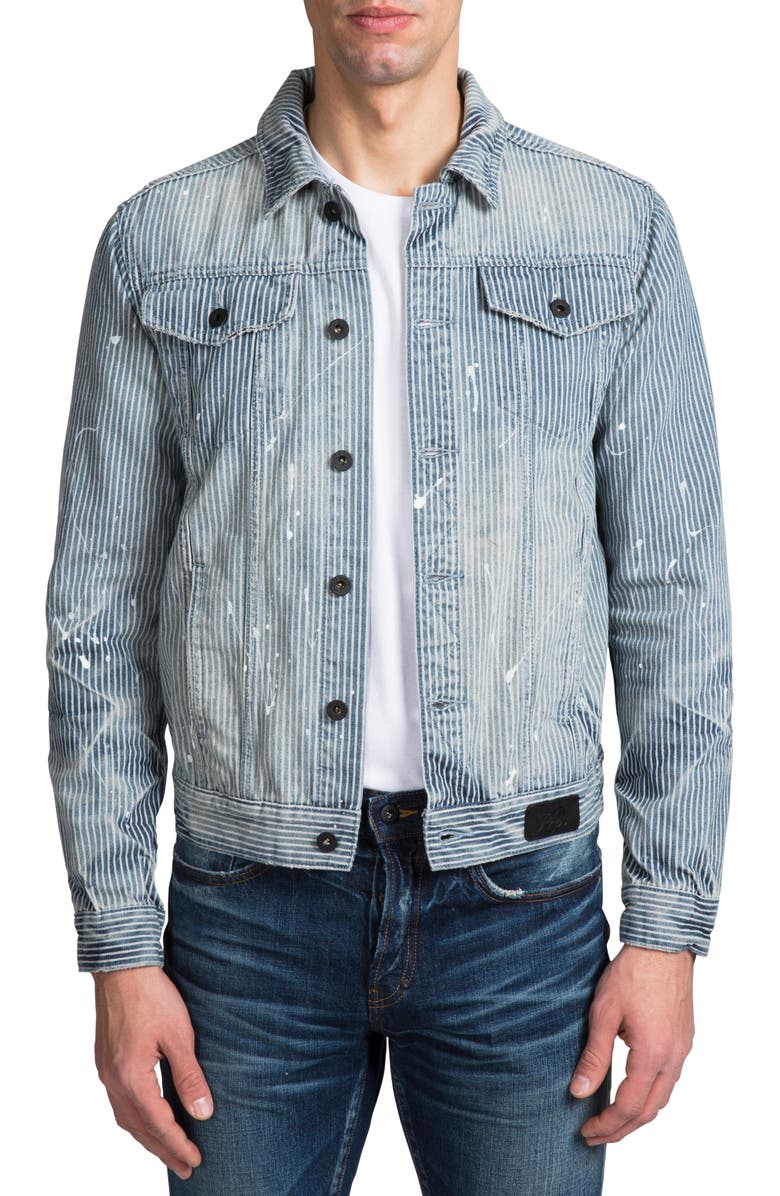
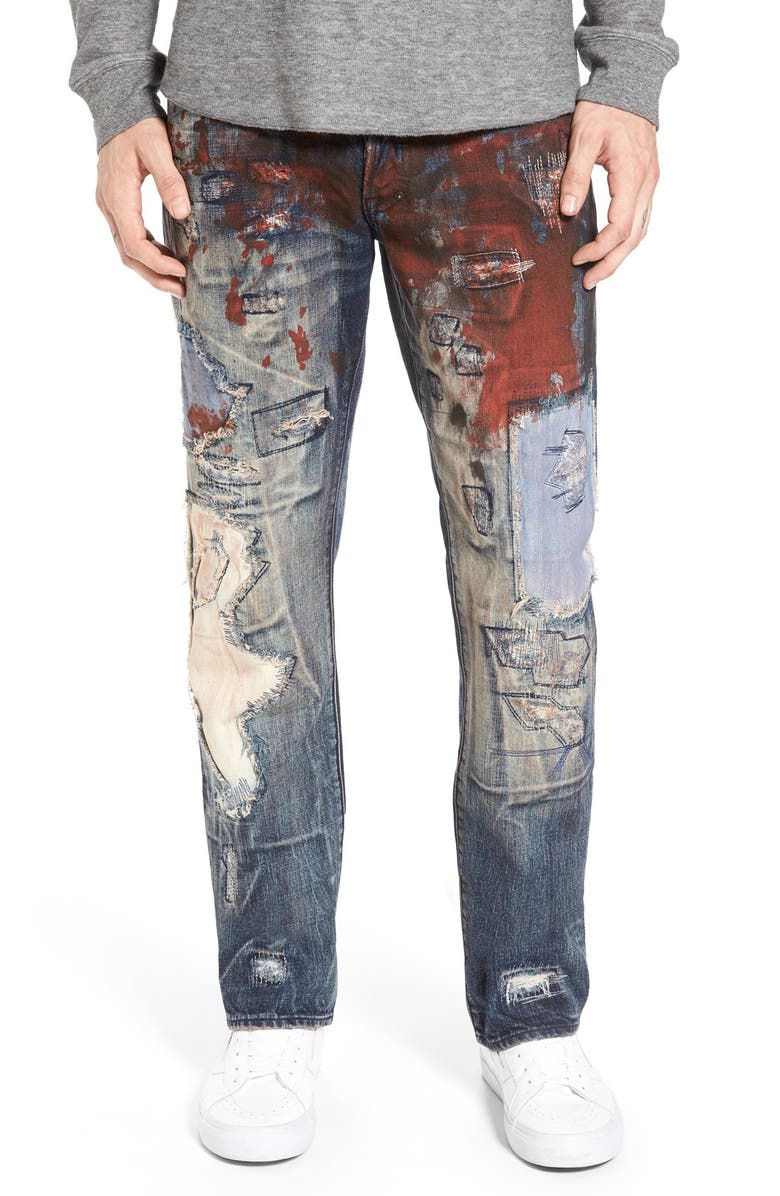
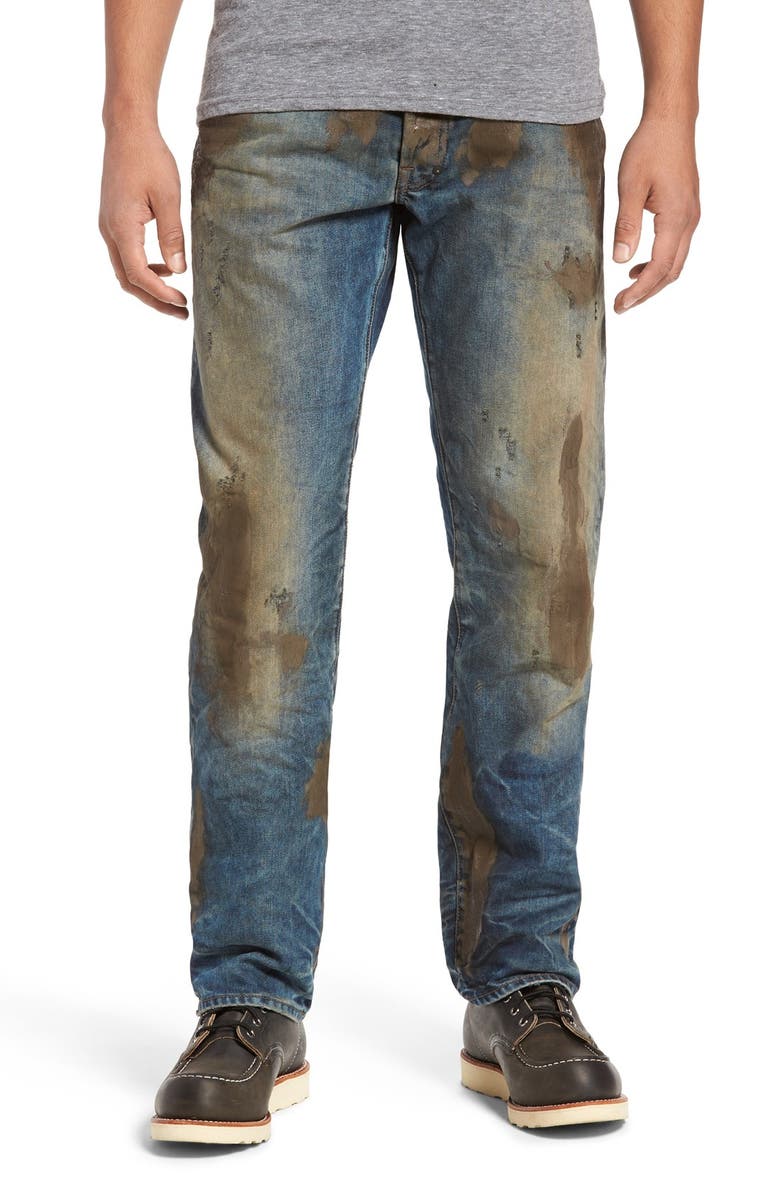
On an episode of a podcast called Minion Death Cult, the hosts discussed some common reactions of tradespeople and Boomers to distressed and some faux-muddy jeans. (Not unsurprisingly, there were a lot of tired jokes about just selling people old, worn-out jeans from "real" tradesmen.) But not a lot of people understand how distressed clothing works, or why it's somehow different from their dad's old, grimy jeans and tattered denim jacket, so I'm going to break it down.

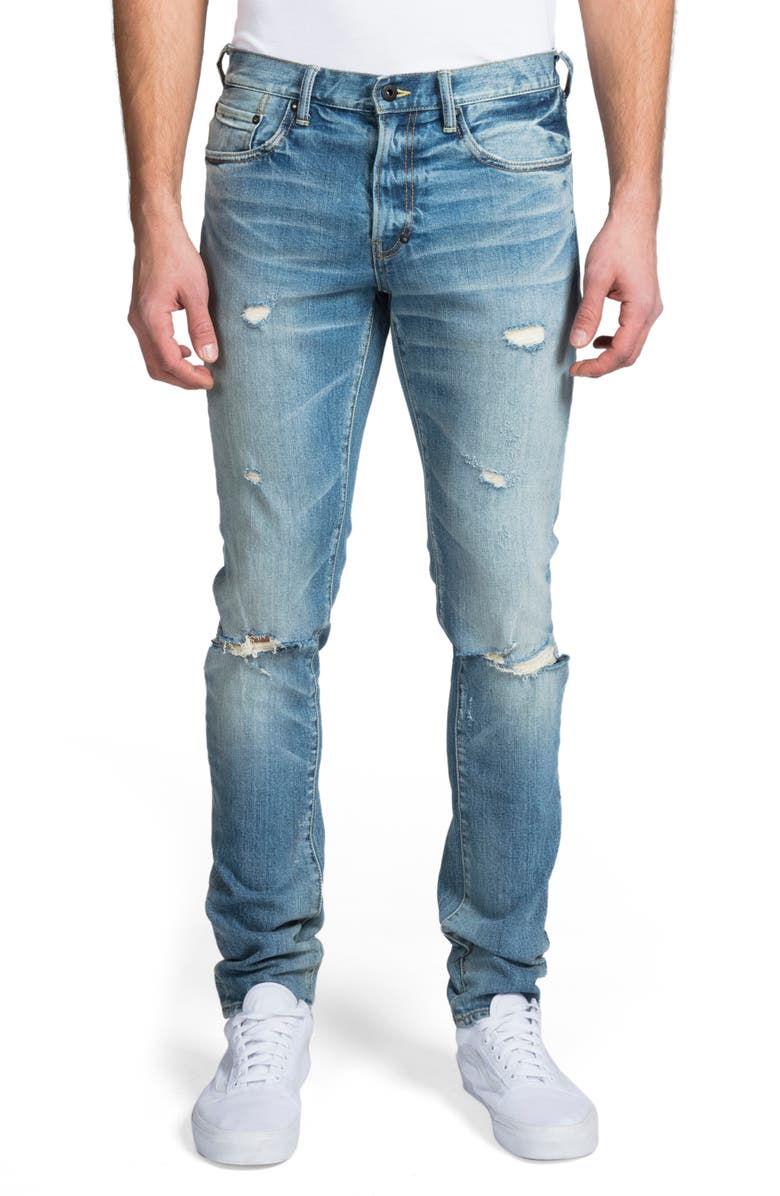
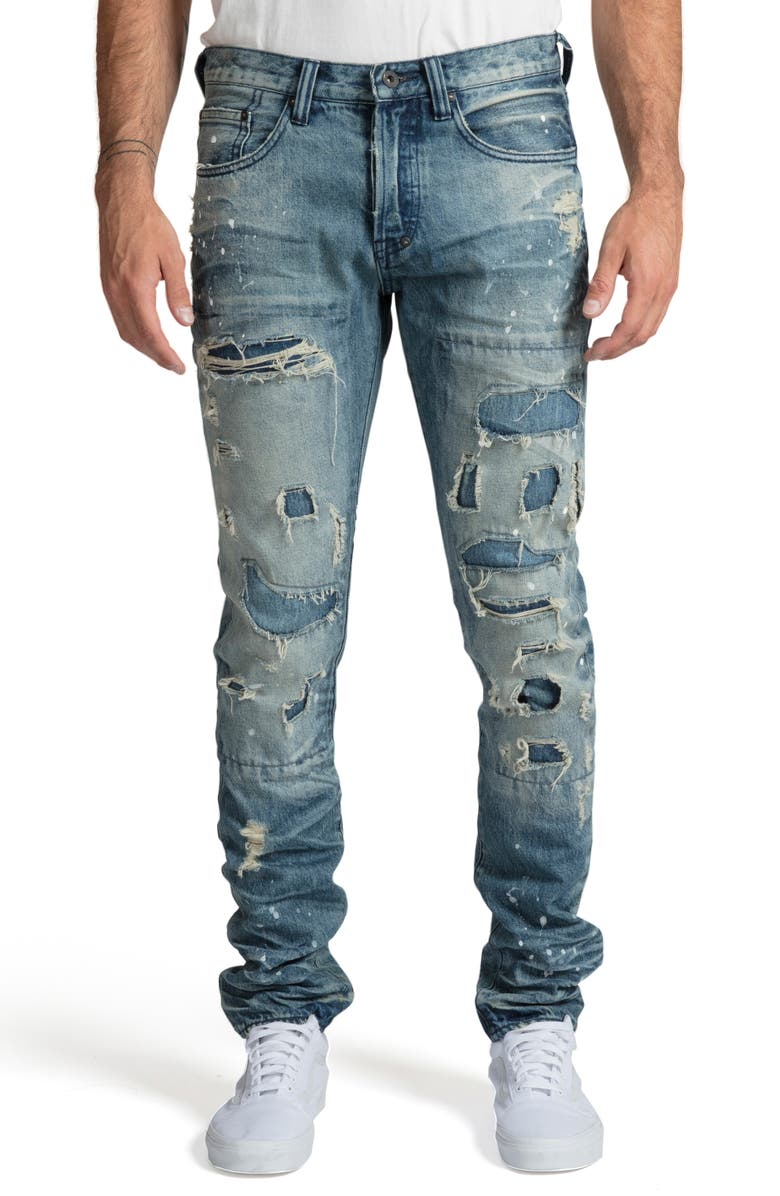
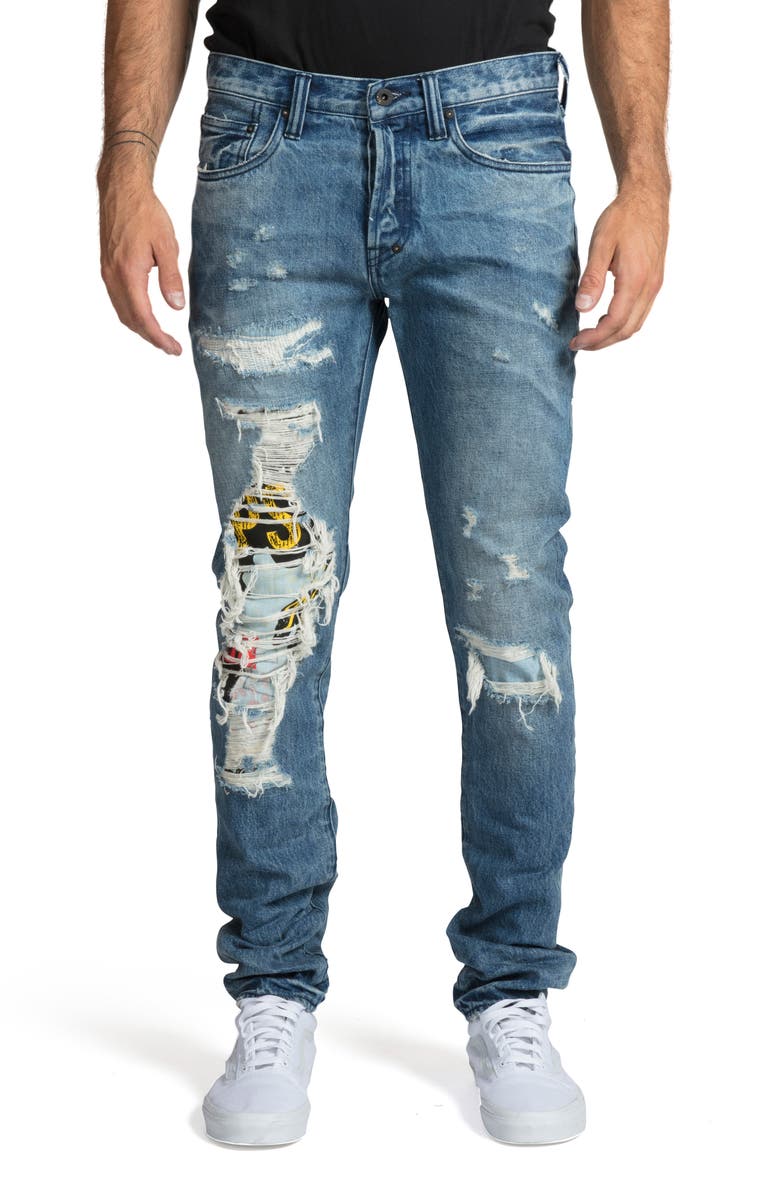
Note: all images in this article came from the Nordstrom website. Most or all are designed by PRPS.


PRPS Barracuda Straight Leg Jeans, Main, color, 490 PRPS Conductor Stripe Denim Jacket, Main, color, AUTO
PRPS Windsor Slim Fit Jeans, Main, color, AMBULANCE
PRPS Le Sabre Slim Fit Jeans, Main, color, FROST


I'm gonna take the unusual stance here of defending distressed jeans, because I've been studying and making distressed knit clothing and other types of distressed clothing for a bit. Why? Because I like post-apocalyptic fashion, and I think wrecked things are often beautiful.

You may be familiar with the term "wabi-sabi," which sometimes passes in and out of vogue for decorating trends. The term is comprised of two Japanese words - wabi, in a nutshell, refers to the beauty of simplicity; sabi, to the beauty of age and use. There's a bit more to it, but that's the quick explanation of these beautiful and imperfectly translatable terms. Wabi-sabi is usually used in reference to home decor, but it totally applies to clothing, too.

Anyway, getting on with the point - the thing about dirty jeans is that they're gonna leave dirt on wherever you sit. Fake dirt still captures the same look, the rather beautiful way the brown stains and fades into the tightly woven blue threads, but it won't leave big ol' scuffmarks on your leather car seats.

As for the distressing, the interesting and beautiful way that denim falls apart tends to happen in less sexy areas - the knees, the thighs, the crotch. Distressing clothes on purpose lets you get the look without impairing the wearability and structural integrity of the clothes. Sometimes that doesn't work at all, like with the cheaper distressed jeans that are all holes and have a high spandex content, but that's still the idea.

As far as how this relates to designing and making clothing, with knitwear (such as the awesome punk sweaters we all may love, or at least have seen before), it's important to know how the particular fibres and yarns work structurally. There's a reason why clothing made to be or look distressed looks so awesome and a lot of actually busted up clothing or "home-made" distressed stuff looks crappy. Knowing where and how to cut fabric in pre-made knits, how to style the runs, or how to make patterns with the runs and holes, is all very calculated. As I've learned myself, if you try to distress a finely-knit sweater, it'll look like crap; distressing needs a chunkier, thicker yarn to be really noticeable. And wet-blocking a ravelled sweater (stretching while wet) is very important - otherwise, the threads maintain their curled appearance, and don't become those straight lines that create contrast with the curving knitted stitches. It's also really important to actually tie off runs in a distressed sweater, or the whole thing will, in fact, unravel.

The advantage of knitting a sweater with a distressed look is that you can control this process. In effect, dropped stitches and yarn-overs create a sort of freeform lace look, and don't destroy the structural integrity of the sweater (which unravelling a pre-made sweater CAN do).

So basically there IS a method to the madness in pre-distressed clothing, and knowing how to distress your clothing well and safely - whether it's for a stage production, Halloween, or fashion - takes more than sharp scissors and boredom!

PRPS Le Sabre Slim Fit Jeans, Main, color, WIND CHILL

PRPS 'Barracuda' Destroyed Straight Leg Jeans, Main, color, 490
Predictably, clothes like this inspire retorts like, "I could give you my old jeans covered in cow manure and farm dirt and motor oil for that price!" But that's the point - the "fake dirt" that so baffled the Washington Post and CNN, where reporters appeared unfamiliar with the concept of "p a i n t", will not rub off or dirty other surfaces. The pants don't contain the scent and sweat of another person's work, nor are they worn out and about to fall apart, as those pants probably are. (For example, the wear patterns and distressing and whiskering all appear on the thighs and calves of the jeans, rather than in the crotch, around the bottom cuffs, and etcetera.) 

It's not about pretending you work - it's about exploring the beauty of entropy and things that are lived-in. The way fabric dye fades, the soft whiskering of denim fabric, the delicate feathers of raw-edged cotton - all of these have their own beauty. Repairs can create a contrast from the original fabric or material as well, and it needn't be ugly. People familiar with "that weird gold thing," kintsuogi, may also know have seen it in cases where useful objects are repaired and the cracks are patched with gold leaf to highlight their beauty. 

Here's another example of finding beauty in marks and unexpected places. When I saw an advertisement for Canada Post that featured a very intriguing necklace, I tracked down the artist's work and had a look at her site.


However, to my surprise, most of her jewelry was either minimalist and geometric, or covered in dented and scratched textures, like this!


There is real value in appreciating things as we wear them out. If we are to shift to a less consumption-driven culture, which is necessary in the fight against climate change, we're gonna have to get used to not having things that look new all the time. Supplies and availability of items may be restricted. Repairing clothing and items instead of just throwing them out has also become pretty popular amongst Generation Z, many of whom are embracing thrifting and minimal-waste lifestyles.

But in addition to that, there's also a beauty in the broken or fraying, the imperfect, the less-than-new. Most of the time we spend with an item will be active. Jewelry gets scratches. Clothes rip. Colours fade. Paper tears. And all of those things expose new beauties and different aspects of the item, revealing its structure and design and suggesting or reminding us of experiences we've had.

After all, our possessions act as anchors for memories. There's a reason why in pre-industrial times, treasured items were passed down through generations or repaired over and over. Our things aren't just pretty diversions or useful parts of daily life - they're parts of our lives, woven or tangled with our memories.

***
Michelle Browne is a sci fi/fantasy writer and editor. She lives in Lethbridge, AB with her partner-in-crime and Max the cat. Her days revolve around freelance editing, knitting, jewelry, and learning too much. She is currently working on other people’s manuscripts, the next books in her series, and drinking as much tea as humanly possible.
Find her all over the internet: * OG Blog * Mailing list * Magpie Editing * Amazon * Medium * Twitter * Instagram * Facebook * Tumblr * Paypal.me * Ko-fi
Monday, 6 November 2017

In My Skin: Fashion and Fat (a guest post by Katie de Long)

Today I have a guest blog from Katie de Long!

In My Skin: Fashion and Fat


One of my favorite things about fashion is its capacity to highlight the individual in a way few other kinds of self-expression can. The industry has its problems, but for many, fashion can be something that helps them stay afloat in a hostile world, be they a gay cis man, or a fat trans woman.

But with increased eyes on the fashion industry thanks to the body positivity movement come additional pressures. As a fat woman, your desireability and sexuality is in question constantly: you’re desperate, you have no self-restraint, you’re lazy, a host of other judgments. Because of this, for fat women to assert their sexuality through fashion is something that may be needed to reclaim professional stature, or simply to feel that they can look at themselves in a mirror. But this presents a problem, since the most common way of “proving” their worth in a thin-centered world is to hype up their figure and sexuality in a way that thin women do not necessarily have to. We’re on board for fat women- so long as they still have a waist that appears nipped-in compared to their hips, and so long as their weight is carried in an evenly distributed manner, rather than in rolls or cellulite.

This is a problem. It saddles fat women with extra time spent on grooming, extra money spent on clothes that are priced proportionally higher- particularly vintage-inspired clothes that highlight the beauty in curves but that are considered “specialty”, or are priced up due to the additional detail and tailoring of the patterns, compared to drapey, minimalist clothes, simply in order to prove that they aren’t “sloppy” or tasteless. And this exacerbates classist problems that tend to affect marginalized people more strongly. That hourglass wiggle dress might make you seem more ladylike to your boss... but for a black person, would their boss have thought they were unladylike in the first place?

It causes a host of other problems, too, in that it may force people to perform femininity in a way that is toxic to them. Many survivors of childhood sexual assault grow up to content with eating disorders- including compulsive overeating- and many even see the additional weight as a way of rendering themselves invisible to the male gaze that has treated them so violently. By forcing these people to wear tight clothes for their professional or personal advancement, society may be forcing them deeper into dysphoria, or unhealthy mental triggers.

I don’t say that to say it’s always the case. I often joke that my style is “fuck-you femme”, because for me, exaggerated sexuality and performative femininity is liberating. It says that I don’t have to change myself to please people- who cares if my clothes are “frivolous” or “high maintenance?” It says that I deserve to experience my womanhood without gendered violence- something that’s crucial to me as a rape survivor- and without the pressure to hide my womanhood to obtain the benefits we afford those with “masculine” traits. I’ll bowl you over with a list of my achievements if you dare imply that my taste speaks ill of me as a person. My fuck-you femme clothes are a shorthand for the unbelievable pain and soaring pleasure of being a woman.

Many trans or nonbinary people, too, are haunted by these ideals- by sexualized clothes that are not intended to highlight their body shape, by ideas that say that a butch trans woman must not “really” be trans, to present so “masculinely”. Put simply, the idea that fat is okay, so long as you still prize your desireability in the right ways still amounts to a subtle tax on fat people who exist in public spaces. Women already spend more time and money on grooming and presentation, and the growing percentage of fat or obese women who nevertheless must gather goodwill and authority through their fashion choices only weights that balance further.

We’re all individuals, completely unique in how we relate to the world, each other, and the fashion we adorn our bodies with. And in that light, body positivity has quite a ways to go before it’s truly expanded fashion’s inclusivity.

Katie around the internet:
Katie's Facebook Reader Group: https://www.facebook.com/groups/696177510494600/
Katie's Twitter: @delongkatie

Friday, 3 November 2017

In and Out of the Closet: A Fat Girl's Personal Style Journey

Content warning: this article deals with body image issues that may be triggering for some readers. Discretion is advised.

I am a member of the Disney Generation. This is hardly a revolutionary claim or point to make, but for a fat femme girl, who's also bisexual, it comes with invisible baggage and fears.

 Full skirts, improbably round breasts, delicate waists, paneled gowns, shimmering fabric, vibrant colours, and jewels shaped my idea of not only desire, but also royalty. Studying history from a young age, I saw rich fabrics, precious treasures, embroidered and lined gowns, and I admired it. Drawing endless pictures of dresses and gowns, often with surprise cut-aways and deep decolletage, I both desired them and wanted to be them. Formal garb was both my ambition and my most secret hope, but it was also something I believe impossible for myself. 

Fat girl life


My mother's body image issues left a deep impact on me, and readily transferred over to my own. I had always been sort of tall, but wished I was taller. Hating my muscles and fat, seeing the curves as proof of a lack of fitness - I didn't grow up within a corset, or with bound feet, but the cage and constant pressure of the BMI chart was just as strangling and hobbling.

In the 90s and 2000s, flatness and muscle and bones were the beauty ideal. I used to daydream about surgery and liposuction and waking up with a body that moved, looked, and felt different. For years, I tried to get by on 1000, 1200, or whatever number of calories per day would work - inevitably failing when encountering food, of course, or when sabotaged by my mother, who'd encourage me to 'live a little' and eat a salty or sweet treat, caving in to her own cravings. But soon, it'd be back on the wheel of nagging to exercise, not for the joy of movement, but to deal with the shame of my flawed body. 

  In this way, I spent my teens and a good portion of my twenties - trying different techniques to shed stubborn pounds that were as good as nailed to my flesh - due, unbeknownst to me to hormonal imbalances. I learned to like certain things, and aspired to climb buildings and corners and walls and roofs, assuming that only by losing weight could I attain those literal high hopes. 

At the same time, in the back of my mind, fashion and clothes I liked were often weighty. Elegant layers, oversized cuts, voluminous skirts, corsets swooping in to hug a waist I didn't think I had - these were things I associated not with femininity alone, but with being regal, imperious, and respected. Later, I became intrigued by swooping, voluminous clothes - Jedi robes, Amidala's gowns, even oversized boxy cuts in music videos. Finding ways to mingle these elements with layers has led to an unexpected but perfect style intersection for me.

#outfit #selfie #clinic #spoonielife

A post shared by SciFiMagpie (@scifimagpie) on


I stopped confining myself to things I 'could wear', and started experimenting with revealing my skin, taking inspiration from slimmer models as necessary and trying out a variety of looks. Overly modest circle skirts, sarongs with jeans underneath, a million skin-tight black turtlenecks, black and white tiered skirts, fishnets and lacy patterned tights, steampunk leather corsets, knitted sweaters and business-like skirts. Eventually, I achieved a more defined and coherent look, featuring cocoon sweaters, leggy wrap dresses, layered corset-cut vests, flowing circle skirts, and oversized scarves - where I'm at these days. Older style elements make their way into clothes, but I dress with more deliberation, strategy, and joy these days, not seeking to hide my shameful corpse under oversized tie-dye t-shirts and baggy jeans or in ill-fitting and suiting button-up shirts. 

The personal is political - pencil skirts included


I've hit a point where I can not only incorporate a variety of influences, but I receive social praise for my skills in doing so. I've begin to feel like I inhabit my own body, that it is not broken, ugly, or in need of repair. The vibrant body-positivity movement has helped this immensely. Then I saw this

At first, I simply ignored it, because I didn't understand it and couldn't relate to it. But after talking about it with a friend, a sort of Pod People-like realisation snapped over me, and I considered that yes, most fat women ARE dressing according to this code. Pretend it's 1950 or face a return to the same old standards and shames. In my retail days, I had to wear carefully coiffed and chosen outfits and makeup, while my very tall, slim manager wore pilling sweaters and got not a word of criticism about it.

Chatting with my friend Katie de Long, who is also both a ferocious feminist and enthusiastic fashionista, I was dismayed and alarmed by the through-line of this pattern. In her words [edited slightly to remove my part of the conversation],

"...There are societal biases that make it MORE needed for fat women to prove their femininity.
No one ever thinks of the "hot curvy girl" as being draped in loose, structural clothes.
They see her va-va-vooming in a waist-training corset and full face of makeup. Anything that "erases" the figure or the curves is seen as undesireable, even if it fits properly and is well-tailored.
I think another thing is that plus sized women are trained to hide their size. We see Christina Hendricks or Amy Schumer's curves as being desireable.... so long as they're in a close-fitting pencil dress. 

But I do admit I'm pretty prey to that shit too. I avoid wearing loose clothes, wear things too tight rather than too lose.... and get really sexual, lots of cleavage, short skirts, slit-up-to-there, etc. I love exaggerated shapes. So I've always hated really drapey clothes, or close-fitting clothes that don't highlight the figure (fuck you, leggings).

Plus, and I know this is victim-blamey, my first semester of college featured a police officer advising the girls in the freshman class to NOT wear loose clothes because it's easier for a rapist to get them off, even without scissors.
So for me, when I wear loose clothes, I have really nasty panic attacks about the idea of someone peeling them off me without my consent. When I wear tight clothes, I feel confident, that they'll have to use scissors, which is more likely to give me an opportunity to either get away, or seize the scissors and take out an eye. As well, my style's fuckyou femme, so for me [as a rape survivor], I feel like my gender and the violence I've suffered because of it is erased when I put on loose, minimalist designs."


What to wear?


At the end of the day, even though clothing choices are fraught with danger and hidden signalling that can be hard to understand, finding a way to express oneself through attire can be very important. From talking to my nonbinary "enby" friends, I've gotten even more insight into this. What strikes me as funny and maybe even uplifting is that my experiences with feminism and trauma have taken me in a circle. Instead of pretending to be a man, or having no identity at all, or seeing my childhood dreams as unattainable, I've been able to make my innermost desires come true.
There's an old saw idea that feminists are ugly, hairy, unconventionally feminine, fat, and basically undesireable. But taking back a sense of inner worth has given me the tools to fight my inner ugliness, wear makeup without feeling as though I'm faking something, and stop hiding my inner exuberance. There is freedom in ugliness and invisibility, and a merit to reclaiming or defying constraints - but at least for me, there is more joy in this new, permissive ground.

Ultimately, I hope that my experiences can make people feel a little better about their own secret desires and hopes. A lot of hay has been made about how 'style has no size', but there's still fierce debate about 'who can wear what'. But simply wearing what one wants isn't as easy as it sounds, and takes time. If you need it, take this as official permission to try out that thing, regardless of your gender. You are not 'too old' or 'too fat' or 'too thin'. 

You are enough. 

And it's okay if it doesn't look right at first. What matters is that your clothing expresses who you want to be. 

Additional reading:

A Nigerian designer using fashion and style to explore feminism and self-expression

Information about the cost of existing in a female body and/or having periods and breasts

The ways we judge women and how it affects their careers 

***

Thanks for returning to the nest. Leave a comment and say hi! I want to hear from you. Keep up with the new releases by getting on the mailing list. Buy my books on Amazon, and keep up with me on TwitterFacebookTumblr, and the original blog. This is the one and only SciFiMagpie, over and out!

Google+