About Me

My photo
Author of queer, wry sci fi/fantasy books.
Showing posts with label sci fi. Show all posts

Friday, 18 November 2022

So, I Forgot to Mention - My Book is Out!

 This is a short one, because I just got back home from the book launch at Analog Books here in Lethbridge - a fantastic independent bookstore that everyone should check out. 

It was small, just myself and a few friends, but the bookstore was open a bit late tonight and I did a little reading for people! I also served up this delicious pineapple cake, in a vegan version (we used an egg substitute). 


Photo by Liza Fleischmann. My dumb ass forgot to take a picture.

But you're not just here for the (virtual) pineapple cake and apple cider - you're here for the book. 

As mentioned, The Meaning Wars Omnibus is finally out - not only in ebook form, but also as a paperback and a hardcover! 


It's exclusively on Amazon right now, for KDP and promotion reasons, but I may change that if people speak up. (Amazon really likes to lock authors down with exclusivity, sadly.) 

I'm so proud of how this turned out, and Kateryna Kyselova did a bang-up job on the cover! Christy Foster was of tremendous help on the formatting. You couldn't go wrong by hiring either of them. 

I have a few blog articles on the backburner, but my biggest priority right now is actually my NaNoWriMo project - Monsters and Fools. That's right - it's taken ten years, but I'm planning to release the long, long-awaited sequel to The Underlighters in spring! 

Look, it took a long time to figure out the plot...but I finally got it done. Stay tuned to this space for more updates on what I'm doing - when I get time for 'em, that is. This has been one crazy year so far...

***

Michelle Browne is a sci fi/fantasy writer and editor. She lives in Lethbridge, AB with her partners-in-crime and their cats. Her days revolve around freelance editing, knitting, jewelry, and learning too much. She is currently working on other people’s manuscripts, the next books in her series, and drinking as much tea as humanly possible.

Find her all over the internet: * OG Blog * Mailing list * Magpie Editing * Amazon * * Tumblr * Facebook * Medium * Twitter * Instagram * Paypal.me * Ko-fi

Wednesday, 5 October 2022

The End of an Era

Releasing soon, it's the final book in the Meaning Wars series - A Jade's Trick! 

I've been hard at work on this, and I'm so excited to be this close to the finish line. 

"Outgunned. Outmanned. Outnumbered.


But out of luck? Not yet...


Crystal has left her abusive husband, and Sarah and her crew have successfully rescued rebel leader Patience Ngouabi. As Patience and Sarah connect, they begin to see a life beyond their struggles in the rebellion. Now this queer found-family crew just has to fight the tyrannical Human Conglomerate into submission. But fighting an interstellar empire is going to take more than big guns. They need funding and allies. Could a renegade - but unionized - group of pirates be their unlikely saviours? A sinister, shadowy political figure back on Ganymede may also be willing to help - and that means going right back to danger's heart.

Fans of Ruthanna Emrys' 
A Half Built Garden and Becky Chambers' Wayfarers series will enjoy this emotional, high-risk finale to the Meaning Wars series."


Preorder here!

It'll be out soon, but help me get those preorder numbers up by grabbing your copy now! Around the same time, I'll also be releasing an omnibus collecting all five books, which will be available in hardcover (a first!) as well as paperback. 

I hope you'll all enjoy seeing the destinies of these characters play out as much as I've enjoyed writing them. Coming to the end of a book series is always bittersweet, but I'm so proud of these characters and how far they've gone. 

***

Michelle Browne is a sci fi/fantasy writer and editor. She lives in Lethbridge, AB with her partners-in-crime and their cats. Her days revolve around freelance editing, knitting, jewelry, and learning too much. She is currently working on other people’s manuscripts, the next books in her series, and drinking as much tea as humanly possible.
Find her all over the internet: * OG Blog * Mailing list * Magpie Editing * Amazon * Medium * Twitter * Instagram * Facebook * Tumblr * Paypal.me * Ko-fi

Friday, 17 June 2022

I'm Getting Married!

 ...And that's where I've been. The last six months have been hectic because of it. However, you can look forward to an article that mentions my marriage in July's edition of Apex. Keep your eyes peeled! 

Although this isn't a wedding blog, and although I try to take a light touch with mentioning personal things, I wanted to take some time to talk about what I'm putting together and how it's happening. Because my wife-to-be is in a sensitive field, I will keep photos of her out of this post. 

Some of you may have read "The Underlighters" or "The Loved, The Lost, The Dreaming," which features an alternate ending for the storyline of the same book. A central feature of that tale is the triad romance between Janelle, Una, and Nathu. Polyamory, the practice (and orientation) of having multiple romantic or significant relationships, is also going to be a theme that I explore in all of my series in other ways. When I wrote that book nearly a decade ago, I didn't expect that I'd find myself in a similar relationship some day, but to my great joy and surprise, that's the case. 

Who, what, when? 

My long-time male partner Andrey (aka Disarcade) has been mentioned a few times. Some years ago, when we moved from Calgary to Lethbridge, we made a friend, whom I'll call Starling. Our friendship continued through Dungeons and Dragons and art, and when the pandemic hit, we were close enough that we decided to share a small bubble, with a couple of other people. 

The pandemic meant that we spent a lot of time together, and only grew closer. There was a personal incident with my family that she was very supportive through, and that was an immense help. As the dream of home ownership was offered to us and then snatched away, talking to her made us all realise how well our life plans dovetailed. 

Between the time and the converging goals, love had rich soil, and sent down its roots. It's been an exhilarating, sometimes challenging ride, but I couldn't be happier that in January, when  I asked her to be my wife, and marry us both, she said yes.

But marriage is between two people, isn't it?

Although plural marriages are not legally recognized - mostly due to the stigma surrounding polygamous marriages, which are different and often based in oppressive religious structures - we're having a handfasting ceremony to recognize our connection to each other. 

The blog More Than Two has some great resources and information about what polyamory is and how it works, but for those not acquainted, it's a type of non-normative relationship structure that can take many forms - including non-monogamy, relationship anarchy, and many other shapes. In our triad, all of us have relationships with each other and together, but that's not the only way to love, either. It's also not the same as swinging, which is generally about sexual interactions, but not emotional ones. 

Although polyamory is seen as non-normative (and is not just a lifestyle, but is an orientation which is discriminated against, meaning that it's on the LGBTQ+ spectrum), polyplatonic relationships are very normal - most people have more than a single friend or even best friend. Anyone wondering "how that works" on a basic level should consider how they can feel affection for multiple family members or friends. It's a good reference point for the similarities. And just as caring about one friend usually doesn't reduce your affection for another - unless there's a problem in the other relationship - loving two or more people doesn't mean loving each person any less. 

What comes next?

I might diverge from my usual pop culture, politics, and writing technique content to mention some of the creative stuff; let me know if you readers would be interested in an article about how we put together an unusual outdoor summer wedding for under $5000. 

We've been DIYing up a storm - and if I was cleverer, I'd have posted a bunch of tutorials and progress shots on here - but preparations are almost ready.  I've had a very messy release schedule for a long time now, but my mental health has been improving, and I'd like to put out more articles. I'm hoping to get some more published articles out as well, with places like Apex and even possibly other magazines. 

But for the next couple of days, until the solstice and the ceremony, my biggest focus is going to be on finishing up some final details, making food for guests, and cleaning the apartment! You would not believe the amount of glitter my fiancée produces. Seriously, there's so much glitter stuck in the carpet, on the couch, the dresses...

Oh, and book 5 is still coming along, too. I have an author event at Analog Books on August 30th here in Lethbridge, AB, so if you're a local, come out and see me that night! I'll have copies of the books mentioned here, and will be reading excerpts from those and my upcoming work, the fifth book in the Meaning Wars saga, the grand finale. When that's done, an omnibus paperback edition will be released, containing the whole series. 

Yeah, that's a lot. It's ambitious. But if my girlfriend, and soon-to-be wife, has taught me anything, it's that it's worth living life adventurously. 

***

Michelle Browne is a sci fi/fantasy writer and editor. She lives in Lethbridge, AB with her partners-in-crime and their cats. Her days revolve around freelance editing, knitting, jewelry, and learning too much. She is currently working on other people’s manuscripts, the next books in her series, and drinking as much tea as humanly possible.
Find her all over the internet: * OG Blog * Mailing list * Magpie Editing * Amazon * Medium * Twitter * Instagram * Facebook * Tumblr * Paypal.me * Ko-fi

Monday, 10 February 2020

The Art of Destruction: Distressed Aesthetics

A belated happy new year, my dear followers!

So, I have a neat idea for a new series coming up. But after the holidays (which were pleasantly busy) and some interpersonal scuffling in January (which was not nearly as lovely, but came to an all-right enough resolution), my idea bank was absolutely flat broke.

A nice chat with friends has filled the bowl up, but while I work on those posts, here is something I stashed off to the side after a Facebook conversation last year.

I often reference fashion and clothing to help get in the right mindset for my writing projects. Whilst working on Poe's Outlaws (Book 4 of The Meaning Wars series; book 3, The Meaning Wars, is ready for beta-reading and edits now!) I indulged in my usual technique of sifting through Dolls Kill and Pinterest to look at various bits of outre, fun, futuristic fashion.

Of course, when working on Monsters and Fools and planning for After the Garden's sequels, I also like to look at post-apocalyptic and distressed clothing. I like distressed clothing anyway, but it tends to get a lot of flack.

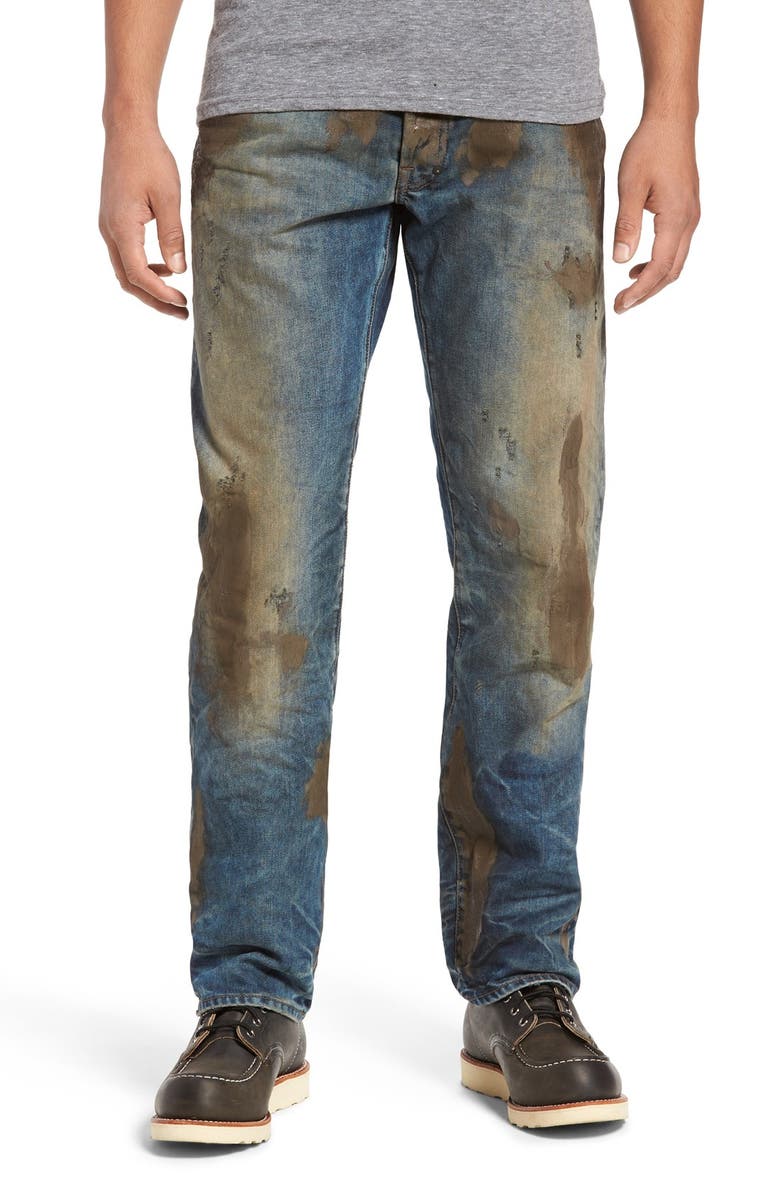
On an episode of a podcast called Minion Death Cult, the hosts discussed some common reactions of tradespeople and Boomers to distressed and some faux-muddy jeans. (Not unsurprisingly, there were a lot of tired jokes about just selling people old, worn-out jeans from "real" tradesmen.) But not a lot of people understand how distressed clothing works, or why it's somehow different from their dad's old, grimy jeans and tattered denim jacket, so I'm going to break it down.

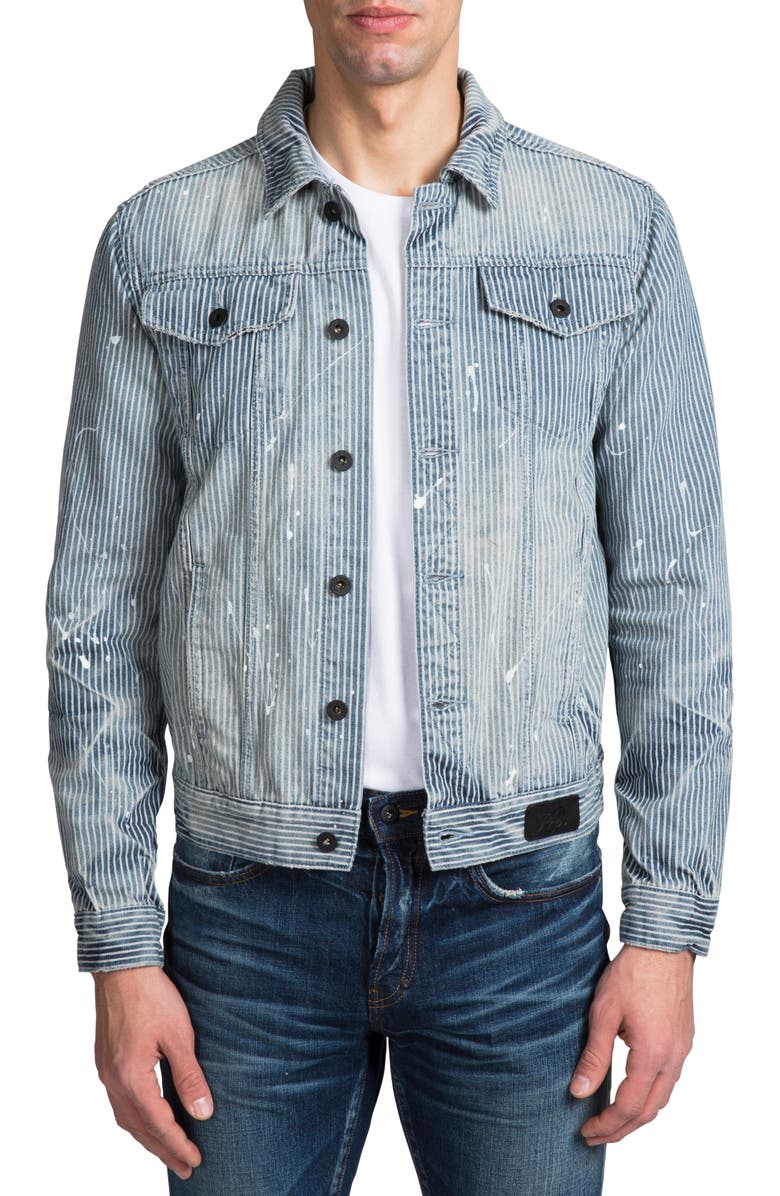
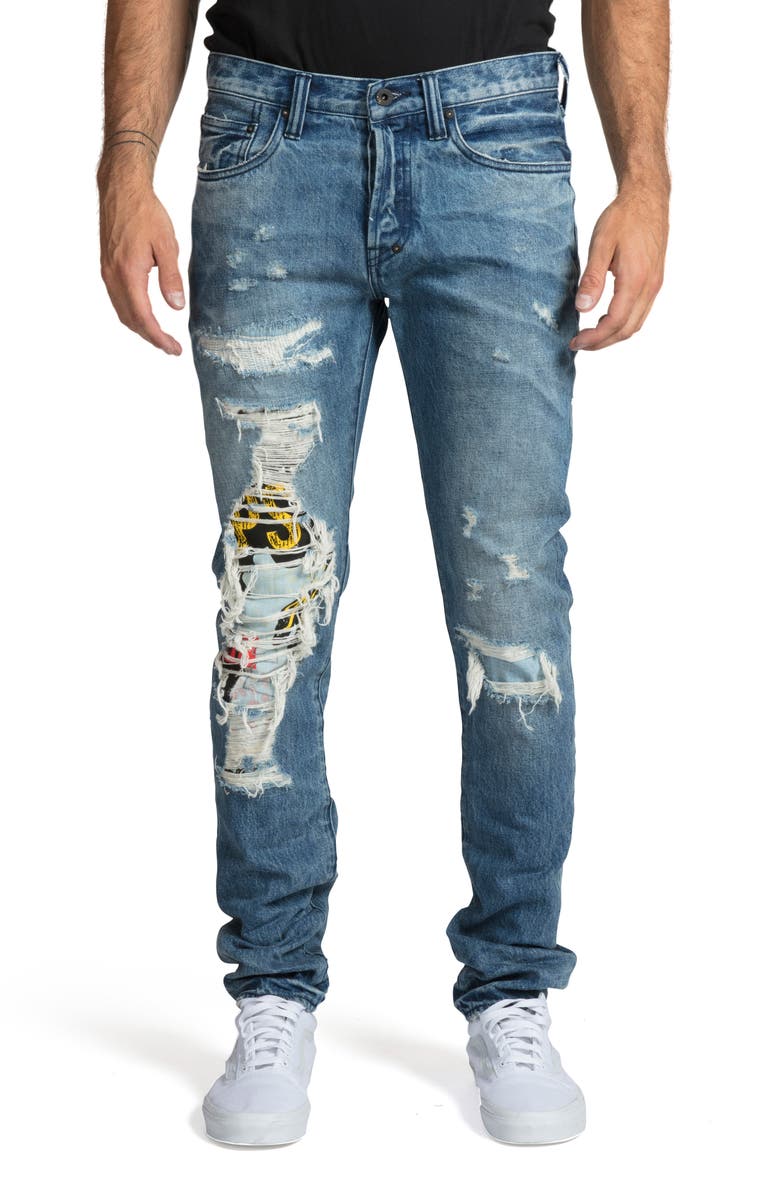
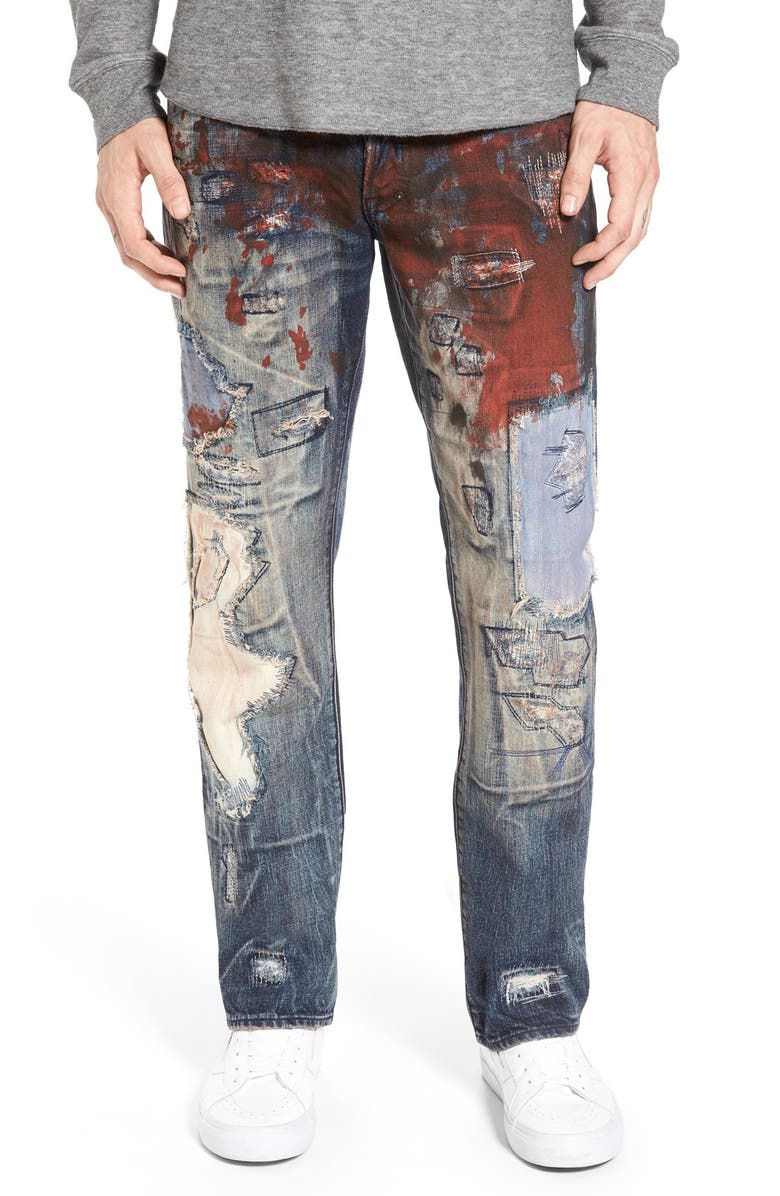
Note: all images in this article came from the Nordstrom website. Most or all are designed by PRPS.


PRPS Barracuda Straight Leg Jeans, Main, color, 490 PRPS Conductor Stripe Denim Jacket, Main, color, AUTO
PRPS Windsor Slim Fit Jeans, Main, color, AMBULANCE
PRPS Le Sabre Slim Fit Jeans, Main, color, FROST


I'm gonna take the unusual stance here of defending distressed jeans, because I've been studying and making distressed knit clothing and other types of distressed clothing for a bit. Why? Because I like post-apocalyptic fashion, and I think wrecked things are often beautiful.

You may be familiar with the term "wabi-sabi," which sometimes passes in and out of vogue for decorating trends. The term is comprised of two Japanese words - wabi, in a nutshell, refers to the beauty of simplicity; sabi, to the beauty of age and use. There's a bit more to it, but that's the quick explanation of these beautiful and imperfectly translatable terms. Wabi-sabi is usually used in reference to home decor, but it totally applies to clothing, too.

Anyway, getting on with the point - the thing about dirty jeans is that they're gonna leave dirt on wherever you sit. Fake dirt still captures the same look, the rather beautiful way the brown stains and fades into the tightly woven blue threads, but it won't leave big ol' scuffmarks on your leather car seats.

As for the distressing, the interesting and beautiful way that denim falls apart tends to happen in less sexy areas - the knees, the thighs, the crotch. Distressing clothes on purpose lets you get the look without impairing the wearability and structural integrity of the clothes. Sometimes that doesn't work at all, like with the cheaper distressed jeans that are all holes and have a high spandex content, but that's still the idea.

As far as how this relates to designing and making clothing, with knitwear (such as the awesome punk sweaters we all may love, or at least have seen before), it's important to know how the particular fibres and yarns work structurally. There's a reason why clothing made to be or look distressed looks so awesome and a lot of actually busted up clothing or "home-made" distressed stuff looks crappy. Knowing where and how to cut fabric in pre-made knits, how to style the runs, or how to make patterns with the runs and holes, is all very calculated. As I've learned myself, if you try to distress a finely-knit sweater, it'll look like crap; distressing needs a chunkier, thicker yarn to be really noticeable. And wet-blocking a ravelled sweater (stretching while wet) is very important - otherwise, the threads maintain their curled appearance, and don't become those straight lines that create contrast with the curving knitted stitches. It's also really important to actually tie off runs in a distressed sweater, or the whole thing will, in fact, unravel.

The advantage of knitting a sweater with a distressed look is that you can control this process. In effect, dropped stitches and yarn-overs create a sort of freeform lace look, and don't destroy the structural integrity of the sweater (which unravelling a pre-made sweater CAN do).

So basically there IS a method to the madness in pre-distressed clothing, and knowing how to distress your clothing well and safely - whether it's for a stage production, Halloween, or fashion - takes more than sharp scissors and boredom!

PRPS Le Sabre Slim Fit Jeans, Main, color, WIND CHILL

PRPS 'Barracuda' Destroyed Straight Leg Jeans, Main, color, 490
Predictably, clothes like this inspire retorts like, "I could give you my old jeans covered in cow manure and farm dirt and motor oil for that price!" But that's the point - the "fake dirt" that so baffled the Washington Post and CNN, where reporters appeared unfamiliar with the concept of "p a i n t", will not rub off or dirty other surfaces. The pants don't contain the scent and sweat of another person's work, nor are they worn out and about to fall apart, as those pants probably are. (For example, the wear patterns and distressing and whiskering all appear on the thighs and calves of the jeans, rather than in the crotch, around the bottom cuffs, and etcetera.) 

It's not about pretending you work - it's about exploring the beauty of entropy and things that are lived-in. The way fabric dye fades, the soft whiskering of denim fabric, the delicate feathers of raw-edged cotton - all of these have their own beauty. Repairs can create a contrast from the original fabric or material as well, and it needn't be ugly. People familiar with "that weird gold thing," kintsuogi, may also know have seen it in cases where useful objects are repaired and the cracks are patched with gold leaf to highlight their beauty. 

Here's another example of finding beauty in marks and unexpected places. When I saw an advertisement for Canada Post that featured a very intriguing necklace, I tracked down the artist's work and had a look at her site.


However, to my surprise, most of her jewelry was either minimalist and geometric, or covered in dented and scratched textures, like this!


There is real value in appreciating things as we wear them out. If we are to shift to a less consumption-driven culture, which is necessary in the fight against climate change, we're gonna have to get used to not having things that look new all the time. Supplies and availability of items may be restricted. Repairing clothing and items instead of just throwing them out has also become pretty popular amongst Generation Z, many of whom are embracing thrifting and minimal-waste lifestyles.

But in addition to that, there's also a beauty in the broken or fraying, the imperfect, the less-than-new. Most of the time we spend with an item will be active. Jewelry gets scratches. Clothes rip. Colours fade. Paper tears. And all of those things expose new beauties and different aspects of the item, revealing its structure and design and suggesting or reminding us of experiences we've had.

After all, our possessions act as anchors for memories. There's a reason why in pre-industrial times, treasured items were passed down through generations or repaired over and over. Our things aren't just pretty diversions or useful parts of daily life - they're parts of our lives, woven or tangled with our memories.

***
Michelle Browne is a sci fi/fantasy writer and editor. She lives in Lethbridge, AB with her partner-in-crime and Max the cat. Her days revolve around freelance editing, knitting, jewelry, and learning too much. She is currently working on other people’s manuscripts, the next books in her series, and drinking as much tea as humanly possible.
Find her all over the internet: * OG Blog * Mailing list * Magpie Editing * Amazon * Medium * Twitter * Instagram * Facebook * Tumblr * Paypal.me * Ko-fi

Sunday, 25 November 2018

Bad, Broken, and a Seed of Hope: How Dark Speculative Fiction Works

After I'd spoken to a client yesterday, I found myself binge-watching (and listening) to a number of short video essays about Greek and Roman history, and a bit of Egyptian history, on Youtube. The purpose was to help research and enhance our Dungeons and Dragons campaign's storyline and setting - which I should probably write about at some point - but it yielded a most unexpected fruit.

Last night, I found myself lost in a very enjoyable dream with a cohesive and interesting plot; as soon as I woke up, I did as I sometimes do after such a dream, and took notes as best I could, in hopes of capturing the story. But the story's setting was decidedly post-apocalyptic - not Greco-Roman in the least, at least not on the surface.

How did the one result from another? Well, I do have a developmental and line-edit of a post-apocalyptic book on the queue right now - a third installment in the superb and bold (and inclusive!) Eupocalypse series by Peri Worrell. (Other platforms to snag books can be found on a drop-down menu on the book's GoodReads page, so I'm including those henceforth.) Dealing with a potential future in which all plastics and petroleum products suddenly break down, the series is an enjoyable, elegantly written, and ultimately hopeful story about a tremendous, world-shattering catastrophe - as well as a cautionary tale about our reliance on plastics and petroleum products.

In my free time, I have been working through The Odyssey at a pace slightly slower than continental drift, but I recently read Emily St. Mandel's Station Eleven, and I'm currently reading Koko Takes a Holiday by Kieran Shea, a trashy but incisive work of dystopian cyberpunk (which may, admittedly, be a redundant phrase, as cyberpunk is seldom cheerful).

Now - how does all this fit together?


Well, here's the key - civilizations on Earth have gone through phases of development, growth and expansion, internal struggle, and ultimately, either collapse or transition. It happened for the august and remarkable Egyptians; it happened for the Greeks, and it happened to the Romans. Yet all of those peoples persist to this day, and while their populations have changed or interacted with invading or arriving forces, their cultures, ultimately, are not dead.

We have the benefit of thousands of years of history as a mirror, and perhaps it is unsurprising that we cannot but ask if we are participating in the same patterns. The answer is "probably yes, somehow" - but the conclusion is decidedly hopeful nonetheless.

The way we run through potential scenarios and hypothetical risks (not unlike the brain while we sleep at night, busily creating its illustrative dreams from scraps of our experiences) is through storytelling and fiction.

Surprise! I'm a writer, not just an editor 


As long-time readers may know, and as newer readers may not be aware, I myself write primarily in two genres - dystopian fiction and post-apocalyptic fiction, both of which fall into the broader categories of science fiction and speculative fiction in general.

Where speculative fiction broadly encompasses all fiction a) including at least one element changing the setting or reality from our own and b) subsequently asking, "What if?", its subset science fiction accomplishes these aims primarily by taking inspiration from biology, climatology and the earth sciences, technology, astronomy, psychology, and medicine. Magical, non-Earthly, or transhuman elements may also sneak in there. Fantasy does so by pulling both from history and (arguably) from non-scientific or trans-scientific ideas, usually based on magic (which is about going beyond the boundaries and limits of science).

But how do dystopias and post-apocalyptic fiction actually work? How do we define them exactly? A fair bit of digital ink has been expended on this topic, but I think it comes down to two very specific iterations of the question.

The question is, "What if everything changed?" In the case of a dystopian book, the question is, "What if everything got worse?" In the case of apocalyptic fiction, it's "What if everything broke?", and in the case of post-apocalyptic fiction, it's, "What do we do after everything breaks down?"

How these questions are answered, and how they change in specific instances - for the much maligned YA romances set in post-apoc or dystopian worlds, the question is, "How do we love after everything breaks/when the worst possible thing happens?"

But the more I thought about dystopian and post-apoc stories in broad strokes, the more I came to a conclusion that surprised me: dystopian books, even the famously grim 1984 by George Orwell, always posit that change is possible. So in a sense, what the two genres have in common  - apart from literally meaning "bad world" and being about "a broken world" respectively - is that they both aim to answer, "and now, what do we do next?"


"It's not for you to know, but for you to weep and wonder, when the death of your civilization precedes you."

To cope with the loss of one's civilization is an almost unimaginable task, but that is what these types of fiction set out to do - and in the process, to ask, "How will we rebuild, and what will we create?"

And from that, as grim as it may seem, we can look to history and feel a sense of hope. As much as Percy Shelly wrote about Ramses in "Ozymandias" as a king's statue broken and abandoned in the desert, we still know and speak his name to this day. We know he was an exceptional and fecund king who brought peace to the Nile kingdoms and built great and beautiful monuments that have outlasted even Time itself. And we are learning more each year about our ancestors. So as much as the Egyptian civilization - which lasted five thousand years and was so old that Cleopatra lived closer to the discovery of flight and space flight than to the building of the pyramids - has fallen to ruin and dust and the sands of time, it's also fine. 

We remember. We speak the names of the fallen. And as Terry Pratchett, author of the magnificent Discworld series put it,

“Do you not know that a man is not dead while his name is still spoken?”
Even if the worst possible things happen, these dark and dire settings are about what we remember, and ultimately, what we rebuild. Post-apocalyptic and dystopian books aren't about the end of the world - they're about a disruption in civilizations and our worlds, and how we carry on and return to greatness.

***
Michelle Browne is a sci fi/fantasy writer. She lives in Lethbridge, AB with her partners-in-crime and their cat. Her days revolve around freelance editing, knitting, jewelry, and nightmares, as well as social justice issues. She is currently working on the next books in her series, other people's manuscripts, and drinking as much tea as humanly possible.

Find her all over the internet: 
The mailing list * 
Amazon * Medium * Twitter * Instagram * Facebook * Tumblr * OG Blog


Sunday, 18 June 2017

Hey Queers, What the &$%#

Hello hello!

Well, it's Pride month, and I'm feeling a little feisty and punchy.

I'm a proud part of the Queer Sci Fi group on Facebook, and as many readers will know, I'm no stranger to writing about queer characters.

I was talking to a mentor of mine about something recently, and my dander's up. The problem is this. The lesbian stigma is absolutely real, and a problem. When seeking out books about queer characters, readers say they want f/f couples. But m/m books outsell f/f books handily, and so do stories with m/f 'straight' couples. (For those unacquainted, 'm/m' is 'male/male', 'f/f' is 'female/female', and yes, I realise that's very gender binary, but that's the industry right now.)

If a book has the most carefully designed and well-blurbed cover it can, and has all its marketing data lined up, at some point, this comes down to readers. It's no coincidence that m/m books on Queer Sci Fi make up the majority of titles.

As my mentor said,

#1. Go to teh LGBT subcat bestseller list- tally how many titles are which "branch" of LGBT. You can also just look at the LGBT subcats and note how many more MM titles there are than basically all the others combined.

I don't have an analytical article today - merely an admonishment and a call to arms. If you are a queer person who has publicly asked for f/f lit in the past, or even just privately wanted to read it - put your money where your mouth is! This year, seek out books about queer women. You can still buy m/m, I'm not going to tell anyone to stop doing something they like, but please support diversity within the LGBTIAPQ/QUILTPBAG community.

It's not that f/f books are 'too special' or 'too good' for mainstream readers. I know a lot of people - even people who have mainstream sexual and gender identities - who like stories about ladies in love. It would seem that although lesbians still get that ol 'pornographic' stigma, presentation of lady-lady or femme-femme love has not hit the mainstream.

So here's my request - whether you are an ally or a QUILTPBAG person, please share, talk about, and read f/f fiction this year. It will help those of us who love the stories get more of them, and push back against the unintentional but ingrained misogyny of the publishing industry.

***

Thanks for returning to the nest. Leave a comment and say hi! I want to hear from you. Keep up with the new releases by getting on the mailing list. Buy my books on Amazon, and keep up with me on TwitterFacebookTumblr, and the original blog. This is the one and only SciFiMagpie, over and out!

Thursday, 15 June 2017

Where did the Magpie Go?

Hello hello!

This has been an interesting year. And admittedly, my longest blog hiatus in three or four years of running this thing. What have I been doing, exactly?

  • Mostly working on editing projects. A lot of manuscripts. Like, a lot. 
  • Trying to fix my sleep schedule. (For a while, it was untenable and I felt awful. This happens regularly. Cross your fingers for my ability to keep the current track up.) 
  • Knitting and listening to podcasts on days off (or when focus eluded me). 
  • Helping my partner look for a job
  • Staring at my drafts folder and wondering if there's any point in posting, given the state of the world and the arts, and whether what I have to say still matters
  • Reading articles on Medium, especially from The Establishment, and cowering in fear at the state of American politics 
  • Resurrecting my editing site from the grave
  • Wrangling my biological family 


That about covers it. However, I'm working on a bunch of scheduled posts right now, so you can start checking on Sunday nights/Monday mornings for your usual dose of SciFiMagpie.

At least, that's the plan. In the meantime, reach out. Leave a comment, ask a question, let me know what you want to hear about. Let me know that you're reading! I've seen the page views, which have been surprisingly steady for years, so I know some of you are definitely having a look at my tiny blog.

***

Thanks for returning to the nest. Leave a comment and say hi! I want to hear from you. Keep up with the new releases by getting on the mailing list. Buy my books on Amazon, and keep up with me on TwitterFacebookTumblr, and the original blog. This is the one and only SciFiMagpie, over and out!
Google+