
As those of you who’ve strayed near a movie theatre in the past couple of weeks may have noticed, there is a very noticeable trend to this summer’s hits. My Facebook feed has been on fire with reports that This Is The End is hilarious and gritty; The Purge has been racing through theatres as well. Catching Fire (which I plan to both re-read, watch, and review) has been advertising itself frequently, as has World War Z, which has been putting much more of an emphasis on the end-of-the-world bits than the zombie bits.
Trend-counting time: we had vampires and werewolves, then a slight interest in dystopias (especially with a dose of romance), a raging surge in zombie fiction and media, and now, we’re hitting a wave of proper dystopian works. What’s up with that? I had some theories before—basically, ‘challenges are fun and so is destroying stuff’—but it’s time to re-evaluate and see whether more forces are at play.
This is going to be a two-parter; in the first half, I’m going to give you some terms and some media, and in the second, I’m going to talk about why everyone is in love with the end of the world more than usual.
Without further ado, let’s talk about some terms.
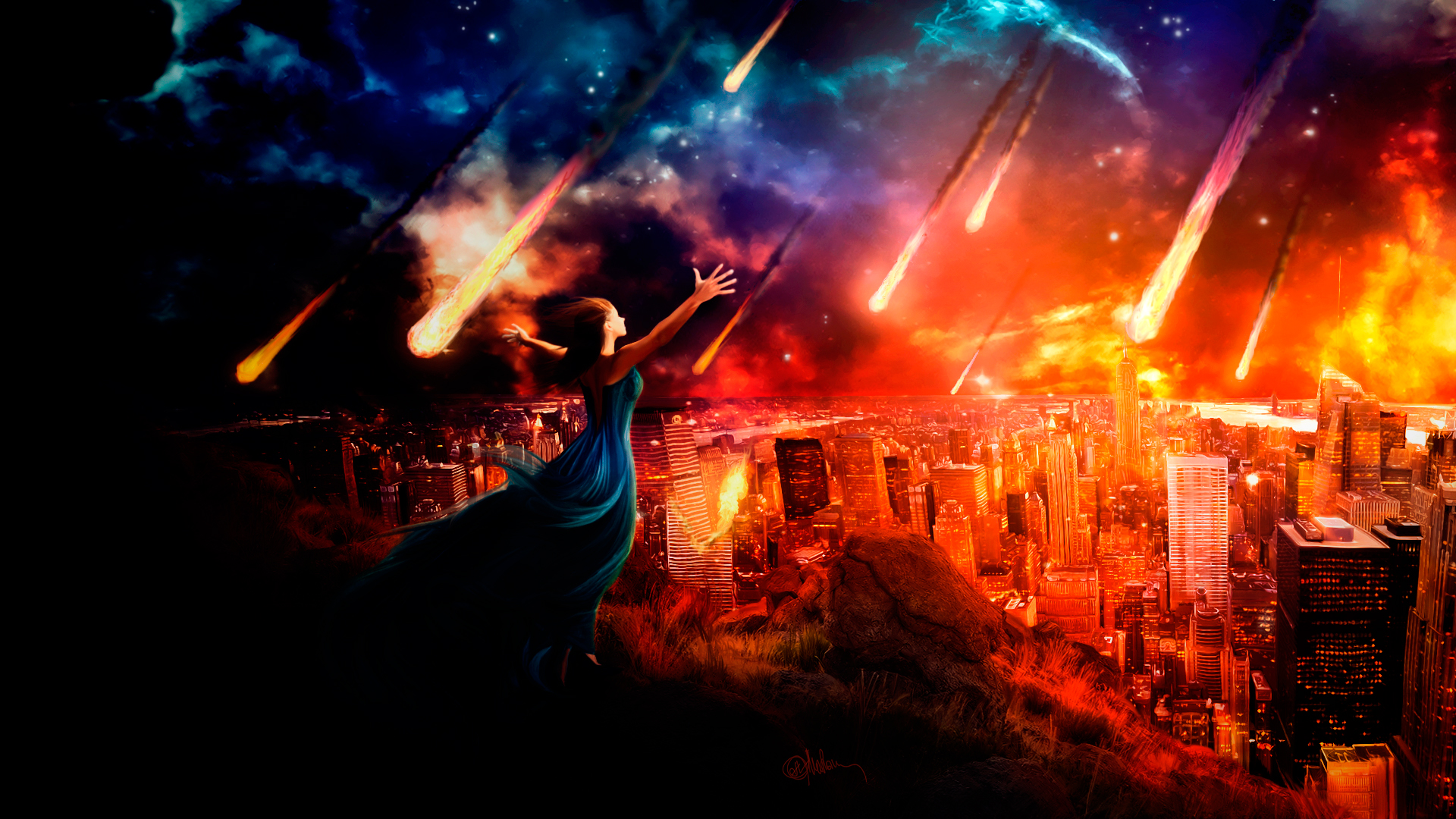 |
Source. This really sums up my feelings on Dark World sci fi. |
Learning new words is fun!
In my last article, I deliberately blurred the lines between cyberpunk, dystopia, and apocalyptic/post-apocalyptic fiction. Cyberpunk is often a style feature in both apocalyptic/post-apoc and dystopian fiction. All three of these tend to be more planet-centric than galaxy-centric sci fi; where some media (Mass Effect, Star Trek, Doctor Who, Dune, Star Wars) focus more on building a big, shiny universe to play in and tour around, these three genres tend to stick to one planet or even one city. I’ll get to a couple of exceptions to the ‘limited travelling’ idea in a minute, but let’s lay the terminology down first. Also, you might want to keep Google or GoodReads open in the side so you can look up some of these titles.
In case cyberpunk just sounds like the word you’d use to describe your smart-ass IT guy, I’ll clarify—cyberpunk is fiction with a heavy focus on mixing analog and futuristic technology into daily life. It tends to be gritty, noire-influenced stuff with an existential bent. Transhumanism and equality issues are often themes, as well—the nature of humanity, of reality, changing social roles, and all the ‘fun stuff’ that comes with it. Think of BladeRunner, Johnny Mnemonic, the Sprawl series by Gibson, the anime Ghost in the Shell, or, of course, The Matrix trilogy. It’s sort of a heavily 80s/90s influenced version of steampunk. I’m going to avoid a discussion on all the ‘punk’ subgenres, and get back to the other types of dark-world fiction.
Apocalyptic fiction can be loosely described as fiction about how everything goes to hell. Post-apocalyptic fiction (such as The Road by McCarthy, Brown Girl in the Ring by Hopkinson, or many zombie books) takes place after everything’s gone to hell already. Desert Punk is another anime example; the Fallout series is probably the most famous post-apocalyptic game set out there, though Metro 2033 is a very good one too. The Terminator and Tank Girl also technically count as post-apocalyptic fiction, too.
A dystopia is, as mentioned in this article, a ‘bad world’, often characterized by totalitarian governments, personal controls, lack of freedom, poverty, and a struggle for survival. The Fade by (author) is a good example. Of course, 1984 by Orwell, Brave New World by Huxley, Fahrenheit 451 by Bradbury, A Clockwork Orange by Burgess, Lord of the Flies by Golding, and I Have No Mouth And I Must Scream by Ellison are famous, even ‘classic’ dystopias. For film media, Dark City is a pretty excellent dystopian movie, and Metropolis (both the black-and-white and animated versions) also serves as another fine example. As mentioned previously, even the two Portal games (part of the Half-Life series) fit into this category.
All of these together fall into the realm of ‘Dark World Sci Fi’, though fantasy elements sometimes sneak in. For obvious reasons, they often overlap heavily; it’s easy to have a post-apoc book that involves a dystopian government or living situation, and survivors might use cybernetic implants (a cyberpunk element) to get by in fights to the death. The Mad Max series, The Ballad of Halo Jones, Firefly, Lexx, and a novel I’m going to review a bit today—The Biomass Revolution and its companion, Squad 19, by Nicholas Sansbury Smith—all make use of overlapping aspects of the terms I mentioned above.
 |
I'm focusing on it because I liked it. |
Oh hey, another book!
Shameless plug time—I came across this remarkable book and then got to help a little with its development; it’s very timely, and I’m about to explain why it’s both a) awesome and b) relevant to the points about why dystopias have gotten the limelight lately. The Biomass Revolution kind of sounds like a sci fi diet plan if you glance at the title alone, but the pretty wasteland cover and the poetic opening immediately tell you which genre you’re in.
The thing that got me about this book is the fact that it wasn't just a technothriller sort of romp. I was expecting that from some parts of it--charge through wasteland, shooting baddies, being big damn heroes. The book focuses on corruption and makes no bones about its political stance, but little details like the dead wives of the leaders really come back to haunt one. Even the 'bad guys' are people. And when civilians get caught in the crossfire, they aren't just meatbags of dramatic convenience. They have names.
The tone is nicely dispassionate, and Sansbury Smith does a good job of referencing reasonable technologies and current issues. They're hauntingly familiar issues; energy, resource wars, conservatism echoing the non-interference Monroe Doctrine of the early World Wars, and, ultimately, the desolation that results. There are haves and have-nots. Immigrants and deviants are treated badly, while people in the right places get off scot-free. It's heavily inspired by its predecessors, but still manages to add to the genre. I'll admit that some of the content has a video-gamey feel to it, which might turn some readers off, and a lot of the characters are very big and very muscly types. However--it all works. It strives for cinematic rather than silly details, and it works.
Getting back on topic...
The thing about DWSF (Dark World Sci Fi; see above) is that the entire field is built on societal subversion and questioning the system. That makes it one of the darkest types of entertainment, almost as dark as horror (an entire field devoted to primal fear responses) and sometimes darker. DWSF is about how wrong things are in the world, and how characters attempt to fix them. Unlike other books, the heroes don't necessarily succeed, either. Sometimes, they just ameliorate things temporarily, but are eventually screwed over by the crushing weight of the world.
There's always that glimmer of hope, though, and it is a little brighter when the surroundings are bleaker. I'd like to think that the reason people love Dark Worlds stuff is that they like a taste of hope that's sharper than usual. However, my suspicions are more sinister. Tune in soon to find out exactly why I think people really dig the dark stuff.
There's always that glimmer of hope, though, and it is a little brighter when the surroundings are bleaker. I'd like to think that the reason people love Dark Worlds stuff is that they like a taste of hope that's sharper than usual. However, my suspicions are more sinister. Tune in soon to find out exactly why I think people really dig the dark stuff.
*****
Thanks for dropping by the nest once again. Don't miss any of the phuquerie. Find me on Twitter, Facebook, and on Tumblr. More interviews and witty commentaries are coming. Keep checking back to see those surprise posts, too. This is your darling SciFiMagpie, over and out!


