About Me

My photo
Author of queer, wry sci fi/fantasy books.
Showing posts with label bioshock. Show all posts

Wednesday, 19 June 2013

The End is Nigh, Part 1: The Biomass Revolution and Other Tales

Hello hello!


As those of you who’ve strayed near a movie theatre in the past couple of weeks may have noticed, there is a very noticeable trend to this summer’s hits. My Facebook feed has been on fire with reports that This Is The End is hilarious and gritty; The Purge has been racing through theatres as well. Catching Fire (which I plan to both re-read, watch, and review) has been advertising itself frequently, as has World War Z, which has been putting much more of an emphasis on the end-of-the-world bits than the zombie bits.

Trend-counting time: we had vampires and werewolves, then a slight interest in dystopias (especially with a dose of romance), a raging surge in zombie fiction and media, and now, we’re hitting a wave of proper dystopian works. What’s up with that? I had some theories before—basically, ‘challenges are fun and so is destroying stuff’—but it’s time to re-evaluate and see whether more forces are at play. I’ll be name-checking some of those previous references in this round, so don’t be surprised if my recommendations and examples have some overlap.


This is going to be a two-parter; in the first half, I’m going to give you some terms and some media, and in the second, I’m going to talk about why everyone is in love with the end of the world more than usual.

Without further ado, let’s talk about some terms.
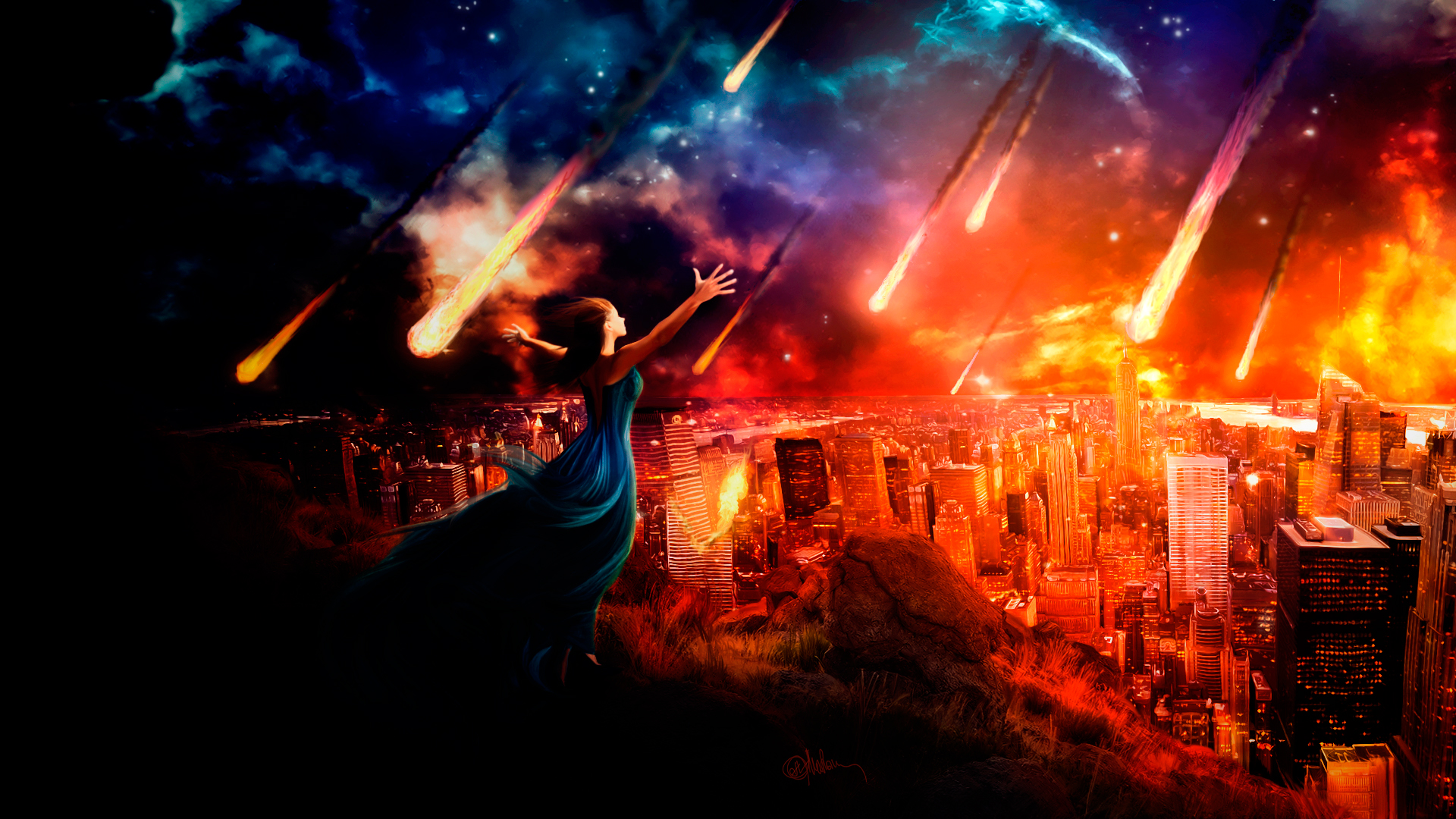


Source. This really sums up my feelings on Dark World sci fi. 


Learning new words is fun!

In my last article, I deliberately blurred the lines between cyberpunk, dystopia, and apocalyptic/post-apocalyptic fiction. Cyberpunk is often a style feature in both apocalyptic/post-apoc and dystopian fiction. All three of these tend to be more planet-centric than galaxy-centric sci fi; where some media (Mass Effect, Star Trek, Doctor Who, Dune, Star Wars) focus more on building a big, shiny universe to play in and tour around, these three genres tend to stick to one planet or even one city. I’ll get to a couple of exceptions to the ‘limited travelling’ idea in a minute, but let’s lay the terminology down first.  Also, you might want to keep Google or GoodReads open in the side so you can look up some of these titles.

In case cyberpunk just sounds like the word you’d use to describe your smart-ass IT guy, I’ll clarify—cyberpunk is fiction with a heavy focus on mixing analog and futuristic technology into daily life. It tends to be gritty, noire-influenced stuff with an existential bent. Transhumanism and equality issues are often themes, as well—the nature of humanity, of reality, changing social roles, and all the ‘fun stuff’ that comes with it. Think of BladeRunner, Johnny Mnemonic, the Sprawl series by Gibson, the anime Ghost in the Shell, or, of course, The Matrix trilogy. It’s sort of a heavily 80s/90s influenced version of steampunk. I’m going to avoid a discussion on all the ‘punk’ subgenres, and get back to the other types of dark-world fiction.


Apocalyptic fiction can be loosely described as fiction about how everything goes to hell. Post-apocalyptic fiction (such as The Road by McCarthy, Brown Girl in the Ring by Hopkinson, or many zombie books) takes place after everything’s gone to hell already. Desert Punk is another anime example; the Fallout series is probably the most famous post-apocalyptic game set out there, though Metro 2033 is a very good one too. The Terminator and Tank Girl also technically count as post-apocalyptic fiction, too.


A dystopia is, as mentioned in this article, a ‘bad world’, often characterized by totalitarian governments, personal controls, lack of freedom, poverty, and a struggle for survival. The Fade by (author) is a good example. Of course, 1984 by Orwell, Brave New World by Huxley, Fahrenheit 451 by Bradbury, A Clockwork Orange by Burgess, Lord of the Flies by Golding, and I Have No Mouth And I Must Scream by Ellison are famous, even ‘classic’ dystopias. For film media, Dark City is a pretty excellent dystopian movie, and Metropolis (both the black-and-white and animated versions) also serves as another fine example. As mentioned previously, even the two Portal games (part of the Half-Life series) fit into this category.


All of these together fall into the realm of ‘Dark World Sci Fi’, though fantasy elements sometimes sneak in. For obvious reasons, they often overlap heavily; it’s easy to have a post-apoc book that involves a dystopian government or living situation, and survivors might use cybernetic implants (a cyberpunk element) to get by in fights to the death. The Mad Max series, The Ballad of Halo Jones, Firefly, Lexx, and a novel I’m going to review a bit today—The Biomass Revolution and its companion, Squad 19, by Nicholas Sansbury Smith—all make use of overlapping aspects of the terms I mentioned above.


I'm focusing on it because I liked it. 


Oh hey, another book!


Shameless plug time—I came across this remarkable book and then got to help a little with its development; it’s very timely, and I’m about to explain why it’s both a) awesome and b) relevant to the points about why dystopias have gotten the limelight lately. The Biomass Revolution kind of sounds like a sci fi diet plan if you glance at the title alone, but the pretty wasteland cover and the poetic opening immediately tell you which genre you’re in. Biomass combines the ripping thrills of a technothriller with the darkness of a dystopia. The moments of beauty in its atmospheric descriptions can be heartstopping--a unique book, that show itself to be far more than it appears at first glance.


The thing that got me about this book is the fact that it wasn't just a technothriller sort of romp. I was expecting that from some parts of it--charge through wasteland, shooting baddies, being big damn heroes. The book focuses on corruption and makes no bones about its political stance, but little details like the dead wives of the leaders really come back to haunt one. Even the 'bad guys' are people. And when civilians get caught in the crossfire, they aren't just meatbags of dramatic convenience. They have names. 

The tone is nicely dispassionate, and Sansbury Smith does a good job of referencing reasonable technologies and current issues. They're hauntingly familiar issues; energy, resource wars, conservatism echoing the non-interference Monroe Doctrine of the early World Wars, and, ultimately, the desolation that results. There are haves and have-nots. Immigrants and deviants are treated badly, while people in the right places get off scot-free. It's heavily inspired by its predecessors, but still manages to add to the genre. I'll admit that some of the content has a video-gamey feel to it, which might turn some readers off, and a lot of the characters are very big and very muscly types. However--it all works. It strives for cinematic rather than silly details, and it works. 


Getting back on topic...


The thing about DWSF (Dark World Sci Fi; see above) is that the entire field is built on societal subversion and questioning the system. That makes it one of the darkest types of entertainment, almost as dark as horror (an entire field devoted to primal fear responses) and sometimes darker. DWSF is about how wrong things are in the world, and how characters attempt to fix them. Unlike other books, the heroes don't necessarily succeed, either. Sometimes, they just ameliorate things temporarily, but are eventually screwed over by the crushing weight of the world.

There's always that glimmer of hope, though, and it is a little brighter when the surroundings are bleaker. I'd like to think that the reason people love Dark Worlds stuff is that they like a taste of hope that's sharper than usual. However, my suspicions are more sinister. Tune in soon to find out exactly why I think people really dig the dark stuff.


*****
Thanks for dropping by the nest once again. Don't miss any of the phuquerie. Find me on TwitterFacebook, and on Tumblr. More interviews and witty commentaries are coming. Keep checking back to see those surprise posts, too. This is your darling SciFiMagpie, over and out! 


Sunday, 20 January 2013

A Shady Dive: An In-Depth Analysis of The Bioshock Games

Hello hello!


Well, I'm definitely late to the party on this one--last Sunday involved far too much work and phuquerie. However, I'm here now, and ready to give you what you really want. That's right...it's time to bear it all, for...THE BIOSHOCK REVIEWS!


Andrey, the long-suffering and patient gamer and partner, lets me sit in when he plays an RPG. When he finally bought Bioshock 2 on sale, and mentioned that Bioshock Infinite will be coming out in a few months, I decided there was no time like the present to remind the internet why these games are amazing and worth a replay. Sure, they're well put-together, but you've already read the blogs about combat mechanics and design. Today, we're going to use brains.

Hey! Come back here! I promise it won't hurt. Put down the crucifix. That's better. Now, let's get cracking and figure out why we all love these damn games so very much. There's more to it than the gameplay, I assure you.

The review is loaded with spoilers, so if you haven't played it yet, look at the pictures and skim read. Play the games, and THEN get back here to enjoy the discussion. Good? Good.

One more round. SPOILERS SPOILERS SPOILERS! SPOOOOOOILERS! There.

So, why is Bioshock so interesting and so appealing? 

Most people, when asked, will shrug and cite a good storyline, or the gorgeous dieselpunk (not steampunk, thank you) setting, or the fact that you get to clomp about in a giant freaking tank suit. The design is admirable, and we'll get to it in a moment, but there's a lot more to the games than scary little girls and freaky, deformed monsters. Whether you've played these games or not, we're going to find out why they're good. By the end, you'll know why you need to either a) run back to your computer and replay them, or b) find a friend who likes to play, and sleep over at their house until they finish a marathon of both games and you dream of roaring bronze monsters and crave sushi constantly.

So, what's the big deal?

This.


Source. Welcome to Rapture. Population: who knows, but they all want to kill you.


First, it's too damn pretty to ignore. 


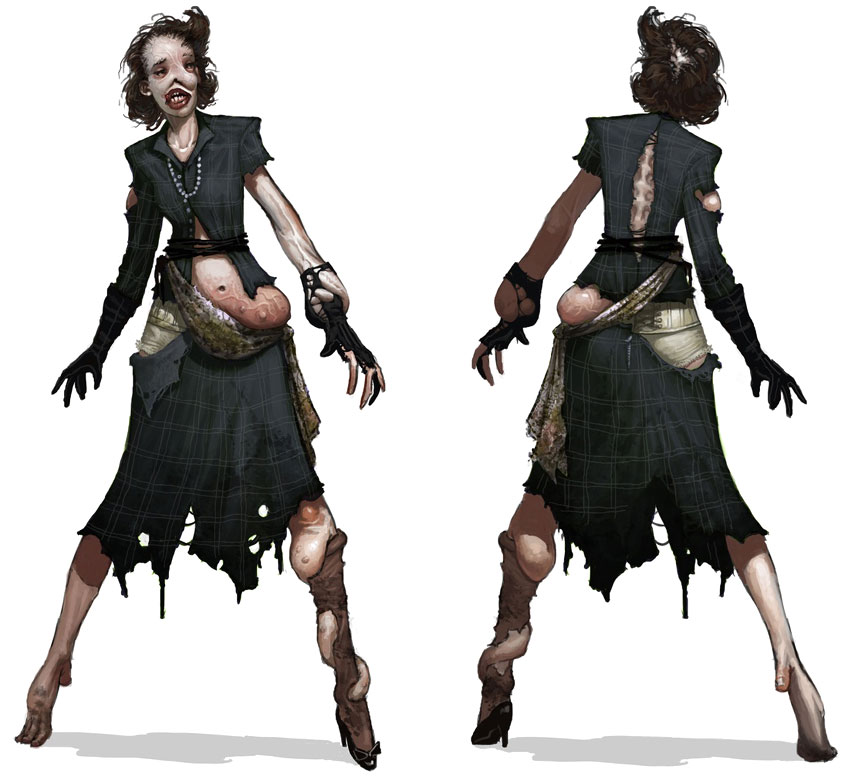
We'll start with the aesthetics, because they're easy. For those unfamiliar with dieselpunk, the descriptor is best applied to that between-wars look with lots of rivets and shiny bronze and brass. There's a decopunk element as well. Artistic elements in Bioshock all match the game's themes, taking the gloss and elegance of an earlier era and twisting and warping it. The leaks in Rapture represent the holes in any ideal paradise, and like a classic dystopia, the things that made it elegant soon become horrible. The grand city no-one walks in, the moulding wallpaper and grim-eyed fish swimming around the towers, call to mind Cthulu and Dagon as much as Atlantis. In this modern Atlantis, with its Greco-Roman themes, the effect is closer to Limbo than Heaven.

The ideals Rapture was founded on are just as leaky and imperfect as the city, and are, at their extremes, just as much of a deathtrap. They belong to an earlier era, and are preserved there, unchanging. We all love seeing beautiful buildings and settings, but seeing them destroyed is even more appealing. When you get into the head of a Little Sister in Bioshock 2, and you see the world through their indoctrinated eyes, everything is well-lit, luxurious, and elegant. Seeing the world without the girl's eyes in the way only heightens the effect of the nightmare, and I couldn't decide whether the falsely sweet image or the ruins were scarier. There's something compelling about gorgeous ruined buildings. It's a sort of poke at mortality, not just our own, but the eventual inevitable mortality of culture as well. We know it will all be over, and seeing it in an imaginary way is irresistible.

There's all that stuff about peering into the abyss and it looking back to you. In Rapture, those metaphors have a nasty tendency to get literal. It sits on a precipice both figuratively and literally, lost in its own conflict and ultimately doomed, rather than being the intended precipice of a new era. The only 'hope' is a lighthouse in the middle of the sea. Think about that. The middle of the phuquing sea. Who's going to find it? Rapture is a dead end, as any paradise is, and the long hallways that lead to corpse after corpse only confirm this. However, as with any near-death experience, Rapture also offers rebirth for both your character and a few other decent souls, like Tenenbaum. In this way, Rapture is also a womb, another symbol linked with the sea and death.

But wait, there's more! Act now!


What really captivates in Bioshock, though, is the literary merit and moral struggles. An underwater war of morality with few clear rules is interesting enough, but the literary and cultural references really make the game. It's the ultimate showdown between Ayn Rand and hippie Communist neo-Buddhists. No, really. Both Bioshock games focus on societal theories and what happens when they're enforced as perfectly as possible. I'm not the first commentator to notice this, but I'm not going to jam the literary references down your throat the way most commentaries do. Good? It's okay. You can come out of the corner of the room now.


Freedom Will Kill You: Bioshock 1


In Bioshock 1, we're introduced to Rapture. Andrew Ryan, your standard mad/eccentric gajillionaire, decides that he's had enough of them damn government controlling types and those assholes who believe in ethics. He decides he'll build his own paradise, with blackjack. And hookers. The thing is, Ryan also believes in freedom of all kinds in all degrees. The repression of the self is ultimately at the cost of betterment of society, the social support system breeds mediocrity, and that science should be allowed to advance unhindered. I probably don't have to tell you that the logical extremes of anything tend to be really, really poor decisions.

Of course, Ryan's attempts to give people ALL the freedom result in having to go in the opposite direction to quell the inevitable chaos, and Rapture turns into a police state, complete with martial law and secret police. The lesson is that fascism isn't actually that far from semi-anarchic libertarianism, and arguably, is one of the only possible direct results. There's sort of a Nietzschain theme here, with the 'every man kills the thing he loves' idea being demonstrated in heartbreaking clarity. Ryan wants freedom for all intellectuals, but he refuses to understand his actions' results, and therefore loses it.

The experiment was doomed to failure, but throw in selfish applications of science, and you have the reason Rapture unravels. The ideology was 'leaky' enough. When combined with the discovery of plasmids and ADAM, the access to instant personal enhancement and superpowers of various kinds really makes the system fall apart. Not only do people become addicted to plasmids, scientists develop a weapon to control the insane and mutated addicts that is just as horrible as the addiction's effects on the Splicers. I'm referring, of course, to the Little Sisters.


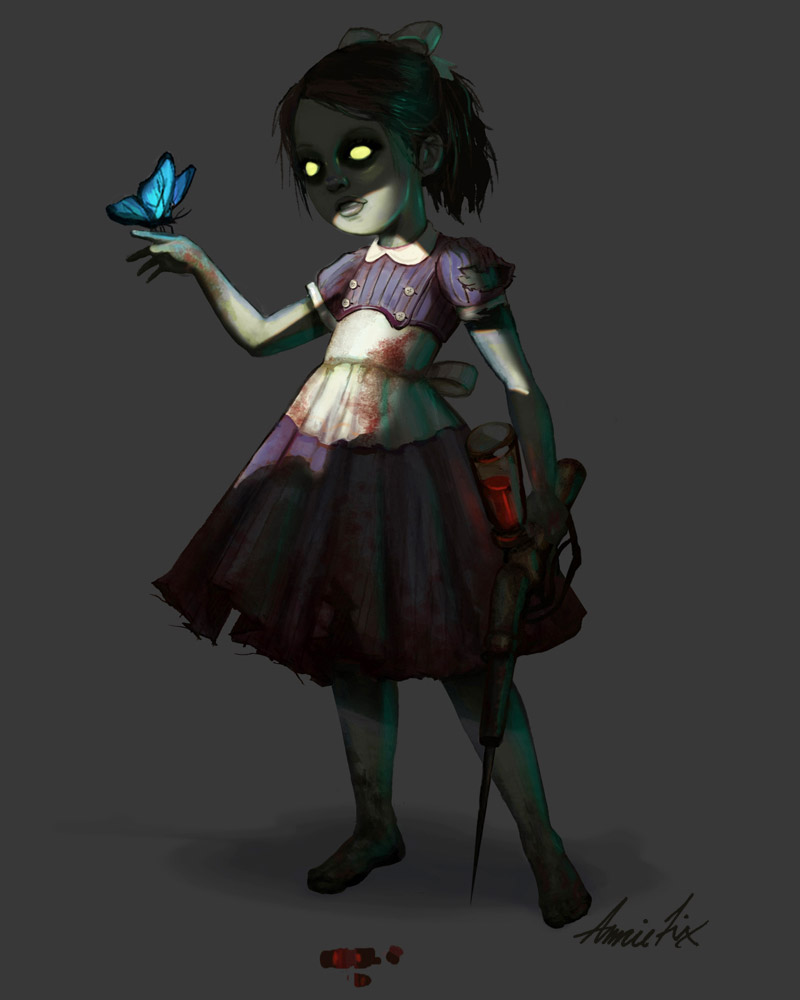
Source.  While evil little girls are nothing new, Bioshock reminds you that it'snot actually okay to kill them.  


The Little Sisters are followed around by their protectors, the Big Daddies, who were conditioned to be their protectors in the most painful ways possible. They're living examples of science gone wrong, logical extremes of experimentation when the test and results outweigh the method. The 'evil scientist' stereotype here is softened by Tenenbaum's attempts to free the girls she experimented on. In the first Bioshock, you literally become one of the monsters you're trying to save, and in the second, an indoctrinated 'ubermensch' girl who bonds with you shows the humanity beneath the terrifying mask.

The really interesting thing in Bioshock one is that the society starts as a lovely, civilized world, and it's science, technology, and growth unrestrained by morality that result in a huge leap backwards. The game gives us a nice tour through the corruption in Rapture, but doesn't really preach a particular doctrine while it condemns Ryan's philosophy.

Perhaps that's not entirely true--it does preach that there are certain lines of morality that shouldn't  be crossed. It's not that ADAM itself is evil--though the slugs do represent the fruit of knowledge--but the way it's used, for vanity and cheap thrills, is condemned. Most importantly, though, the game wants us to know that hurting children is bad. Really. The kids are cute, and you have countless opportunities to save the girls rather than ripping the ADAM-loaded slugs out of their throats. Getting a happy ending requires sticking by moral principles based on human decency. You can harvest the little girls for ADAM and get the power you need to defeat Ryan, but if you do, you'll pay for it and Tenenbaum will condemn you.


Source. Stare at this for a while and try to sleep peacefully. Good luck. I didn't.

Confessions of a Former Neo-Buddhist Infatuation and Psuedoscience Junkie: Bioshock 2


Of course, as we all know, the best solution to going too far in one direction is becoming an extremist in the other direction. Sophia Lamb, a psychiatrist, is brought to Rapture by Andrew Ryan in order to treat the population. Going against his doctrines and anti-religious, anti-compassion ideals, he imports the good doctor and she sets about going into full-bore psychobitch mode.

The doctor's techniques, of course, end up resulting in the development of a religious cult and Lamb deposes Ryan once he's passed away. Her followers are somewhat protected, but her package of love and self-understanding is still candy-coated poison. She's sort of communist, but her society's underlying morals are meaningless in effect; she ends up running a world too similar to Ryan's for comfort.

In addition to that, her attempts to create an 'ubermensch' daughter to 'redeem' the splicers, and the constant use of her blue butterfly symbol in-game feed into more themes. She refers to love as a 'chemical' process and continues the Evil Heartless Scientist schtick from the first game. Of course, Eleanor has developed a conscience, free will, and is not interested in Mommy's ideas about forcing people to be saved. She comes to you for help, invading your thoughts, and with the help of Tenenbaum and August Sinclair, justice is served and lives are saved. Oh, and Rapture finally falls into the abyss, taking the few Splicers you haven't killed with it.

We interrupt this examination of idealism to bring you...Daddy and Mommy Issues! 


I haven't really addressed the fact that the Little Sisters' protectors are known as Big Daddies. In the first game, your nameless chain-tattooed character becomes a Big Daddy with Tenenbaum's help, and after he kills his own father, Andrew Ryan, becomes a father to the Little Sisters he saved, raising them in the normal world and giving them normal lives. At the end, he dies of old age and happiness. The second game explores a mother's attempt to mould her daughter into something perfect, and their competition, as well as the way your character 'fathers' Eleanor the saviour. There's a bit of a negative portrayal of mothers in both games; at best, they're ambiguous characters with huge flaws. Father figures--Ryan excepted--are the heroes.
The fact that the game manages to dodge the 'creepy predator' or Lolita dynamic so well is testament to very careful writing, but even with the Big Sisters added to the roster in the second game, it's still a 'dads as heroes' bias. I'm not saying that's wrong, but I do think it's interesting that fathers in video games tend to be traitors, ambiguous characters, or absent. In a way, Bioshock returns us to a fairy-tale style morality system. Eleanor is even shown asleep in a glass chamber, with her 'wicked witch' mother standing guard and ready to strangle her. Not cool, game.

I'd like to see a lot more heroic mothers in gaming, period, but it's sort of nice to see the paternal side of the dynamic portrayed in a healthy, pleasant way. I do have mixed feelings about some of the heavy-handed applications of morals, though, and it still bothers me that the Splicers can be killed pretty indiscriminately while you save the girls. Ultimately, the hellish 'family life' of Rapture is something that can be overcome for a normal life, and even if you've done evil things, you're worth saving and redeeming (since you can keep Sophia Lamb alive). Still, there are some elements there that make me twitch, such as the 'little girls are perfect and innocent' theme. Hopefully, Bioshock Infinite will go in a different direction, though I'm fine with the 'killing children is bad' motif sticking around, personally.


Source.  More kick-ass armour is okay, though, in the next games. My only regret with the Big Sisters is insufficient playtime to try them out


So, why do we love it? 


In a world of RPGs that force you to come to your own conclusions and actually reward dickish behaviour, the non-judgement of Bioshock and its hardline 'don't hurt people' morality is really refreshing. There are lots of rewards for being a good person and lots of symbols and ideas to think about while you romp around, fighting Splicers. Even the most horrifying characters are granted a degree of humanity and have good reasons (sort of) for their actions. It's impressive, moving, and likely to make you tear up.

Furthermore, as I've explained, it's a game that will stay with you. I wouldn't have analysed all this--and neither would the other thousand or so bloggers--if it hadn't resonated with us, moved us. The replays are worthwhile just for the sake of enjoying the nuances. The antagonists and protagonists have layers. The voice acting is damned good. And ultimately, no matter how awful things get, redemption is there. There is a happy ending, where love triumphs and idealism doesn't matter a damn bit. The idea that common humanity can overtake all the crap we put each other through, that's something everyone across the political spectrum can enjoy.


*****
Thanks for dropping by the nest once again. Don't miss any of the good kind of crazy. Find me on TwitterFacebook, and on Tumblr. I've got a few reviews to catch up on, more news coming, and even some fantastic interviews with fellow authors. Stay tuned and please share. This is your darling SciFiMagpie, over and out!
Google+