About Me

My photo
Author of queer, wry sci fi/fantasy books.
Showing posts with label Mass Effect. Show all posts

Sunday, 27 July 2014

D%&$ It, Bioware, I Was Using That Heart: Mass Effect Revisited

Hello hello!

So, my turbulent and ultimately ill-fated love affair with the Mass Effect trilogy is pretty well known at this point. In case you missed all that, you can find info here, here, and here. There are

SPOILERS SPOILERS SPOILERS


 about the first three games at all six of those links, by the way. I've written about this series a lot, and one of the reasons I love Farscape so much is that it gave me what I was hoping for from Mass Effect, but without the most tragic backstory ever written.

Well, the release of the fourth game in the franchise has been revealed at--where else?--the San Diego Comic Con. I waited with baited breath as I clicked on the link, hoping for a reveal of the future of the universe.


 Source: Cheezburger.


The next game is going to happen concurrently with the events of the last one, ME3. You know, that game. The one that ruined a company's reputation, earned EA the "Worst Company of the Year" award in 2012, and was universally hailed as a clusterphuque of earthshaking proportions. The original ending was so universally hated, they ended up revamping it with extended narration and explanations of the consequences. More on the extended endings in a minute. But all the phuquerie that resulted from that terrible, cliched, tropey, backstabbing of an ending happened because gamers felt betrayed. I was even one of them, and I shed my tears with the rest. But why? And why did I get a bad case of feels when I finally watched the extended cuts today?

What went wrong?


I'll try to keep this short because it's been discussed elsewhere. The problems with the ending boil down to five things.

First, the ending felt too simplistic compared to the complex and multilayered games that preceded it. The endings of the first two games were heavily reliant on previous actions, with Mass Effect 2's ending being the best example of that. Perhaps all the storylines they had going ended up collapsing on their own weight, but I think most of us expected some sort of large final battle where the results were determined by resources and alliances accrued and accumulated during the rest of the games. That isn't what happened. Like, at all.

Second, Shepard dies unnecessarily...or lives, if you (possibly) sacrifice all Geth and Synthetic life. I'm not restating that blog post about why hero death is a stupid and borderline unhealthy trope, but here's another link to it.

Third, the Starchild is a stupid and unnecessary brat with terrible voice acting and worse writing. The Illusive Man, a Geth, EDI herself, a Keeper (you know, those plot device bugs who were never used for anything in spite of substantial build-up in the first games?), or even, why not, the Rachni Queen, would all have been better choices. Sure, you have the little weird kid running around in Shep's head through the first half of the game, but freaky children are a stupid cliche at best, and it didn't belong in this game. Add in all the stuff about madness in the excellent DLCs for the series and you have a sinister perspective on the little brat--who, we are somehow supposed to believe, is some kind of peaceful and neutral force. You choose the McGuffin or you epic-fail. I actually love the new fourth ending, but the last time I saw an ending this hamstrung was at a sex show involving bondage and oral pleasure. At least with the "refusal" option, the stupid storytelling bit at the end makes sense.

Fourth, your team crash lands on a random planet for no particular reason. Why? Why did this happen? Why did they get sucked into a portal? Sure, the extended endings fix that up a bit, but why does this even occur?

Fifth, that stupid damn storyteller ending. I love Synthesis, and I can stand Destroy because Shepard lives, but Control always felt evil to me. And yet all three of these end with a stupid cutscene after the credits that even Buzz Aldrin's cameo couldn't save. The Starchild voice actor returns (shudder) and an old man tells him he might go to the stars...in a way that implies all knowledge of space travel has been lost. That blatantly contradicts two of the three endings, and worse, the "tell me another story about the Shepard" bit teases us with the false promise of another game about our protagonist. You know, the game they promised they'd never make. This storytelling ending actually makes sense for the Refusal ending, which was the most coherent, but the fact that they left it in the extended endings felt like a slap in the face.


This is basically how I feel about the whole thing. 

Why are we rehashing all this?


Oh, there's a reason. The new game will be set at the end of the third. Are they going to retcon the ending? How will they deal with the incredible fame of Shepard's character if your character is just some scrub? Are you going to have somehow never heard of the most famous person in the galaxy, a.k.a. Space Jesus? It's going to focus on the multiplayer side of things, sure, but this feels like a stall for time. My partner called it a money-grab, and not the real sequel, and added, "unless I'm absolutely wrong, you can completely ignore this game." Did I mention that they explicitly promised the next game would be set in the far future?


Okay, fine; how could you possibly fix it?


Just abandoning the series--which would actually be wise--probably isn't a viable option. A jump backwards in time would have solved a lot of their problems, and quite a few fans have been hoping for something set during the human-Turian First Contact War. Jumping drastically far forward into the future would also be an option.

What I'd love to happen, as much as I will weep angry tears over the impossibility of it, would be a proper exploration of the Synthesis ending. The extended version hints that a golden age was dawning, but change is scary. There's plenty of conflict you could mine from the sudden friendliness of the Reapers, the ancient technologies gifted to the unprepared galaxy, the fact that all races and species have the possible opportunity to be immortal, and the equalization forced on everyone. Diplomacy games! New wars! Playing as a Reaper! Dealing with grieving! New conflict rising as unknown or rare civilizations are encountered! Religious conflict! All the ingredients of amazing story potentials are right there, and there is no way we'll get to play with those toys.


Synthesis in a nutshell. 


The lesson in all of this is that creating a series is hard, and kind of dangerous. It's hard to please fans at the best of times, but the more complicated your world gets and the more plot devices and plotlines you pile on, the easier it is to screw them up. Terry Goodkind's The Sword of Truth series is the only one even close to Mass Effect in terms of McGuffin implosions, and that was a mess too. The lesson is that introducing endless plot mechanics and shiny toys is a bad idea. And sometimes, you just have to pretend something didn't happen and move forward with the story instead of trying to fix an old problem that's basically unrepairable. Writing is not always fun and it's rarely "easy", but at least we can learn from the failures of others.

*****
Thanks for dropping by the nest once again. Don't miss any of the phuquerie. Find Michelle on TwitterFacebook, and on Tumblr, and find her work on Amazon. Check back on the blog to see when one of the irregular posts has careened onto your feed. This is the one and only SciFiMagpie, over and out! 

Sunday, 28 April 2013

Strong Women, Weak Fathers: Daddy Issues in Sci Fi

Hello hello!

As some of you who follow my Twitter phuquerie know already, I am a recent convert to Doctor Who-ism. I'm also a Farscape and Lexx fan and pretty fond of Mass Effect. Star Wars is a childhood favorite. My literary science fiction fair tends to be pretty diverse and focus on subgenres, so it's TV and by-proxy gaming that provide a lot of my mainstream sci fi fixes. I'll warn you right now. There are

SPOILERS SPOILERS SPOILERS 

for a few of these and of other sci fi games to come, so don't say I didn't warn you.

You might notice that these are mostly 'quirky' programs. I'm going to be exploring some sci fi cliches in a future post, and also examining how science fiction handles other equality issues, but my remarks today are going to centre on some things I noticed while watching the Ninth and Tenth Doctor's only and first seasons (respectively). I noticed them while enjoying Mass Effect, too.

What is it you say?

It's daddy issues. Strong female characters who are otherwise well-developed are invariably hamstrung by family or daddy issues; it's chronic for romances. This is one of sci fi's few regressive afflictions and it NEEDS to stop.


Source. This character arc is done extremely well...but the fact remains that  there are some uncomfortable parallels between her father and the Doctor in terms of personality.


Daddy issues?


I can hear you protesting already. "But Magpie, it's normal for characters to have family trauma! Chriton has daddy issues in Farscape too!"

The thing is, male characters with daddy issues generally are trying to impress their fathers. Female characters have the emotional connection thing going on. They usually did not know their fathers or had a poor connection. In Doctor Who, Rose's father died when she was a child (though she later meets him). Liara's 'father' in Mass Effect ran out on her mother after marital problems. The Leia/Darth Vader thing in Star Wars is another example.

The problem with the daddy issues is that it is usually used to make the heroine more accessible to the hero. I wrote a long blog post about the love interests in ME and their issues some time ago--I give some points to Tali for trying to impress her father as a son would, but Tali, Liara, Ashley, and Miranda all have enormous daddy issues. EDI does not have these (unless you count Cerberus as her father....) and Morinth and Samara also lack them...but none of these can be properly romanced. Jack doesn't have daddy issues but did have a severely traumatic childhood nonetheless. Compare the male love interests' issues--Garrus has duty and honour, Kaiden has the biotic thing, and Thane--who does, admittedly, have the issue with his son--mostly is concerned about his wife. Jacob does have daddy issues as well, but he's the only one.

A few series manage to avoid this issue, but those characters aren't usually love interests. Consider Zev in Lexx.  She doesn't have daddy issues, but like Jack, she does have a traumatic/unnatural childhood. I don't watch Battlestar Galactica, but a quick info check on Wikipedia revealed that even hard-drinkin' and sharp-shootin' Starbuck had a traumatic childhood and was abused; her father was also conspicuous by his absence. Aeryn Sun, a personal favorite, had an absent father and grew up in a facility with restricted freedom. Admittedly, Starbuck and Aeryn both have romances in their series, but considering how powerful they are, the fact that they're hobbled by a similar past trait is interesting.

Diverting into the superhero world, more evidence of the rule of daddy issues OR being raised in an unnatural facility is easy to find. Spiderman's Gwen Stacy conflicts with her father. The Marvel X-Men are rife with it. Oh, not all females are abused, and plenty of the men go through the same sort of trauma (Batman's parents, for instance), but it's still a disturbingly consistent trend.


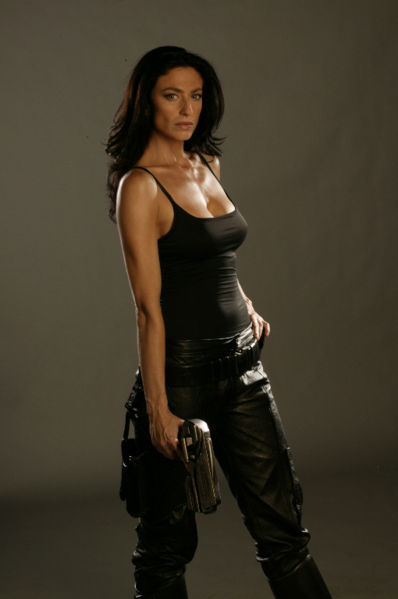
Source. This ass-kicking geek goddess was Morrigan in Dragon Age,  voiced two characters in Mass Effect, was a  main character in both Stargate SG-1 and Farscape, has been in Gears of War, and was in Pitch Black. 

Why is this happening? 


It's a reasonably well-known fact that girls often base their romantic expectations on their interactions with their fathers from a young age. I don't have information on how this is affected by orientation, but it definitely has an impact on the relationship's longevity and health. When I was still in classes and studying for my degree, the link between healthy parent-child relationships and attachment to a partner was a big topic of discussion. Without delving too much into psychology textbook territory, the cliche that problems are usually rooted in childhood has a nasty tendency to be true.

We see the echoes of this in science fiction. The ladies I've mentioned here often choose strong alpha male heroes to replace their absent fathers. Their damaged histories make them more approachable, giving the hero a shot at winning their hearts. It's as though a strong woman can only be made by childhood trauma and an absent father. Is it really necessary to suggest that the only way a woman is accessible is if she's had a terrible childhood? Would a woman with a healthy background look twice at these heroes, or--worse--would she be even more of a threat to them? None of them really lead independent lives without their love-interest heroes, who are usually implied to be quite fine standing on their own without said girlfriends. It would be nice to even suggest that these women would be fine without the men in their lives having come by to save and 'fix' them.

I have to give Farscape and Mass Effect and Portal some points though; all of these explored issues with the female character's mother in great detail, as opposed to blaming absent fathers for all of the issues. I also loved that Bioshock 2 had the father figure as the nurturing one and the mother as the villain. However...mothers are often absent when fathers nurture. I've even done that in my own writing. It's clearly a tricky balance. So why are mothers the next go-to villain?


Source.  If you look carefully, you can see that GLADoS does look like a bound, tied-up woman, as the designers intended. Also, her voice actress is an opera singer! 

Mommy Dearest--the scariest villain


Mothers as villains tie right back into the stories of our childhood. Most fairy tales across cultures focus on evil mothers. In fact, the Brothers Grimm originally collected tales about evil mothers and only made them stepmothers to avoid offending their audience. There are few things more frightening than the idea of the ultimate nurturer turning against us, the mother eating her children for example (something that literally happens a lot).

When you realize in Portal 2 that GLADoS is made of Carolyn's mind and that Carolyn was apparently Chell's mother (it's implied by the 'take your daughter to work day' stuff and a tiny shadow of Chell in the portrait of Cave and Carolyn in in Cave Johnson's office) the entire story becomes far more horrifying and touching. It's one of the many reasons I absolutely love Portal and why it's an effectively frightening and creepy game.


Does it need fixing?


Well...yes and no. The fact that heroines in romantic relationships invariably have daddy issues is kind of disturbing. It would be nice to see a healthy girl fall for a hero for once instead of having that too-easy emotional vulnerability set up in advance. Also, it implies that even in the far future, women will always be hamstrung by our family's expectations and previous life damage. I'm not saying that family trauma has to go away completely...but what about some siblings? These girls tend to be only children as well.

The weird thing is that women hamstrung by their families are all in sci fi. I've seen less of it--so far--in fantasy. Leiliana in Dragon Age comes to mind. When it is not a family issue, it tends to be a sexuality thing. Consider Molly of Neuromancer, a former call girl, or the many prostitutes in Phillip K Dick's work. So...sex and family define women in the world of the far future. It's not exactly reassuring and suggestive of societal advance.

On the other hand, the fact that these women are still strong and that all of them resolve their family issues is pretty reassuring. That's a good thing. I mentioned Lexx as a program I liked earlier, and the fact that Zev does not really have a family and that her issues centre on her training to be a wife as well as body-image issues makes her a nice deviation from the norm. However, she is a rare exception and the sort that doesn't get nearly enough air time. 

One could also argue that it gives a voice to women who've been abused or have had these sorts of traumatic childhoods. I don't know if I'm qualified to give an opinion on that, so I'd appreciate feedback on it in the comments. I can say, though, that science fiction and fantasy do offer both escape and inspiration during life's dark times, and that their usefulness in that respect alone definitely merit an article. You can expect that in a future post. 

Admittedly sci fi is still kind of a men's field and a boy's game, so that is probably part of the reason. However, I'd still like to see this change. There are female sci fi writers--and we should gently introduce this change. We can do better. Lots of books do. This is our gender role issue, the same thing as the presumed misogyny in so many fantasy settings. Time to step into the 21st century. We are so much more than just our families of origin or our childhood trauma. The future should reflect that, not merely echo our past.


*****

Thanks for dropping by the nest once again. Don't miss any of the good kind of crazy. Find me on TwitterFacebook, and on Tumblr. More interviews and witty commentaries are coming. Keep checking back to see those surprise posts, too. This is your darling SciFiMagpie, over and out! 

Monday, 25 June 2012

A Brief Comment About Mass Effect 3: The Extended Cut

Hello, everyone!

Well, it's virtually unavoidable: time to dig up a metaphorical dead horse and possibly beat it with a stick. You know what I'm talking about: the Mass Effect 3 ending fiasco.

Wait, what? You don't know what I'm talking about? Have you been on the internet since March? If you've avoided it, by intent or accident, this should help: my post about ME3. If that doesn't help explain some things, this post might: a reflection on why heroes die. Go read them and come back, if you're confused.

Okay, enough shameless self-plugging. At this point, our proverbial horse is basically a slowly fossilizing skeleton, already leaving immortal calcium deposits on the history of gaming. The mess Bioware got itself into by providing three very different endings with radically similar animation is now legendary, and will probably be the bete noire of gaming companies completing epic stories for years to come. After all, is there anything worse than slaving over a beloved game and pouring your heart into it, only to discover that fans resent your decisions and consider them an emotionally damaging pile of slapdash phuquerie?

As a writer and a casual artist, I have to sympathise, and say I can't imagine anything much worse than that. However, I'm also not part of a large corporation rushing me to finish something and forcing me to achieve consensus with dozens of other writers. And, for better or for worse, I don't have hundreds of thousands of fans breathing down my neck every time I make a decision they don't like (yet). At the risk of being a hypocrite, much as there are plot holes that the Normandy herself could pilot through with ease, I can see why they wouldn't want to change their own work.

However, I am a fan, and though I enjoyed at least one of the endings, the emotional dissatisfaction with similar animation and similar implications for all three was truly heartbreaking. There have been other games that caught my attention, and made my heart beat faster. There have been other games that made me truly care about the their protagonists, settings, and struggles. And yet, I have not seen a game as richly alive and as soul-captivating as the Mass Effect trilogy. The ending, which was nearly a cliff-hanger in its brevity, seemed to foreshorten the struggle. A whole world of possibilities opened for the ending, but we didn't see them. The only options given were a variety of failures, and nearly all involved possible or implied genocide of various flavours.


Source. Personally, I liked the green apple flavour! Or, as some would have it, the watermelon flavour. Strawberry was also okay, but phuque the blue raspberry flavour. Did anyone choose blue? Didn't think so.


This downloadable content should fix the problem of tying up plot threads and fixing the "oops, we didn't mean to kill the galaxy" issue, but it's not going to change the ending. Our hero will still make the ultimate sacrifice, or kill everyone else trying. This was Bioware's decision, from the sound of things. I won't pretend it's perfect, but when you work hard enough to get either that much-vaunted red or green ending, there is still a certain satisfaction about it. They got their controversy, all right, and then some.

So, final thoughts. Have I seen the DLC yet? No, of course not, though you can bet your shapely blue asses I'll be writing some thoughts up as soon as I do. Am I happy that saving the galaxy (?) will probably require Shepard's death? Not really, because I really was crossing my fingers for a happy ending, or at least something less clichéd. However, if it's a question of whether or not I respect the writers for having the guts to say they weren't going to make everyone happy, that's an easy answer. In spite of all the fire, the dissatisfaction, the endless threats, raging, trolling, and even lawsuits, they're going to be faithful to their own work. And that represents an ethic that deserves no argument.

*****

As always, I hope you enjoyed today's batch o' fresh thoughts. There will be more Humble Bundle, more writing updates, some missed-it reviews. Keep an eye on new releases by following on Twitter and on Tumblr. This is your SciFiMagpie, over and out!

Thursday, 26 April 2012

Space Boobies: Sexy Aliens, the Pros and Cons (Yes, There are Cons)

Hello again, flock!

Today's post is brought to you by Facebook. A most excellent male friend often posts a question of the day, and they are generally geektastic opportunities for all of us on his friend list to riff and crack witticisms as we answer. Today's question was focused on sexy alien races, and which were the most appealing. It led to predictable hilarity, but, as these things so often do, it got me thinking.

Now, when I say 'sexy alien', you probably thought of the Asari race from Bioware's Mass Effect immediately. If you didn't, shame on you. And I'm about to show you why.


Source. Warning: contains shrill feminism.

You probably also thought of Twi'leks, from Star Wars. Here is the famous Oola, the chick who refuses to give Jabba sexual favours and is then eaten by a Rancor in Return of the Jedi.


Source. Warning: contains Wookiepedia's writing style and the beautiful Femi Taylor.

There are other examples, of course, but given that I had to turn Safesearch on just to find images that weren't pornographic, especially for Oola, I'm going to skip ahead. Point is, there are a lot of Sexy Alien Girls, from races named and unnamed, and Captain Kirk has slept with most of them.

This may surprise you (unless you actually read my blog regularly), but I'm not going to complain about the proliferation of hypersexual female aliens everywhere. Exaggeratedly large breasts, slim waists, full hips, juicy lips and wide eyes, long legs, elegant hands and feet--chances are, if you have a sexy alien race, they will be female and they will have all of these traits. The eyes sometimes change, and hair is usually the first thing to be modified or lost--along with skin tone, which is almost always blue for some reason--but the rest remain. And, again, in addition to finding these girls attractive myself, I don't have a problem with their designs. Blatant fanservice is fine, because males in zap-gun, zoom-pow sci-fi are inevitably pretty attractive and virile. Also, I fail to see how sex, and sexualization are a) new in human history, and/or b)OMG SO EVIL U GUYS!!!1!11

So, what's the big deal, again? If you like the sexy, why did you mention cons, SciFiMagpie?

So, sexy content is fine. It would be nice if it wasn't in every single bit of fiction ever, as that gets repetitive. In a general way, it would also be nice if the universes that include a Sexy Fanservice Female Race would compensate more by averaging some hideous and 'normal'-looking females into those races as well. There's also the issue of having one unrealistically attractive race making everyone else seem ugly, and therefore imposing a higher standard of physical beauty on every race/species involved in the universe, just to compensate. For example, Bioware allows players to create a muscular fat male player character in the Star Wars: The Old Republic MMORPG while withholding that option from female player builds. And, sure, ugly alien females exist in Star Wars, but when was the last time you saw an ugly female Twi'lek outside a convention? Didn't think so. In fact, just the fact that my joke was funny shows that Twi'lek beauty standards are annoyingly unrealistic. The boyfriend, who actually plays the MMO, claims that some do exist, but I haven't seen them myself, and you'd probably have to look pretty hard.

And, sure, it annoys me that all sexy alien girls are sexy in the same, somewhat Americanized way, but that's something that may improve with time. I can't blame the various science fiction authors and creators for giving us pretty, exotic girls: exoticism is always interesting, due to our biological imperative to mix genes.

(This is why foreigners are "always" sexy, if you were wondering: you're attracted to their hardy immune system and varied genetic stock. Doing the horizontal tango with someone from a different region or country means that your offspring will, in theory, be hardier and more genetically diverse. This is also why I have to beat away chicks with a club from my Russian boyfriend. I digress, here's the link to back it up.)

Proof of that immune system thang.

So, exotic girls with idealised beauty: all good, gives you something nice to look at while you're cruising around the galaxy. But...where are the sexy male characters? This is the crux of my problem. Having defended the reasons for feminine eye-candy, I find myself utterly unable to explain why the 21st century hasn't brought a bunch of equally delicious male species. Apart from various iterations of elves with a science fiction-flavoured twist, and, depending on what you're into, tentacled species, there aren't really a lot of sexualized male species out there. There are a few with outstanding charisma, sure, but even Bioware's Turians and Drell in Mass Effect are respectively a) really hard to sleep with and likely to cause an allergic reaction in humans and b)amphibious. There's a tendency to modify 'male' races more, give them more peculiar traits that are less attractive or more dangerous. Women are exactly as shallow as men when it comes to reactions to visual sexual stimuli, and it would be nice to see that reflected in character design. For example, broad shoulders, full lips, and well-shaped legs and chests are easy ways to keep our eyes on the guys. Then take that and add some creativity. Come on, visual designers, I know you can do this. And you can't say you're afraid of being called 'gay'. Gay guys play games too, and I'm pretty damn sure they'd love a little fan service. It's pretty damn sad when Googling 'sexy male aliens' yields nothing but...human males. And this.


Source. Warning: contains awesome. This chick has a good sense of humour.

I'm well aware that it's highly unlikely that Hollywood or the big game studios will give a crap about a few feminist blog posts asking them to a)tone down the exaggerated attractiveness of their female characters or b)scale up the physical attractivenss of their non-human male characters, but for the sake of argument, let's follow this through. Games are starting to show less hyper-sexualized chicks--compared to, say, Grand Theft Auto (different genre, I know, shut up) games such as Dark Souls, Skyrim, and films such as--oh wait, there weren't any science fiction movies last year that involved aliens. Never mind--are making a conscientious turn away from forcing all alien/exotic females to be sex toys. This is good, but we need more. Literature, of course, is fine, because authors can do whatever the hell they want, and there are enough books out there about alternate gender issues and that sort of thing that we don't need to worry. Visual media, however, are slow to catch up.

And the point is...?

Sex is okay. Being sexy is okay. Sexy girls are great. We just need a little more variety and more balanced representation of eye candy between the genders. Failing to do this not only bores us, it addes to that repetitive message about the unacceptability of physical flaws in this or any other universe. Also, boobs are great.


Well, that's our show for today. For more gamer jokes, analysis, and adorably witty insights, follow me on Twitter at SciFiMagpie. Don't forget to share this page and come back for more!If you don't, Oola will be very, very sad. And you don't want that, do you?

This is the SciFiMagpie, peacing out!

Thursday, 22 March 2012

Mass Effect 3...Or How I learned to stop worrying and love Bioware

Hi Everyone! Sorry for the post lag. As you've all figured out,Mass Effect 3 ate me alive for a while. Andrey is a thorough gamer, much to my fortune, this is one piece of work that punishes the shit out of you for anything less than thoroughness. It really is a masterpiece, and today I will explain a little bit about why this game lives up to almost all expectations.

So, without further ado, here is my review so far of the writing in ME3. The ending and some of the philosophical questions brought up by the game will get their own airtime in posts to come; this is just a discussion of content until the finale. Since a) we are not finished and b) rumours of DLC abound, that has to be put off.

Bioware rarely disappoints and this game surpasses the usual standard. The atmosphere is great and dialogue is tight. Some of the dialogues about time spans are inordinate, as it has only been six months or so since the last game, and the power of the Reapers is touched on but not adequately explored. However, a lot of interaction between squad members was added, and between personal reflections and lots of humour, there is no lack of entertainment. Joker is revealed to have an insightful side and Ashley has a meltdown, and it is all compelling stuff. Background dialogues with NPCs are also far above par.

While the timed events for important character development and War Resources can sometimes be tricky and irritating, the elegant tie-ins starting from minor characters in the first game and continuing into thousands of subplots in the second game reward players who patiently ground through the first two. If you were kind to puppies and rescued kittens (or Asari) from trees, you will have endless rewarding details to enjoy. Every plot thread, from endlessly annoying Conrad Verner to Khalil Al Jihani, our favorite punching bag, gets a moment in the spotlight. The details are mindblowingly well-followed.

So, setting is fine. Great. What about character writing?, I hear you say. Well....I am not much of a marshmallow, but so far I have been in tears twice at least and we not done the game. Although our Paragon MaleShep has saved the krogans, Mordin's death as the price was awfully high. I liked the little guy a lot. He does get an epic death scene at least and that is comforting. Legion's death (or dissolution) also drove me to tears. Udina, not so much, but it was satisfying. This game does have a high body count though.

As for plot, the small details are great, but the ending so far feels as though it is coming unsteadily. My one complaint is that some things have been predictable, and that Cerberus is used as a forced McGuffin/Deus Ex Machina a bit too often. Shouting 'Cerberus did it!' after minor mishaps has become a meme in my household. Still, MaleShep has good voiceacting and I am dying to see how it all plays out. Well done Bioware!

Wednesday, 22 February 2012

Luv in Space! Part 2: Mass Effect Romances

Welcome back! 

Well, it's been a couple of days since Part 1--non-blog writing distracted me from the internets, but I'm sure the prospect of more funny soon will allow you all to forgive me. 

So! Let's not waste any time with an intro--if you're confused, read Part 1--and get right down to talking about love. And sex. And censorship. I don't think I even need to say that this involves a lot of Mass Effect and a lot of spoilers. If you haven't played the games in a while, do so; meanwhile, the Mass Effect wiki, available here: http://masseffect.wikia.com/wiki/Mass_Effect_Wiki is a solid source and a handy way to figure out who and what the hell I'm talking about. 

I previously outlined a few basic 'pros' and 'cons' of the love interests by describing their personalities and a few strengths and weaknesses. Bioware needs some serious applause for its effort in developing rich, interesting people for us to both hang with and fall for (read: attempt to bone) in both of these games. When you romance someone in Mass Effect, you take them with all their flaws intact. That means Ashley will always be a xenophobe, Liara will be soft and unexpectedly wounded, Miranda will be uptight and snobbishly administrative, and Jack will be bugfuck crazy in every way possible. However, this does mean that the pre-scripted character conflicts you run into will be that much more difficult if you are fond of the characters. For example, Ashley trying to pop a cap into the loveable Wrex, Miranda and Jack bitchfighting, and Liara whingeing about being alone for two years and trying to break it off in a weak, 'give me love and attention' kind of way, or even the Miranda/Jacob sexual tension are all things you'll run into anyway, but they're more frustrating if you have to be involved directly. 
On one hand, this can be really annoying, because we want our videogame romances to do the right thing, or at least not be as annoying as real people. To be fair, some of these problems really reflect North American society and its common relationship problems, so you could argue that they're more realistic this way. However, given that Mass Effect is set in the and I'm going to break down the romance issues in list form, because, surprisingly, the problems in some individual romances are actually the same issues in others--just with different mustaches. 

Problem 1: Daddy Issues.
Hoo boy. For the record, if you count a grandparent and a 'female' male partner who acted as a father, then Ashley, Liara, Miranda, and Tali all fit the bill. Hell, if you count the 'Mom' issues between Morinth and Samara--which are essentially the same--all this makes for one messed-up cast of babes. The only characters who weren't a) abandoned, b) trying to live up to, or c) trying to get away from Big Bad Dad's history are Kelly Chambers, the most normal and well-adjusted human being EVER, and Jack, who was so badly abused by Cerberus that 'Daddy' might as well be the corporation. Having trouble with your father or father-figure is acceptable and common, but for every single female who wants a piece of MaleShep to showcase this behavior is a little much. 
The men are almost as bad. Jacob definitely has Daddy problems, Thane's are expressed through problems with his son, and Garrus has C-Sec to be a replacement for a Daddy. (Given that his failures at C-Sec are spoken of in the same kind of way as the other stuff, frankly, C-Sec can count as a Dad.) The only one issue-free is Kaidan, and given that he is basically a less-messed-up Jack, you can still sort of count Jump Zero as a father-figure to escape. 
Granted, in their plotlines they all get a chance to resolve this, which is more than I can say for real life. The stories are interesting and rich, but when Daddy issues (and a few Mommy issues) are in every single story line, you start to worry about the characters' mental health and ability to be in a grown up relationship just a little bit. Everyone has something they have to get over, and parents are part of it, but sheesh! 

Problem 2: Previous Relationship Drama. 
This one is a bit better in the sense that it's more representative, sorta. Miranda, Liara and Tali are virgins, Ashley is ambiguous but implies not having had any serious relationships, and Jack and Kelly are adventurous. Samara and Morinth don't count here, because one won't sleep with you and the other will eat your soul if you try to get your funky mind meld on with her. Kaidan and Garrus are not virgins, but are sort of inexperienced with serious relationships, and Thane has a dead wife that he never really gets over. Jacob, like Kelly, is a Normal Human Being, but won't talk about the fact that he and Miranda had a thaaaang a long time ago, or at least, won't talk about it much. I dislike the fact that some of the women are token pure virgins--though admittedly, they all have solid reasons for it--while the guys have a bit more variety than either 'slut' or 'virgin' in their background. And, as I'll get to in a minute, don't you dare fall for or date more than one of these people at a time. As with Problem 1, I blame our romance film culture, especially here in North America, for this particular paradigm and its pernicious proliferation. 

Problem 3: Commitment, Commitment, Commitment. 
Relationships are work. This is no surprise. I have an amazing one myself, but it got there through blood, sweat, and tears. You definitely get the blood, sweat, and tears handed to you in a game, which is fine, but the way that both male and female characters waffle on commitment (hi there, Liara, Jack, and Garrus...) is both compelling and annoying. Still, all of the characters--at a certain point in the romance--pretty much force you to be either VERY SERIOUS about the relationship, or give you the option to go to hell. There is no casual dating for the Shep, apparently. 

Problem 4: Character Inconsistencies with the Rest of Life. 
This one is a minor problem, really, but things like Ashley's horribly forced love of poetry, compared to Garrus' display of a sweet and vulnerable side show that some unexpected character developments work, and others make you stab your eardrums out with a fork. Still, the imperfections that all of us writers have are probably to blame, and if not that, well, you can bet it's probably the editors. Obviously, no game is perfect, and getting over the faults of your zeitgeist is one of the most difficult parts of good sci-fi. A few romantic inconsistencies, such as Jack's adventurous past and her status as a monogamous male-only option, really grate. However, a little sloppy writing or just a loose end can be overlooked, because with all the time and love lavished on characters and crewmates, really, I just can't tear down Bioware's writers for this too much. 

Problem 5: Somewhere, a Writer or Editor was Too Conservative. 
As both a member of the community (someday I will get used to saying that) and a strong supporter of LGBTQ rights, I have a duty to be sort of consistent in saying that suppressing romance options for both sexes is really not fair. As a writer, though, I am terribly disappointed by some of the cuts here because there were some incredibly interesting options that you just don't get. FemSheps get sexytime but only with Asari. Kaidan was supposed to be bi, which would have made him a lot more interesting, and the same thing goes for Miranda; Jack's lack of availability as a female romance option is just puzzling. All of the story richness, extra romance possibilities (both past and present), and little details that sexual diversity bring were also lost in these cuts.
However, Mass Effect 3 does promise to offer male-male romance options, so I, for one, feel a bit of hope. It would be nice if girls could get some non-alien action too--not that Liara isn't a cutie, but by making female options essentially 'alien only', well, there are some unpleasant subtle implications there. 
Also, I don't want to turn this into a feminist fist fight, so I'll just point at the stereotypical female archetypes above, and mention that apart from Kasumi and (in the first game) Tali, you can romance ALL THE THINGS with a vagina but not all the things with (some sort of?) penis. 

Problem 6: Sex Only Happens When We're About to Die. 
Jack offers you casual sex but if you take it, you're fucked for a real relationship with her; Kelly will dance for you and cuddle you, but sex is ambiguous there. You can get a little something blue and tasty from the Consort in the first game, if you act dense. Other than that, the Commander only gets a little dick/pussy when you're both on your way to the end of the world or something really life-threatening. That's a pretty sex-negative attitude, and considering the universe and the many sexual standards and morals that are set up elsewhere for the various cultures, it's downright unrealistic. I don't need to say that threesomes are out of the question, but I will cast a longing look at Dragon Age for its sheer gutsiness, excellent character development, and quiet embrace of far more sexual diversity. Come on, EA/Bioware, good people have sex too. 

Problem 7: If You Cheat/Break Up with Someone, YOU GO TO HELL AND YOU DIE. 
Now we get to the fun part: Drrrrrraaaaamaaaaaa! Drama drama drama jealousy jealousy drama. The designers have gleefully threatened us that if a romance in the first Mass Effect is, uh, interrupted by cheating in the second game, we will pay for it, and painfully. 'Negative consequences', from these people, means 'you are totally fucked'. In the first game, if you try to romance Liara and Ashley at the same time, Ashley throws an epic shit-fit and stomps off, although Liara is all 'I can share, I'm good', which would have been an interesting balance. In Mass Effect 2, oh god...you can date pretty much every girl there, and remember that Miranda romance I mentioned? And the Miranda/Jack catfight? Yeaaah, if you romance one or the other and choose the wrong side in the fight, one of the girls will dump your sorry ass. That's sort of fair, and one can't help but appreciate the way the game forces you to be either a saint or an asshole, because cowards never get the girl in real life, either. However, even though Liara says she is fine with any new romance options you pick after her--if you were romancing her before--and gives you her blessing, Mass Effect 3 may not reflect that same peaceful attitude. And even if she is nice about it...well, good luck getting the same response from Ashley. You're going to need Mordin's help sewing your bits back on, buddy. 

So, why is romance so hard to write well? We all love it in our stories, but sometimes it complicates them unnecessarily. Much as I have reamed out the stories' faults--and I have been preeeetty unrelenting--I have to say that the romances flow naturally and seem to fit the stories. If you don't romance the characters, you lose out on their unique personalities and insights, too. However, it's hard to stray from norms and expectations, pretty damn hard to write for those 'abnormal' (read: statistically less common) relationships, and even harder to make sure that character development is enhanced by the love, as opposed to harmed or stopped by it. A few more battle scars, more richly developed relationship histories, more alt-sex identities, and a bit less family trauma would be welcome changes to the scene.

So! Thanks for sticking with me through a very long two-parter. Remember, Mass Effect 3 comes out soon, and you can bet you'll be hearing about the love resolutions in that opus very soon!

Next time: more info about And the Stars Will Sing, including some very exclusive origin info. And, yes, as time goes on, you'll get to see some self-critiques of work too, including the dreaded romances. So long for now!


Thursday, 16 February 2012

Happy Valentine's! Luv in Space, Part 1

Happy belated Valentine's!

Also, Happy Mass Effect 3 demo day! I was going to put this out on time, but I was distracted by dinner home-cooked by Andrey, the Dashing Boyfriend. So, in honour of the biggest breakup/engagement day of the year, I will meditate on romance in the Mass Effect universe: who you get to love, In part 2, we talk pros and cons, and where the game fails and succeeds, and why good romance is so damn hard to write. This might take a while, so don't touch that dial!

(If you don't know what Mass Effect is, do yourself a favour and get it for PC or console RIGHT NOW. I'll wait. Play both of the ones released so far and don't you dare show your face until you're done.)

Welcome back. So! Mass Effect currently has two installments; appropriately, they are entitled Mass Effect 1 and Mass Effect 2. I'm not going to include the extra stories and supplements in too much detail because the most important stuff happens in those two games. I will note that the one prejudice in this review, apart from the usual ones, will be a strong favoritism for Paragon Sheps, because neither I nor Andrey could handle the nastiness and stupidity that a proper Renegade playthrough sometimes requires.

As a reminder, and for those who were silly enough not to play the game, the plot involves the usual human-savior-of-the-galaxy-of-bullheaded-aliens device. However, a richly developed world and excellent design details keep it from feeling like so many retreads of the One Dude Against Everything stereotype. MaleShep's voiceacting and lines tend towards the cowboyish, at times, but even occasionally wobbly voiceacting on the masculine version of the character can't keep the interesting subplots, difficult ethical choices, and rich character development from shining through. That rich character development does fail sometimes, so without further ado, it's time to cut up some hearts and talk about love in the 22nd century AD. Cue the porn music.

Romances in the First Game:

Kaidan Alenko: When EB learned that a male romance option was in the works, they stripped it, fearing fan backlash from boi luv. However, everything but the sex scene is still there in the game code. And let me tell you, when they made this character UN-GAY, they stripped his personality. A dorky hick trying his hardest to be a manly man, even his attractive facial features can't make the hetero romance option for female Shepard (femShep from now on) an interesting person. A shame, really, because the bi orientation and some other cut dialogues would have given him at least a bit more personality than a cardboard promo cutout. They don't even reward players with better combat skills if you drag him out with you. I have yet to meet a single fan who actually liked this boring-ass sidekick.

Ashley Wilson: The human female romance option for MaleShep is really not much better. A tomboy with a prickly personality and a tendency towards bitchy girrrrrrl drama, Ashley's only redeeming features are a half-hearted attempt to develop her character with a love for poetry and her shapely ass. Since shapely asses in gaming are about as unique as 'B' for the Back button, the first is not much of a sale. Still, she sort of fits MaleShep's tendency to be an ignorant cowboy, and she is nothing if not gutsy--even if she has grandpa issues. At least she's less of a slack-jawed, 'hurr hurr, alien boobies' xenophone than Kaidan. She's okay in battle, but both the other romance option and other characters are much better.

Liara T'soni: This adorable blue alien chick has to be one of the cutest romance options in a recent game. As an Asari (not an Atari, though you can play with her console too, hurr hurr) she represents the 'other' box on the orientation check list. In fact, if you as MaleShep try to romance both girls, Liara will be fine with it--it's Ashley who will force you to choose and probably stomp off in a huff. Both MaleShep and FemShep can romance her, and it's a good thing. Shy, geeky, scholarly, but good with a Singularity, Liara is not only a fine lookin' gal with nicer booty than Ashley and a softer personality, she's an excellent combat choice. Her sex scene is also marginally better than Ashley's, though they're mostly identical.

The first game also forces you to sacrifice either Ashley or Kaidan and there's no way of getting out of it. Her bitchiness made Ashley the first to get it in the neck, but after one or two playthroughs more, it was boring, ignorant Kaidan that we voted off the island, every time.

The game ends with the usual promises of danger and suggestions of a happy ending, and at some point in there, Shep gets some tail. All seems well until...Mass Effect 2!

Mass Effect 2: The Search for More Luvz


Bioware, the company that developed Mass Effect, got a fair bit of flack for its lack of options in the first game. The second game sought to remedy that by letting you romance ALL THE THINGS, to alter a quote from the delightful Hyperbole and a Half. That said, with a better plot, more complex characters, and a large increase in the size and complexity of the universe, even the most annoying characters are rendered tolerable.
Romance options from the first game, surprisingly, didn't really carry over in plot, although even failing to sleep with your true love won't keep them from being counted as your one and only (assuming you imported a save game). If you see Ashley/Kaidan, whichever of them you were forced to let survive, they will be snotty because you're working for The Bad Guys. If you romanced one of them, they will still be snotty, but you'll get an apology note later. If you didn't sleep with them, well, no apology for you!
Liara's character will be talked about in some detail, because fans loved her so much that a major download providing both plot advancement and 'special time' with her was added to the otherwise lackluster short quest in-game.
As for the new faces in town, going in order of appearance is probably easiest. We'll talk about what happens if you try to have your cake and eat it too by cheating on your old significant other with the new peeps in a few minutes, but first, let's look at your new honeys.

Jacob Taylor: A big, attractive black man who's got the personality of a Labrador Retriever. He's about as smart, from outward appearances, but he's a Nobel Laureate compared to Kaidan. Still, he's sweet-natured, good in combat, and actually fun to talk to. If you want a quiet, pleasant male romance option, well, your FemShep is in luck. A lot of fans disliked or just didn't care about Jacob, but there's no getting around the fact that he's a pretty nice guy, and easy enough on the eyes. His personal story is pretty neat, too.

Miranda Lawson: This smokin' hot Aussie is the new Ashley, but Ashley 2.0 is a lot smarter and easier to put up with, even in spite of daddy issues (which, to be fair, is something even Liara suffers from, even though all Asari are female). Unfortunately, she is MaleShep only. Her faults do include a bitchy streak. She's somewhat witty, knows how to handle a gun, and has some talent with biotics, though she's no Asari...or Jack. We'll talk about Jack in a few minutes...

Garrus Vakarian: I would be lying if I said this wasn't one of my favorite characters and probably my romance choice. This fan favorite from the previous game is a tall, handsome (...you know, for a raptor) Turian who gets all scarred up about ten minutes after you meet him. He's got a few of Batman's traits without the psychological trauma, and the development from an earnest young officer to a vigilante in the slums of Omega is actually well-portrayed. The only disdvantage to romancing him is the difficulty in making Turian and human physiology, uh, compatible. The adorable and annoying Mordin, the hilarious scientist, warns FemShep that 'chafing' is a possible side effect and that she shouldn't consume any Turian fluids due to possible allergic reactions. Uhhh...yeah, that sort of takes the fun out of kissing, and god help you if you go bareback. At least he's a gentleman and witty, as well as an amazing shot. However, there are no bromance options for MaleShep, so the gents are once again left out.

Tali Zorah Vas Neema (later Vas Normandy): Everyone's favorite Unseen Babe from the first game shows up as a naive (but no longer jailbait) new crewmember and romance option. This was another fan request, and I have to admit, Tali is pretty darn cute. She's smart, an excellent shot and useful engineer, and she's brave: basically, a sexy Muslim alien Darth Vader. That works better than it sounds, I promise. You don't get to see her face, though, which had a lot of the same fans who wanted her in this one crying out with the rage of a thousand wilted boners. Still, she's cute and really sweet-natured, and MaleShep could do a lot worse...

Jack: ...Jack...is...Jack. A psychotic badgirrrrrrl with mad control of the Force--I mean, biotics, this tattoo-covered scantily-clad bald chick is everything your mother warned you about at the same time. That sounds kind of sexy until you add serious childhood trauma, a foul mouth, emotional issues, constant hostility, dozens of murders, and, oh yeah, the ability to kill you if you left up the toilet seat again. A lot of fans love her, but this (surprisingly) male-only romance option was just too psycho for both my tastes and Andrey's. Although her character is a reference to the main protagonist in Les Miserables by Victor Hugo, she is nothing like old Jean Valjean. Don't make eye-contact and don't try to be nice; letting her whine at you leads to romance or nothin'. This girl does not take to being friendzoned. Ever. Even after The Big Fight, you will be greeted with a big old 'FUCK OFF' if you end up in her area of the ship.

Thane Krios: This zen assassin with a fatal disease and a heart of gold is an interesting character, but a better buddy than a romance option. He's fascinating to talk to, though his character development is forced. He does give some neat information about other worlds in the Mass Effect universe, though. However, loving him--FemShep has this dubious privilege--involves a lot of talking about his dead wife, his disobedient son, and the fact that you can't replace her or live up to how lovely she was. I'll pass.

Liara T'soni: Liara is only really a romance option if you romanced her in the first game. In the second, she shows up as a more vicious, pale, anxious version of herself, trying to track down The Shadow Broker for revenge. She was disappointing at best on first appearance, and doesn't seem to want to deal with Shepherd when he/she comes to say hello, even if she loved the character before. She whines about how long ago it was and how hurt she was, and it's more annoying than you'd think. (You'd think she'd clue into your resurrection, even though she saved your sorry, dead, space-freezerburned ass from the old exploded Normandy, whether or not you were seeing each other.)
Either way, talk about a loyal friend. However, the download--which still allows you to hang out with her and take down a corrupt politico--shows her developing a case of badassery that seems forced and incongruous. Still, she gets her sense of humour back, and if you are smart enough to see through her whining and womanese, you can get her to chill out and take you back. Invite her back to the Normandy, and sexytimes will likely commence. Even if you actually ditched her, you can talk about your new romance and she will be universally very accepting of the new partner. However, Bioware warned players that they would, in effect, get their asses beat if they ditched a lover from ME1 for a new flame in ME2, so we'll see how sincere she is about no hard feelings in ME3.

There are also some bonus options who, since you can't actually have sex with them, don't count against your romance from the first game. If you want the fun without the sad shot of your ex's picture facedown on your desk (fixable, if you break up with your fling before going through the Omega 4 relay), you can try one of these ladies. As a bonus, they're romanceable by both MaleShep and FemShep.

Kelly Chambers: A cute, sweet, efficient secretary who likes to flirt, is warm and caring, and will do a sexy dance in an Asari stripper suit at the end of the game if you play your cards right. A cutie, and your best option.

Samara: This paladin has a heartbreaking backstory, and won't actually put out when you fall in love, because her code forbids a partner and commitment. Shame, really, because this cougar is an interesting lady to talk to and quite pretty. However, there are some issues there, partly related to her daughter, Morinth.

Morinth: A succubus from outer space with goth affectations, a taste for danger, and a need to kill and hurt that makes even Jack look borderline cuddly. Kind of. Well, not really, but Jack has a conscience somewhere. Morinth isn't actually very well-developed, considering all the hype about how badassed she is, and as a 'bonus', if your Renegade Shep romances her after killing her mother (this is what you have to do), she will suck your soul out and you die. Bummer.

Well, that's the cast...in Part 2, we'll talk about some obvious and less obvious problems, try to make a few guesses at what will blow up in Mass Effect 3, and explain why both dating and breaking up are really hard to do.

See you tomorrow!



Friday, 10 February 2012

Why I Love Sci Fi: Part 1

Mass Effect 3 is coming out soon! I was going to cover this in fangirl squeeing, but then my brain kicked in, and I started to think about why I like it so much. Given that train of thought, I'd really like to talk about what makes for an excellent and well-developed universe, because sci fi game series exemplify it really well--and better, I think, than fantasy universes can. I realise that's a thorny topic, that people will disagree, and etcetera, but let me share my perspective.

I've enjoyed science fiction since I was a kid, and the reason for that has a lot more complexity than just the appeal of a certain kind of badass character and his shiny ship. I like aliens as much as the next person, of course. The ability to mix science and magic--something that is less common in a lot of fantasy writing, though that's changed around the fringes of the genre--is closer to the heart of why I love sci fi. Above all else though, it's the human conflicts and personal issues that get a chance to be more richly developed in this genre than any other.
I would argue that unlike fantasy--again, this is a generalization, and not true of some especially excellent authors, such as Terry Pratchett and Neil Gaiman--sci fi is less bound by conventional moral rules and human historical trends. It's harder than I'd like to find mainstream fantasy that isn't either a flavour variation of traditional D&D sword and sorcery, or some sort of awkwardly construed urban fantasy oriented around creatures like vampires, werewolves, angels, and fae. Things in the cross-genre area tend to be different, so for the sake of comparison, we'll stick to the settings and story types that the vast majority of the section is constructed from. Sometimes this stuff can be great. Who doesn't love a well-done fairy tale? Holly Black comes to mind. An epic yarn about heroic tales and castles and dragons is always a pleasure, but generally, with fantasy, you're a bit more rooted in old human prejudices and perspectives. And, I hate to say it, but the quality of writing, from a literary perspective, tends to be higher in sci fi than in fantasy. (That's a debatable point, though, and I'll be saving my infamous literary style analyses for another post.) Still, I find that sci fi tends to be about challenging preconceived notions and ideas about humanity and 'where we're at' more often than fantasy. Fantasy often focuses on the human story--not necessarily offering new morals or insights, and more often confirming what we already know.

Now, I've made my argument for sci fi as having a more open mind about than fantasy. Alternate life forms, societal forms, robots and other synthetic or semisynthetic creatures are fair play in sci fi; sometimes, human beings aren't even included as a species. The organic-based life forms tend to be more varied in shape; insects, mammals, amphibians, plants, reptiles, and semi-humanoids are all fair game for starring roles, whereas fantasy tends to stick to dragons, humanoids, and the odd monster or shapeshifter. Although quite a few universes--Star Trek is infamous for this--often fall through on delivering a diversified culture or well-rounded villains for protagonists to explore, there are lots of exceptions to this. Even when there is only one race working against/with humanity, they often get a good exploration, complete with ethical dilemmas--Larry Niven's Kzin series is a fine example of this. Stranger in a Strange Land by Heinlein is also an excellent example, with its careful and rich exploration of Martian culture, physiology, and thoughts. However, even when sci fi is set on Earth, and confined there, instead of allowing for 'kicks on a space ship',  there is plenty of variation. Even within the dystopian subgenre, everything from the satirical world of the Fallout series to the bizarre techno-nightmares of Phillip Dick and William Gibson is fair play. Sometimes, as in short stories in Asimov magazine, the world settings are well-developed enough that dystopia/utopia/realism/post-modern societal construction patterns don't even apply. Oh, sure, there is a certain human perspective that is hard to escape, but the world is bigger, and there are things you can do with aliens--especially in terms of environmental and physiological differences--that make for more different mind states than an all-humanoid cast can develop. The single-culture and interspecies racism thing is an issue in both genres, and can sometimes crop up as poorly done or artificial in both; it's not a sin of fantasy alone. Still, again, sci fi tends to explore more than just ancestral grudges leading to present-day conflict, something that even the finest fantasy series often fall prey to.

Hopefully that will give some grounds for my argument that sci fi settings are just better than fantasy settings. More flexibility leads to more creative possibilities and fewer limits. Changing up moral standards and settings, and greater variety in the same general flavours (i.e., long journeys, hostile and friendly races with lots of quirks, challenges that involve a greater scope than the hero's usual world, etcetera) means that you can do more because there are fewer things you aren't allowed to do. And that allows writers to be more relevant and challenging. The best universes and stories leave you with questions about your own to take home with you once you shut off your TV or close your book.

The finest work, of course, involves both genres blending, but exploring the ways that can be implemented would need a blog of its own. (You can count on some posts on that soon, though!) However, because this posting could go on almost infintely, I'll leave you with a teaser about subjects to be explored in future.  Magic vs. science, what it takes to make a universe believable, and some unabashed fangirl squeeing as a do a post-release review of both ME 1 and ME 2 in anticipation of ME 3's release. Excited yet?

Reading List: Here is a handy summary of the authors and series referenced in this post. Most of these authors have multiple titles published, and the series have multiple installments and episodes.

Authors:
Asimov (Magazine)
Holly Black: Tithe
Phillip Dick: Through a Scanner Darkly, Do Androids Dream of Electric Sheep? 
Neil Gaiman: American Gods, Neverwhere 
William Gibson: Neuromancer
Robert Heinlein: Stranger in a Strange Land
Larry Niven: Kzin 
Terry Pratchett: Discworld


Series: 
Star Trek: 'Voyager' (a personal favorite)
Star Wars: 4, 5, 6 and extended universe

Games:
Fallout: 1, 2, 3, Tactics, New Vegas
Mass Effect 1, 2, & 3
Google+